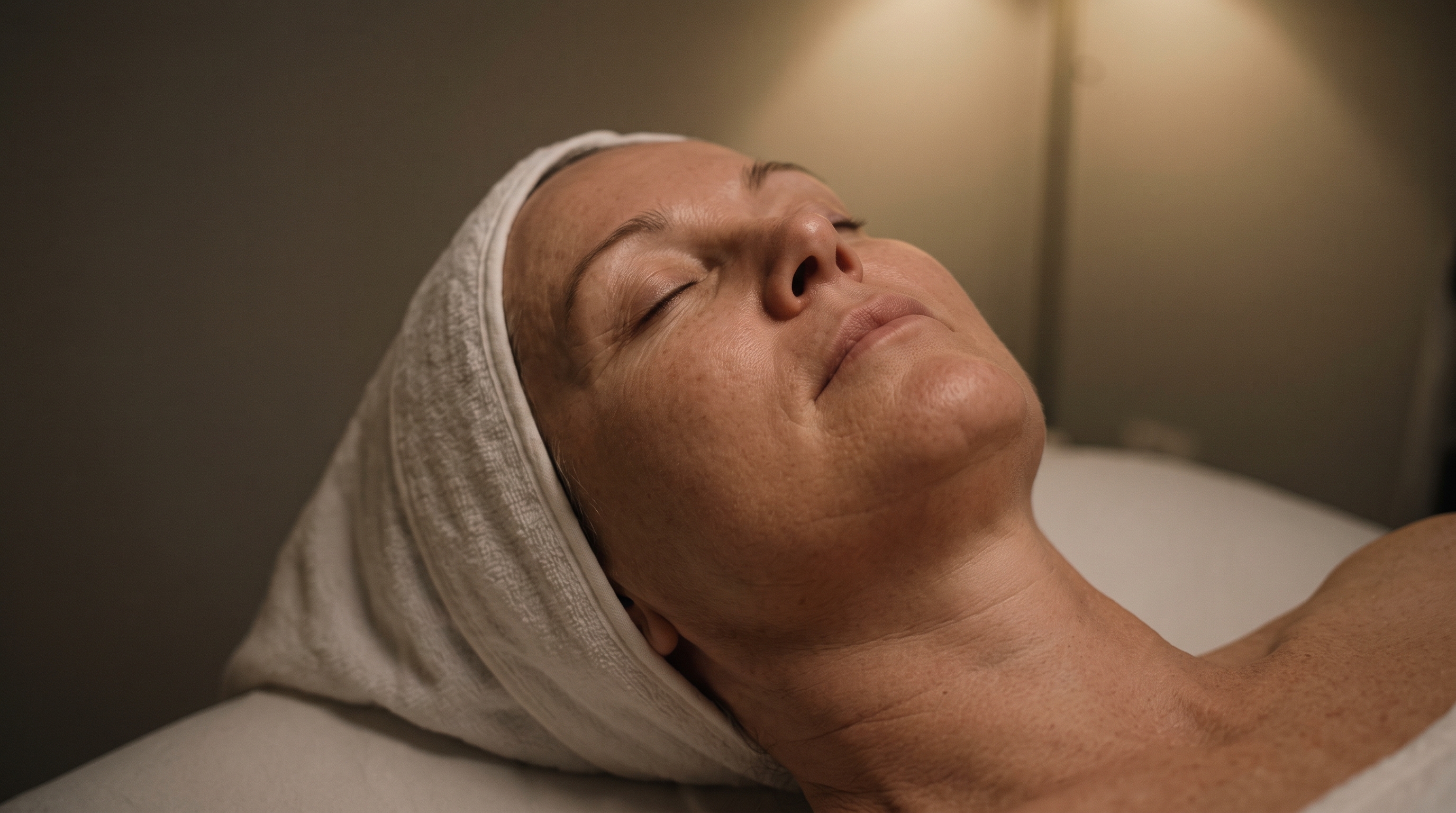
Facial for Wrinkles: What a Treatment Room Can and Cannot Change
Which facial modalities have published wrinkle data, which ones sell sensation, and how long each effect really lasts
You leave the treatment room and the mirror in the lobby is extraordinarily kind. Skin looks plumped, poreless, lit from somewhere behind. By Thursday it has quietly gone back to being your face.
That fade does not mean the facial failed, and it does not mean the esthetician oversold you. It is the honest, predictable timeline of what a facial does. Working out which layer of your skin a treatment reaches explains almost everything about how long its results hold, and which treatments on the menu are worth repeating.
What a facial actually changes
Strip away the branding and most facials are built from four mechanisms: cleansing and extraction, exfoliation, hydration, and some form of stimulation.
Every one of them works at the top of the skin. Cleansing and extraction clear the follicle. Exfoliation, whether by acid, enzyme or blade, removes corneocytes from the stratum corneum, the layer of flattened dead cells that scatters light when it is rough and reflects it evenly when it is smooth. Hydration swells those same cells with water. Massage, cupping and vacuum tools move interstitial fluid out of the tissue, which flattens morning puffiness and sharpens the jawline in a way photographs pick up immediately.
All four effects are real. None of them is happening in the dermis, which is where a wrinkle is structurally built.
A facial changes how light leaves your face, and light is most of what you are reacting to in that lobby mirror.
The visible improvement is also partly inflammation. Manipulation, steam and acid all produce mild redness and low-grade swelling. Slightly swollen skin sits tighter against fine lines, which is why the effect tends to peak somewhere between 24 and 48 hours, and why experienced estheticians tell clients to book two weeks before a wedding rather than the morning of.
Which modalities have wrinkle data behind them
Not every item on the menu is equally supported, and the gap between them is wider than the pricing suggests.
Mechanical massage has better evidence than its low-tech reputation implies. When researchers applied a massaging device to human skin explants twice daily and then measured protein expression, they found higher rates of procollagen-1, decorin, fibrillin and tropoelastin, with the response depending on the frequency of the stimulus [1]. Mechanical strain does signal fibroblasts. The caveat is dose. That was sustained, repeated, twice-daily stimulation, not sixty minutes once a season.
Intense pulsed light is where the marketing runs furthest ahead of the biopsies. In a histological and immunohistochemical study of periocular skin after six IPL sessions, investigators measured collagen types I, III and VII, newly synthesised collagen, total elastin and tropoelastin, and found no statistically significant change in those matrix proteins, alongside no clinically noticeable improvement in facial wrinkles [2]. IPL earns its reputation on redness and pigment, which it genuinely addresses. Wrinkle depth is a different claim.
Chemical peels are the modality that most reliably crosses from surface to structure, and depth is the variable that decides it. A double-blind vehicle-controlled study of 50% glycolic acid found clinical improvement in photoaged skin alongside histological thinning of the stratum corneum, enhancement of the granular layer and epidermal thickening [3]. Lower-strength alpha-hydroxy acid applied daily over an average of six months produced roughly a 25% increase in skin thickness, with increased collagen density and improved elastic fibre quality in the papillary dermis [4]. Those are structural changes. Note what bought them: either strength, or repetition over months.
That pattern holds across the whole menu. Single sessions move the surface. Structural change needs depth or frequency.
The layer a facial rarely reaches
A wrinkle is a deficit of organised collagen and functional elastin in the dermis, produced over decades by ultraviolet exposure, repeated muscle folding, and a fibroblast population that slows its output with age. Sixty minutes of product, steam and hands is not an intervention against that process. It is a very good intervention against dullness, rough texture, congestion and fluid retention, and those four things account for more of how tired you look than most people credit.
Ask what a treatment is supposed to have changed by Thursday, and the honest answer sorts the menu faster than any price list.
This is also why at-home facials are less of a compromise than they sound. If the mechanism is surface-level, the setting matters less than the frequency. A device-driven treatment like HydraFacial delivers its cleansing and hydration efficiently, but the efficiency sits in the delivery, not in reaching a deeper target.
What actually moves wrinkle depth
The interventions with repeated histological evidence for wrinkle effacement share one property. They are applied continuously, and they signal fibroblasts to build.
Topical retinoids remain the clearest example. In a randomised, double-blind, vehicle-controlled study in which 0.4% retinol lotion was applied to one arm up to three times a week for 24 weeks, treated skin showed glycosaminoglycan levels around 40% higher than vehicle-treated skin, along with increased collagen production, which the investigators identified as the likely basis for wrinkle effacement [5]. A full course of chemical peeling can do structural work as well, but it does it in episodes with downtime, and the maintenance still happens at home.
The limitation everyone meets with retinol is tolerance. Conventional formulations rely on solvents and penetration enhancers that disturb the lipid organisation of the barrier in order to get the molecule through, which is why so many people abandon the ingredient during the first month of redness and flaking. Nanoretinol takes a different route. The retinol sits inside biomimetic lipid nanoparticles that the skin recognises as self and allows through the epithelial barrier without that disruption. In North Biomedical’s clinical study summary, the nanoparticle-delivered form was 232% more effective in collagen recovery and 73% more effective in elastin recovery than conventional retinol, with drastically reduced cytotoxicity, which matters most to the people whose skin is already reacting to the facial they just had.
Booking with the right expectation
A facial is worth having. Book it for the job it does: clearer, smoother, better-hydrated skin with less fluid sitting in it, peaking a day or two later and holding for a week or two. Choose peels when you want the surface genuinely resurfaced, choose massage-based work if you will actually keep it up, and stay sceptical of any light-based promise aimed at lines rather than colour.
Then treat the nightly routine as the part doing the structural work. Getting rid of wrinkles is a slow, cumulative process that happens in the dermis on a timeline of months. The treatment room can make this week look better. What you put on your face for the next six months is what changes the face you bring back to it.
References
- Caberlotto E, Ruiz L, Miller Z, Poletti M, Tadlock L. “Effects of a skin-massaging device on the ex-vivo expression of human dermis proteins and in-vivo facial wrinkles.” PLoS One. 2017;12(3):e0172624. doi:10.1371/journal.pone.0172624
- El-Domyati M, El-Ammawi TS, Moawad O, Medhat W, Mahoney MG, Uitto J. “Intense pulsed light photorejuvenation: a histological and immunohistochemical evaluation.” Journal of Drugs in Dermatology. 2011;10(11):1246-1252. PMID 22052303
- Newman N, Newman A, Moy LS, Babapour R, Harris AG, Moy RL. “Clinical improvement of photoaged skin with 50% glycolic acid. A double-blind vehicle-controlled study.” Dermatologic Surgery. 1996;22(5):455-460. doi:10.1111/j.1524-4725.1996.tb00347.x
- Ditre CM, Griffin TD, Murphy GF, Sueki H, Telegan B, Johnson WC, Yu RJ, Van Scott EJ. “Effects of alpha-hydroxy acids on photoaged skin: a pilot clinical, histologic, and ultrastructural study.” Journal of the American Academy of Dermatology. 1996;34(2 Pt 1):187-195. doi:10.1016/s0190-9622(96)80110-1
- Kafi R, Kwak HS, Schumacher WE, Cho S, Hanft VN, Hamilton TA, King AL, Neal JD, Varani J, Fisher GJ, Voorhees JJ, Kang S. “Improvement of naturally aged skin with vitamin A (retinol).” Archives of Dermatology. 2007;143(5):606-612. doi:10.1001/archderm.143.5.606