Glycolic Acid Serum: How Strong, How Often, and What It Can Really Change
Glycolic acid is the most studied exfoliating acid for sun-damaged, aging skin. Here is how a leave-on serum differs from a toner or cleanser, and how to choose and use one safely
Glycolic acid is the exfoliating acid dermatologists have studied longest in sun-damaged, aging skin. It comes in cleansers, toners, pads, peels and creams, but the leave-on serum is the format most people reach for when they want visible change: smoother texture, a brighter surface and softer fine lines.
That popularity hides a lot of variation. Two glycolic acid serums with the same number on the front can differ several-fold in how hard they actually work. Understanding strength and pH is what separates a serum that transforms your skin from one that simply stings.
What glycolic acid does, layer by layer
Glycolic acid is the smallest alpha hydroxy acid (AHA), which is why it penetrates faster than lactic or mandelic acid. At the surface, it loosens the bonds between dead skin cells so they shed evenly instead of clumping into rough, dull patches [1]. That is the part you see within a week or two.
The more interesting effects happen deeper and more slowly. When forearm skin was treated with a 20% glycolic acid lotion twice daily for three months, biopsies showed increased type I collagen gene activity and more hyaluronic acid in both the epidermis and dermis compared with a plain lotion [2]. In a longer study, lotions with 25% AHA applied for about six months increased skin thickness by roughly 25%, with denser collagen and better-quality elastic fibres, and no inflammation [3].
For a broader tour of the ingredient, see our guide to glycolic acid benefits.
Why the serum format is different
A glycolic acid cleanser touches your skin for thirty seconds before you rinse it away. A toner is usually a thin liquid at a moderate strength. A serum is designed to stay on all night, which gives the acid hours rather than seconds to work.
Understanding strength and pH is what separates a serum that transforms your skin from one that simply stings.
That extra contact time is why a serum can deliver more than a wash, and also why it is more likely to irritate. If you already use a glycolic toner, our guide to glycolic acid toners explains how the two compare, and why most people should choose one or the other rather than layering both every night.
What the strength numbers mean
The research gives useful reference points:
- 8% glycolic acid cream, used twice daily for 22 weeks by 74 women aged 40 to 70, helped 76% of users improve by at least one grade in overall facial photodamage, compared with 40% on the base cream. The researchers described the benefit as modest but real, and the cream was well tolerated [4].
- 20% to 25% leave-on lotions produced the collagen, hyaluronic acid and skin-thickness changes described above, but these were research formulations applied to forearms, not faces [2, 3].
Most consumer serums sit between 5% and 10%, which lines up with the 8% face data. Higher strengths belong in supervised peels.
pH: the number most labels leave out
An AHA’s safety and effectiveness depend not only on its concentration but on pH, contact time and the amount of free acid present [1]. Glycolic acid’s pKa is about 3.8. At a pH near that value, a large fraction of the acid is in its active, free form; at pH 5 or higher, most of it is neutralised and the serum behaves more like a mild moisturizer.
Your skin can feel the difference, because a 7% serum at pH 3.6 can work harder than a 10% serum at pH 4.5. In the US, the Cosmetic Ingredient Review panel concluded that AHAs are safe in consumer products at 10% or less with a final pH of 3.5 or higher, with directions to use sun protection [5].
Your skin can feel the difference, because a 7% serum at pH 3.6 can work harder than a 10% serum at pH 4.5.
Since most brands do not print the pH, use sensation as a rough guide. A brief tingle for a minute or so suggests an active formula; persistent burning means it is too strong for your skin right now.
Choosing a glycolic acid serum
- New to acids or sensitive: 5% or less, or consider lactic acid, which is gentler. Our comparison of lactic acid vs glycolic acid helps you decide.
- Normal or oily skin with rough texture, dullness or sun spots: 7% to 10%, two or three nights a week to start.
- Look for a stated percentage, fragrance-free formulas, and soothing hydrators such as glycerin, panthenol or hyaluronic acid.
- Be cautious with “cocktail” serums that combine glycolic acid with salicylic acid and a retinoid in one bottle, unless you already tolerate each separately.
How often to use it
Start with two nights per week and add one more night every week or two if your skin stays comfortable. Many people settle at three or four nights; very few need a glycolic serum every night. Signs you have overdone it include stinging from plain moisturizer, a tight, shiny look, flaking and new redness. When that happens, stop for a week, then restart at a lower frequency.
The sunscreen rule is not a suggestion
Glycolic acid makes skin temporarily more vulnerable to UV. In a double-blind study, four weeks of 10% glycolic acid at pH 3.5 increased the number of sunburn cells after UV exposure and lowered the dose needed to redden the skin. The sensitivity was gone within a week of stopping [6].
In practice, that means a broad-spectrum sunscreen every morning while you use a glycolic serum, and for at least a week after you stop. Skipping it can undo the brightening you are paying for.
Glycolic acid and retinol: take turns
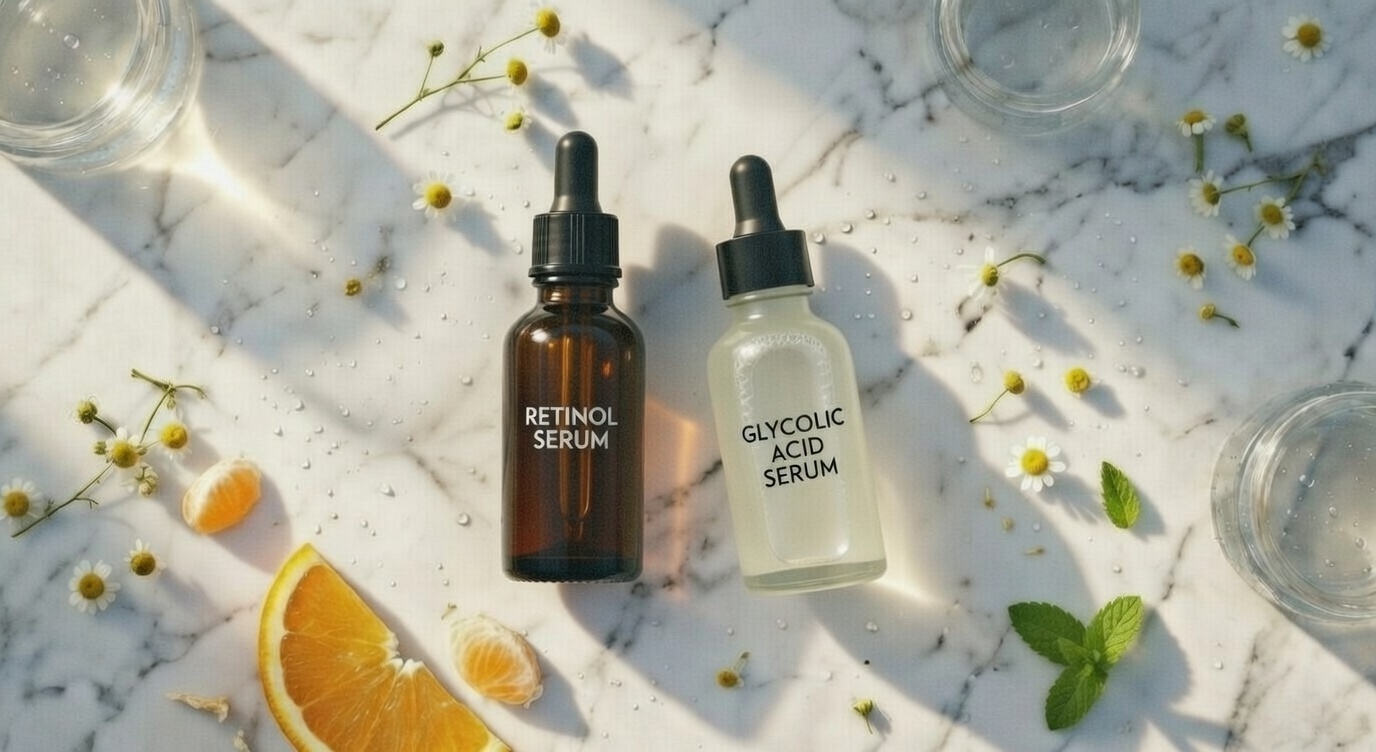
Glycolic acid resurfaces from the top down. Retinol works from the inside out, signalling skin cells to renew and fibroblasts to rebuild collagen. In a vehicle-controlled trial, 0.4% retinol applied to the arms of older adults for 24 weeks significantly improved fine wrinkling and increased collagen production and glycosaminoglycans, the molecules that help skin hold water [7].
The two are complementary, but combining them on the same night is one of the most common causes of irritation. Our guide to using retinol with glycolic acid covers the details; the short version is to alternate nights.
That rhythm is easier to keep with a retinol that does not add its own irritation. Nanoretinol carries stabilized 0.2% retinol in biomimetic lipid nanoparticles that the skin recognises as its own, delivering retinol to skin cells without breaking down the barrier the way conventional formulations can. In North Biomedical’s study summary, Nanoretinol was 232% more effective in collagen recovery and 73% more effective in elastin recovery than conventional retinol, with a 61% increase in firmness after 56 days [8]. A glycolic serum on two or three nights, Nanoretinol on the others and sunscreen every morning gives you both a smoother surface and firmer structure underneath.
Making glycolic acid work for you
A glycolic acid serum is one of the most proven over-the-counter tools for rough, dull, sun-damaged skin, provided you respect three rules: pick a strength and pH your skin can handle, use it a few nights a week rather than every night, and never skip sunscreen. Give it at least three months before judging the deeper results.
References
- Tang SC, Yang JH. “Dual Effects of Alpha-Hydroxy Acids on the Skin.” Molecules. 2018;23(4):863. doi:10.3390/molecules23040863
- Bernstein EF, Lee J, Brown DB, Yu R, Van Scott E. “Glycolic acid treatment increases type I collagen mRNA and hyaluronic acid content of human skin.” Dermatologic Surgery. 2001;27(5):429-433. doi:10.1046/j.1524-4725.2001.00234.x
- Ditre CM, Griffin TD, Murphy GF, et al. “Effects of alpha-hydroxy acids on photoaged skin: a pilot clinical, histologic, and ultrastructural study.” Journal of the American Academy of Dermatology. 1996;34(2 Pt 1):187-195. PubMed: 8642081
- Stiller MJ, Bartolone J, Stern R, et al. “Topical 8% glycolic acid and 8% L-lactic acid creams for the treatment of photodamaged skin. A double-blind vehicle-controlled clinical trial.” Archives of Dermatology. 1996;132(6):631-636. doi:10.1001/archderm.1996.03890300047009
- Kornhauser A, Coelho SG, Hearing VJ. “Applications of hydroxy acids: classification, mechanisms, and photoactivity.” Clinical, Cosmetic and Investigational Dermatology. 2010;3:135-142. doi:10.2147/CCID.S9042
- Kaidbey K, Sutherland B, Bennett P, et al. “Topical glycolic acid enhances photodamage by ultraviolet light.” Photodermatology, Photoimmunology & Photomedicine. 2003;19(1):21-27. doi:10.1034/j.1600-0781.2003.00013.x
- Kafi R, Kwak HS, Schumacher WE, et al. “Improvement of naturally aged skin with vitamin A (retinol).” Archives of Dermatology. 2007;143(5):606-612. doi:10.1001/archderm.143.5.606
- North Biomedical LLC. “Nanoretinol vs. Conventional Retinol: Efficacy in Collagen and Elastin Recovery.” Clinical Study Summary, 2024. Study summary