Best Lip Mask: What Overnight Treatment Can and Can't Change
Lips lose water faster than any other skin on your face. Here is how to choose a mask for that, and what to use for the lines around it.
Two completely different complaints send people to the same shelf. One is “my lips are dry and they flake and nothing lasts.” The other is “the skin around my mouth has started to look pleated, and lipstick travels into it.” A lip mask solves the first one well. It does almost nothing for the second, and knowing which problem you are actually buying for is most of the decision.
Why lips behave nothing like the rest of your face
The vermilion, the coloured part of the lip, is not a smaller version of facial skin. Researchers measuring its surface properties directly found it functionally distinct: a far thinner stratum corneum, essentially no sebaceous glands, and consequently a much higher rate of transepidermal water loss than the cheek beside it [1].
That single measurement explains nearly everything people find confusing about lips. The rest of your face maintains a thin film of sebum that slows evaporation. Lips have no such film. They also have no sweat glands to draw on. So a lip sitting in dry indoor air is losing water continuously through a barrier only a few cells thick, with no built-in mechanism to replace or retain it.
This is also why licking makes it worse in a way that feels backwards. Saliva evaporates in seconds and takes surface water with it, leaving a drier lip than before, and depositing digestive enzymes on skin that has no barrier to speak of.
What a lip mask is actually doing
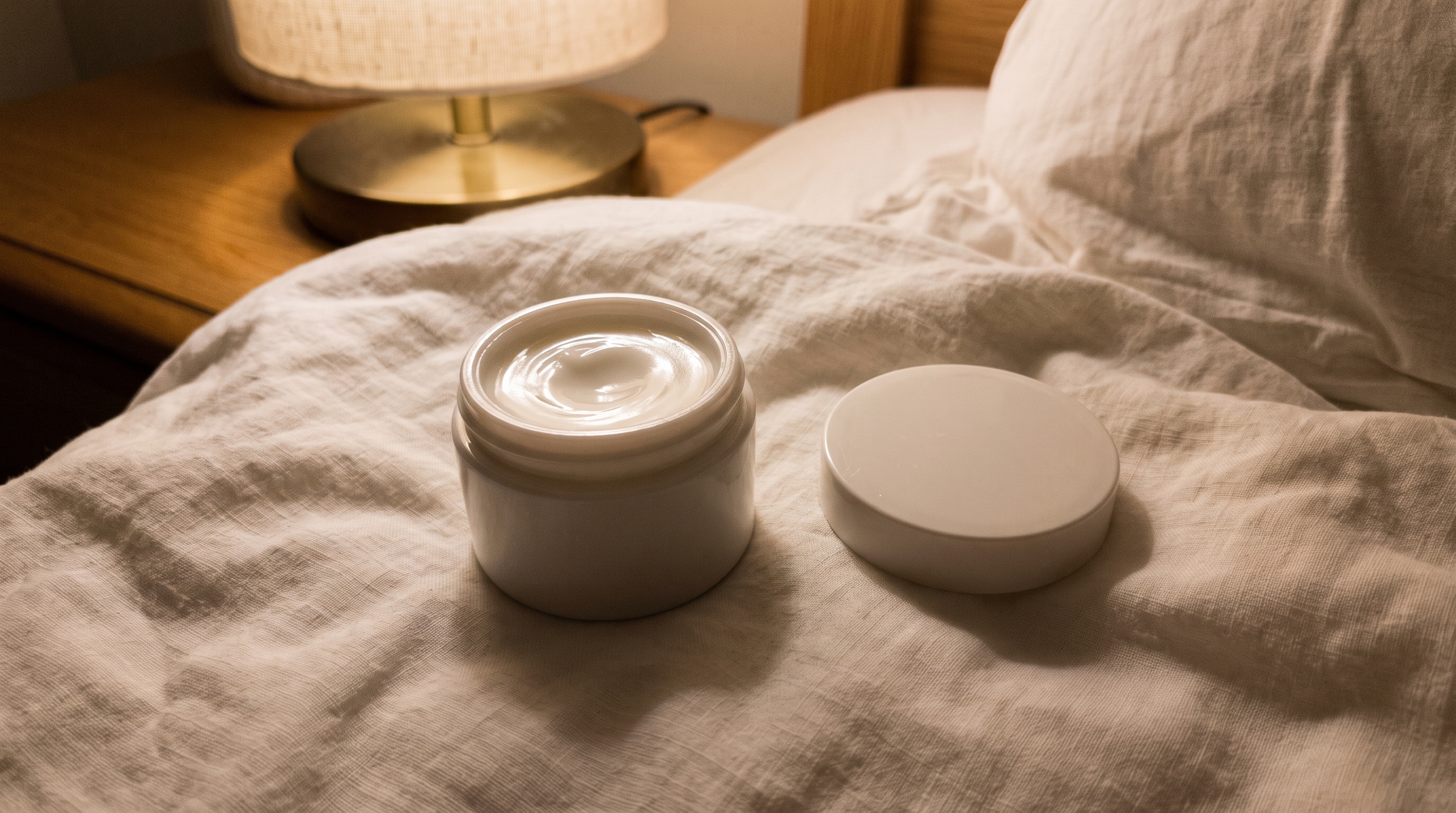
Strip away the packaging and an overnight lip mask is one thing: a thick, slow-spreading occlusive layer that sits on the lip for hours and physically blocks evaporation. Its whole function is to keep water from leaving. Very little of what is in the jar gets absorbed and used.
Petrolatum remains the reference standard for that job, and the evidence is better than its unglamorous reputation suggests. A study examining petrolatum on human skin found it did considerably more than sit inertly on the surface, upregulating barrier differentiation markers and antimicrobial peptides while restoring barrier function [2]. If a mask’s ingredient list opens with petrolatum, lanolin, shea butter or a heavy ester, it will work. Whether you enjoy the texture is a separate question.
Silicones like dimethicone are excellent at reducing water loss and feel light, though some people find they never quite absorb.
The alternatives are legitimate but differ in degree. Lanolin closely resembles human sebum and is unusually good at this. Shea butter and cocoa butter are softer occlusives that feel better and hold slightly less. Silicones like dimethicone are excellent at reducing water loss and feel light, though some people find they never quite absorb.
The humectant trap
Now the part most guides get wrong. A large share of lip masks lead with glycerin or hyaluronic acid, and shoppers read those as the active ingredients. They are humectants, and they work by binding water, including water pulled from deeper in the tissue.
In a well-formulated product, that is fine, because glycerin’s benefit to barrier properties has been demonstrated when it is delivered in a proper vehicle [3]. The vehicle is the point. A humectant needs an occlusive above it to hold what it has attracted. A humectant-heavy mask with little occlusive content, used in genuinely dry air, can leave the lip drier than it started.
So the practical test for any lip mask is the occlusive-to-humectant ratio, and it should shift with where you live. In humid air, a lighter, more humectant-forward mask is comfortable and sufficient. In dry winter air, in aeroplane cabins, or anywhere with forced-air heating, you want the ratio weighted firmly toward occlusives. The same product genuinely performs differently in Miami and Denver, which is why reviews contradict each other so violently.
How to read the label in ten seconds
Look at the first five ingredients. If two or more are occlusives, the mask will hold overnight. If all five are water, glycerin, humectants and thickeners, treat it as a daytime comfort product rather than a repair treatment.
The tingle reads as efficacy and is actually low-grade irritation on skin with no barrier to defend itself.
Then scan for the irritants that appear surprisingly often in lip products: menthol, camphor, peppermint and cinnamon oils. The tingle reads as efficacy and is actually low-grade irritation on skin with no barrier to defend itself. Salicylic acid appears in some “lip scrub” hybrids, and on already-compromised lips it will extend the problem rather than end it. Our guide to choosing a daily lip balm works through the same ingredient families for daytime use.
The problem a lip mask cannot touch
Which brings us back to the second complaint. Vertical lines above the lip, a lip that looks less full than it did, a border that has gone soft: none of that is a hydration problem, and no occlusive will change it.
The perioral region ages structurally. Reviewing what actually happens there, researchers describe changes in the underlying soft tissue and the dermal support of the lip and surrounding skin, with the vermilion itself thinning and lengthening over time [4]. Layered on top is cumulative ultraviolet exposure, which the lower lip receives in unusual quantity because of its angle to the sun. A meta-analysis of actinic cheilitis risk factors confirms chronic sun exposure as the dominant driver of that damage [5].
You can hydrate a lip with structural collagen loss beautifully and it will still show lines, because you have improved the surface of a tissue whose problem is underneath it.
What does change the structure
The category with real evidence for rebuilding dermal collagen is the retinoids. The foundational work here showed that tretinoin applied to photodamaged human skin restored collagen formation, measured in the dermis rather than inferred from appearance [6]. That effect depends on the molecule reaching the living layers where fibroblasts are, which is exactly where conventional formulations struggle, since they rely on disrupting the barrier to get anywhere. On perioral skin that is already thin and reactive, that trade is a genuine obstacle, and the fuller picture is in our guide to lip lines.
Nanoretinol was built around that obstacle. It carries retinol inside biomimetic lipid nanoparticles that the skin recognises as “self” and allows through the epithelial barrier, so delivery no longer depends on damaging the barrier first. In North Biomedical’s clinical study, the system proved 232% more effective than conventional retinol in collagen recovery and 73% more effective in elastin recovery, at a concentration of only 0.2%, with drastically reduced cytotoxicity in cellular assays [7]. It is water-based and suitable for sensitive skin and the eye contour, which matters on the delicate skin bordering the mouth. Applied to the perioral area rather than the vermilion itself, it addresses the structural half of the problem while the mask handles the surface half.
Using both, correctly
Treat them as separate tools with separate targets. The retinol product goes on the skin around the mouth at night, on the perioral area where the lines actually form. The mask goes on the lip itself, generously, as the final step. Give the retinol fifteen minutes to absorb before the occlusive layer goes over the top of it, and keep the mask off the vermilion border if you are new to retinoids and prone to irritation there.
Do this consistently and the timelines will differ. The lip will feel better within a few nights, because occlusion works immediately. The lines will take months, because cell turnover and collagen remodelling run on a much slower clock. Judging the second product by the speed of the first is how most people conclude that nothing works.
References
- Kobayashi H, Tagami H. “Functional Properties of the Surface of the Vermilion Border of the Lips Are Distinct from Those of the Facial Skin.” British Journal of Dermatology. 2004;150(3):563-567. doi:10.1046/j.1365-2133.2003.05741.x
- Czarnowicki T, Malajian D, Khattri S, Correa da Rosa J, Dutt R, Finney R, Dhingra N, Xiangyu P, Xu H, Estrada YD, Zheng X, Gilleaudeau P, Sullivan-Whalen M, Suárez-Fariñas M, Shemer A, Krueger JG, Guttman-Yassky E. “Petrolatum: Barrier Repair and Antimicrobial Responses Underlying This ‘Inert’ Moisturizer.” Journal of Allergy and Clinical Immunology. 2016;137(4):1091-1102. doi:10.1016/j.jaci.2015.08.013
- Lodén M, Wessman W. “The Influence of a Cream Containing 20% Glycerin and Its Vehicle on Skin Barrier Properties.” International Journal of Cosmetic Science. 2001;23(2):115-119. PMID: 18498456
- Iblher N, Stark GB, Penna V. “The Aging Perioral Region: Do We Really Know What Is Happening?” The Journal of Nutrition, Health & Aging. 2012;16(6):581-585. doi:10.1007/s12603-012-0063-7
- Rodriguez-Archilla A, Irfan-Bhatti A. “Risk Factors for Actinic Cheilitis: A Meta-Analysis.” Journal of Dental Research, Dental Clinics, Dental Prospects. 2021;15(4):285-289. doi:10.34172/joddd.2021.047
- Griffiths CE, Russman AN, Majmudar G, Singer RS, Hamilton TA, Voorhees JJ. “Restoration of Collagen Formation in Photodamaged Human Skin by Tretinoin (Retinoic Acid).” New England Journal of Medicine. 1993;329(8):530-535. PMID: 8336752
- North Biomedical LLC. “Nanoretinol vs. Conventional Retinol: Efficacy in Collagen and Elastin Recovery.” Clinical Study Summary, 2024. Study summary