Glycolic Acid vs Retinol: Which One Should You Actually Use?
Two of the most proven anti-aging ingredients work in completely different layers of your skin — here's how to choose
Two Headliners, Two Different Jobs
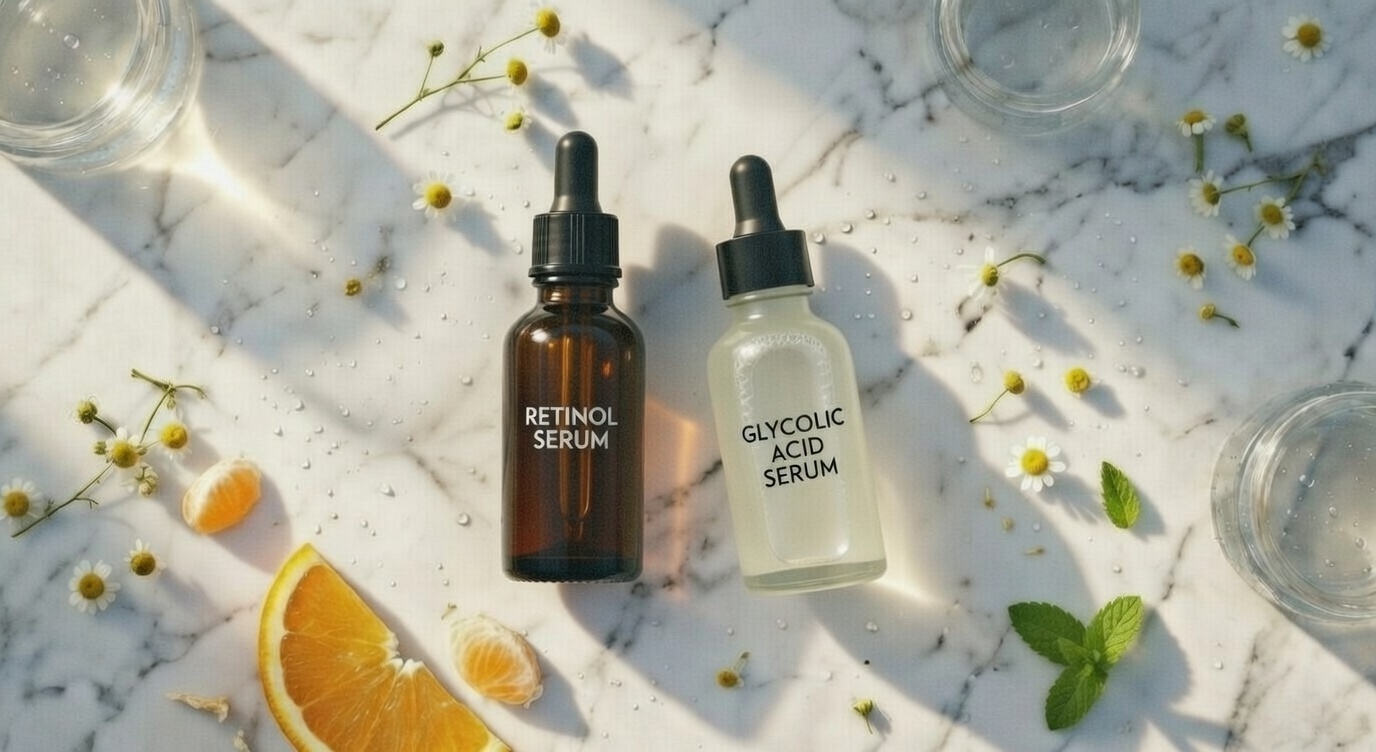
If you’ve spent any time comparing anti-aging products, you’ve run into the same two names again and again: glycolic acid and retinol. Both have real science behind them. Both promise smoother, brighter, younger-looking skin. And both show up in serums priced from drugstore to designer. So when people ask which one to buy, they’re usually expecting a simple winner.
The honest answer starts with a distinction most marketing skips: glycolic acid and retinol don’t actually do the same job. They work in different layers of the skin, through different mechanisms, on different timelines. Once you understand what each one is genuinely good at, the choice — or the decision to use both — gets much clearer.
What Glycolic Acid Does
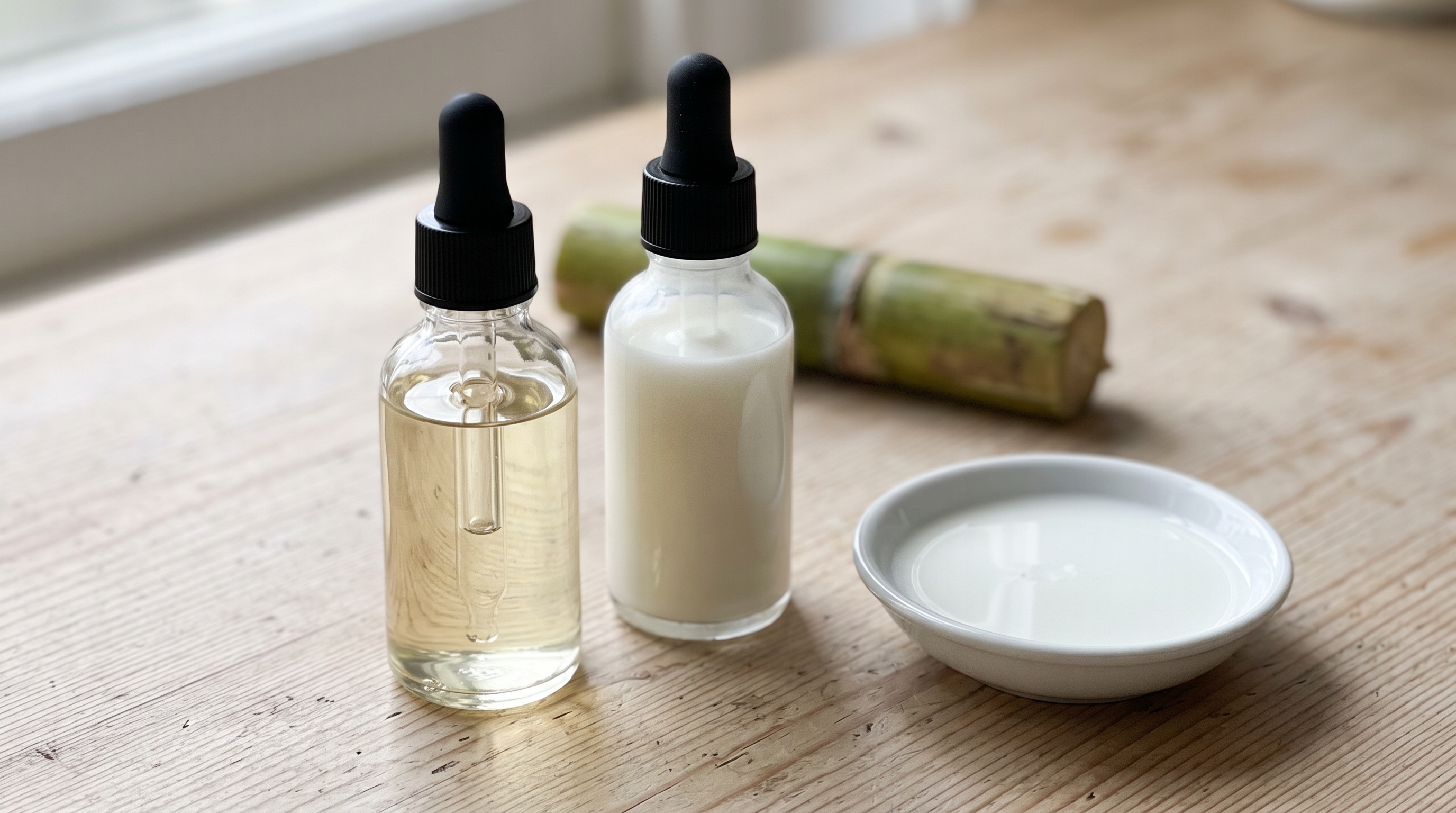
Glycolic acid is an alpha hydroxy acid (AHA), the smallest one, derived originally from sugarcane. Its small molecular size lets it penetrate the outermost skin efficiently, where it does its primary work: dissolving the bonds that hold dead, dull surface cells together. This is chemical exfoliation. By loosening that top layer, glycolic acid reveals fresher skin underneath, smooths rough texture, and evens out tone and superficial discoloration.
That surface action delivers fast, visible gratification — skin often looks brighter within a week or two. But glycolic acid isn’t only a surface player. Applied consistently over months, it reaches deeper too. In one controlled study, forearm skin treated with glycolic acid showed increased type I collagen messenger RNA and higher hyaluronic acid content compared with untreated skin, evidence of genuine dermal remodeling, not just exfoliation [1]. A longer pilot study applying alpha hydroxy acids to photoaged skin found thicker epidermis, increased dermal collagen and glycosaminoglycans, and longer, better-organized elastic fibers after about six months [2]. So glycolic acid earns its anti-aging reputation — but its headline strength is renewing and brightening the surface.
The honest answer starts with a distinction most marketing skips: glycolic acid and retinol don’t actually do the same job.
What Retinol Does
Retinol is a vitamin A derivative, and it operates on an entirely different principle. Rather than exfoliating from the top down, it signals from within. Once converted in the skin to its active form, retinol binds nuclear receptors that switch on the genes controlling skin renewal and collagen production. It tells your fibroblasts — the dermal cells that manufacture structural proteins — to build new collagen, and at the same time it suppresses the matrix metalloproteinase enzymes that break collagen down [3].
That makes retinol fundamentally a remodeling ingredient. It also accelerates skin cell turnover, which improves texture and tone in ways that overlap with glycolic acid, but its defining contribution is structural: rebuilding the collagen scaffold that thins with age and sun exposure. The depth of evidence here is substantial. In a landmark New England Journal of Medicine study, photodamaged skin treated with topical tretinoin (the prescription retinoid) showed restored new collagen formation in the dermis on biopsy, while untreated skin did not [4]. Retinol, the gentler over-the-counter cousin, drives the same machinery more gradually.
Head to Head: What the Research Says
When researchers have compared the two directly, a consistent pattern emerges. A study evaluating retinoic acid against glycolic acid found retinoic acid more effective overall — particularly in cell renewal and remodeling — even as glycolic acid performed its exfoliating role well [5]. The reason isn’t that glycolic acid is weak; it’s that the two ingredients are aiming at different targets. Glycolic acid is exceptional at the surface concerns: dullness, rough texture, superficial uneven tone, and clogged-looking skin. Retinol is the stronger choice for the deeper, structural signs of aging: fine lines, wrinkles, and loss of firmness driven by collagen decline.
A useful way to think about it: glycolic acid renovates the surface you already have, while retinol rebuilds the foundation underneath. If your main complaint is “my skin looks dull and rough,” glycolic acid will likely satisfy you faster. If it’s “I’m seeing lines and my skin is losing its bounce,” retinol is the more direct tool — and the one most dermatologists reach for first when wrinkles are the goal. For a fuller picture of each, it’s worth reading up on the benefits of glycolic acid and the benefits of retinol on their own terms.
If you want to combine them deliberately, here’s how to pair retinol and glycolic acid without wrecking your barrier.
Do You Have to Choose?
Often, no. Glycolic acid and retinol are complementary, and used thoughtfully they can amplify each other — exfoliating the surface while remodeling the depth. The catch is that layering two actives that both increase cell turnover can overwhelm the skin barrier, producing the redness and flaking that make people quit. The standard solution is to separate them: glycolic acid in the morning or on alternate evenings, retinol on its own nights, with a well-timed routine. If you want to combine them deliberately, here’s how to pair retinol and glycolic acid without wrecking your barrier.
The recurring obstacle, though — whether you use retinol alone or alongside an acid — is tolerance. Conventional retinol is famously irritating, and stacking it with an AHA only raises the odds of a reaction. That irritation isn’t a sign the product is working; it’s usually a sign the skin barrier is being compromised, and it’s the single biggest reason people abandon retinol before it has time to deliver.
A Retinol Built to Skip the Irritation
The irritation problem traces back to delivery. The skin barrier exists to keep substances out, and most conventional retinol formulas get through by partially disrupting that barrier — which is exactly the mechanism that triggers stinging, peeling, and redness. You end up trading tolerance for penetration.
Nanoretinol was designed to break that tradeoff. It encapsulates retinol inside biomimetic lipid nanoparticles that the skin recognizes as “self” and passes through the barrier intact — a biological Trojan horse rather than a chemical battering ram. Because it doesn’t damage the barrier to get in, it delivers more active retinol to the fibroblasts with dramatically less irritation. In North Biomedical’s clinical study, this delivery approach was 232% more effective at collagen recovery and 73% more effective at elastin recovery than conventional retinol, in a water-based, 99% natural formula gentle enough for sensitive skin. For anyone who tried retinol, couldn’t tolerate it, and defaulted to a gentler acid instead, that changes the calculation: you may not have to choose the milder option to keep your skin comfortable.
The Bottom Line for Your Routine
Glycolic acid and retinol aren’t rivals so much as specialists. Reach for glycolic acid when your skin looks dull, rough, or uneven and you want a faster surface refresh. Reach for retinol when fine lines, wrinkles, and lost firmness are the priority, because rebuilding collagen is what it does best. Many people get the most from a routine that uses both, carefully spaced — and the limiting factor is almost always tolerance, not efficacy. Solve the irritation problem, as a well-engineered delivery system does, and retinol’s structural benefits become available to far more people than the harsh formulas of the past ever allowed.
References
- Bernstein EF, Lee J, Brown DB, Yu R, Van Scott E. “Glycolic acid treatment increases type I collagen mRNA and hyaluronic acid content of human skin.” Dermatologic Surgery. 2001;27(5):429-433. PMID: 11359487
- Ditre CM, Griffin TD, Murphy GF, Sueki H, Telegan B, Johnson WC, Yu RJ, Van Scott EJ. “Effects of alpha-hydroxy acids on photoaged skin: a pilot clinical, histologic, and ultrastructural study.” Journal of the American Academy of Dermatology. 1996;34(2 Pt 1):187-195. PMID: 8642081
- Mukherjee S, Date A, Patravale V, Korting HC, Roeder A, Weindl G. “Retinoids in the treatment of skin aging: an overview of clinical efficacy and safety.” Clinical Interventions in Aging. 2006;1(4):327-348. PMID: 18046911
- Griffiths CE, Russman AN, Majmudar G, Singer RS, Hamilton TA, Voorhees JJ. “Restoration of collagen formation in photodamaged human skin by tretinoin (retinoic acid).” New England Journal of Medicine. 1993;329(8):530-535. PMID: 8336752
- Campos PMBGM, Gaspar LR, Gonçalves GMS, Pereira LHTR, Semprini M, Lopes RA. “Comparative Effects of Retinoic Acid or Glycolic Acid Vehiculated in Different Topical Formulations.” BioMed Research International. 2015;2015:650316. PMID: 25632398