Lip Flip: What It Does, What It Costs, and What It Can't Fix
A cosmetic doctor's-eye look at the Botox lip flip, how it differs from filler, and the aging it leaves untouched
Somewhere between “I want fuller lips” and “I don’t want anything injected into my lips,” a small procedure found a very large audience. The lip flip has quietly become one of the most-searched aesthetic treatments of the decade, and for good reason: it promises a subtler, cheaper, needle-shy alternative to filler. But like most things that sound almost too easy, the lip flip does exactly one thing well and leaves a surprising amount untouched.
What a Lip Flip Actually Is
A lip flip is a tiny dose of botulinum toxin, the same neuromodulator sold as Botox, injected into the muscle ringing your mouth: the orbicularis oris. That muscle is a purse-string. It contracts to pucker, whistle, and sip, and in doing so it curls the pink of your upper lip slightly inward and downward, tucking it out of view.
When a handful of units of botulinum toxin, typically four to six, relax the upper fibers of that muscle, the lip stops tucking. It rolls gently outward, exposing more of its natural pink surface. In clinical terms this is called upper lip eversion. A 2025 systematic review of botulinum toxin lip augmentation confirmed the procedure reliably produces this eversion with a generally favorable safety profile [1].
The key word is reveal. A lip flip does not add a single drop of volume. It uncovers what your anatomy is already holding back. A small prospective study using precise three-dimensional imaging found a modest but statistically significant increase in visible upper lip height after neuromodulation, with no measurable change in actual lip volume [2]. You look like you have more lip because more of your lip is now on display.
Lip Flip vs. Filler: Two Different Tools
The most common point of confusion is lip flip vs. filler, and the distinction is worth getting right before you book anything.
Lip filler is hyaluronic acid gel injected into the lip body to physically inflate it. It adds volume, and it can reshape, define borders, and correct asymmetry. Results are immediate and last six months to a year or more.
If your lips are fine but your upper lip vanishes when you smile or talk, the flip is the more elegant fix.
A lip flip changes shape, not size, by relaxing a muscle. Think of filler as adding air to a balloon and a lip flip as simply un-tucking a folded collar. Filler makes a small lip bigger. A lip flip makes an already-adequate lip look more generous by rolling it into view. If your lips are naturally thin and you want genuine fullness, a lip flip will disappoint you; that is filler’s job. If your lips are fine but your upper lip vanishes when you smile or talk, the flip is the more elegant fix.
How Long It Lasts and What It Costs
Here is where expectations need managing. Botulinum toxin works by cleaving a protein called SNAP-25 inside nerve endings, which blocks the release of the signal that tells muscle to contract [3]. That blockade is temporary. As nerve terminals regenerate, the muscle wakes back up.
Because the lip flip uses such a small dose in a constantly moving, frequently used muscle, it fades faster than Botox in your forehead. Most people see their flip last two to three months, on the shorter end of the botulinum toxin range [3]. If you want to keep the look, you are signing up for roughly four treatments a year.
On lip flip cost, the small dose keeps it accessible. In the United States, a lip flip typically runs $80 to $300 per session, dramatically less than a syringe of filler, which commonly costs $600 to $1,000. That affordability, combined with the near-zero downtime, is much of the appeal.
Who It Suits, and Where It Goes Wrong
The ideal candidate has reasonable lip volume but a “gummy” smile that exposes too much gum, or an upper lip that thins and disappears during animation. For them, a lip flip is a small, reversible tune-up.
The risks are minor but real, and they come from that same muscle doing everyday work. Over-relaxing the orbicularis oris can make it briefly hard to whistle, pronounce “p” and “b” sounds cleanly, sip through a straw, or hold a spoon steady. In studies these effects are described as mild and transient, resolving within weeks as the toxin wears off [1]. An experienced injector using a conservative dose is your best protection.
Most people see their flip last two to three months, on the shorter end of the botulinum toxin range.
What a Lip Flip Cannot Touch
Now the part almost no one mentions in the consultation chair. A lip flip changes the position of your lip. It does absolutely nothing for the quality of the skin around it, and for anyone over 40, that skin is usually where the real aging shows.
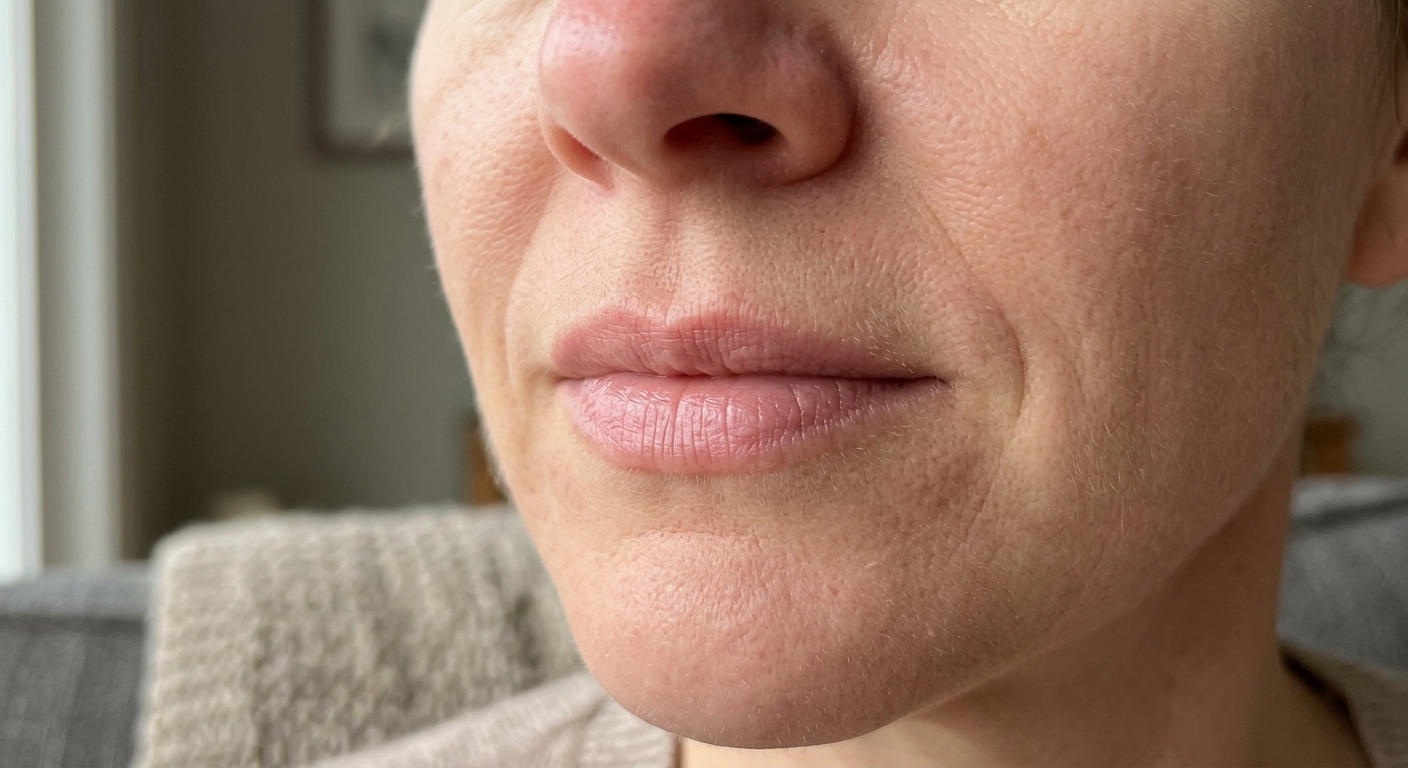
Look closely at a mouth that reads as “older” and it is rarely the lip volume that gives it away. It is the fine vertical creases feathering up from the lip line, the ones sometimes called barcode lines or smoker’s lines. It is the crepey, thinning texture of the perioral skin and the deepening wrinkles around the mouth. None of that comes from a muscle you can relax. It comes from collagen loss.
The dermis, the living scaffold beneath your surface skin, is roughly three-quarters collagen by dry weight. From your mid-twenties onward, you lose it at about one percent per year, and the perioral zone is hit especially hard because the skin there is thin, mobile, and endlessly folded by speaking and eating. As that scaffold thins, the surface loses support and etches into permanent lip lines. Research on naturally aged human skin shows the aging dermis is caught in a double bind: fibroblasts make less new collagen while collagen-degrading enzymes run higher [4].
This is the honest limit of the treatment. You can flip a lip that sits above skin covered in fine vertical lines, and those lines will still be there. Repositioning does not rebuild. That is a job for skincare, and specifically for the one ingredient class with decades of evidence behind it.
The Anti-Aging Move a Lip Flip Skips
The single most studied topical for rebuilding collagen is the retinoid family: retinol and its prescription cousins. In that same aged-skin research, applying vitamin A stimulated fibroblasts to grow, increased collagen production, and lowered the enzymes that break collagen down [4]. A recent review on retinol confirms it drives collagen synthesis, inhibits the matrix metalloproteinases that dismantle it, and thickens the dermis over time [5]. In plain terms, a retinoid works directly against the process that carves lines around your mouth.
There is a catch for the perioral zone. This skin is thin and easily irritated, and conventional retinol earns its reputation for redness and peeling honestly, because standard formulas rely on partially disrupting the skin barrier to get the molecule in. On the delicate skin framing your lips, that is exactly the trade-off you do not want.
This is the problem Nanoretinol was engineered to solve. It encapsulates a stabilized 0.2% retinol inside biomimetic lipid nanoparticles that the skin recognizes as “self” and waves through the barrier, a kind of biological Trojan horse, without the damage that drives irritation. Delivery efficiency, not brute concentration, is the point: more active retinol reaches the cells that build collagen. In head-to-head lab testing against conventional retinol, the encapsulated form drove 232% greater collagen recovery and 73% greater elastin recovery, and in a 56-day clinical evaluation, users saw a 61% rise in skin firmness and 56% in elasticity, all with drastically reduced cytotoxicity and gentleness that makes it suitable even for the eye contour [6]. For thin, sensitive perioral skin, gentle and well-delivered is precisely the profile you want.
What a Lip Flip Can and Can’t Do
A lip flip is a clever, low-commitment way to reveal more of a lip you already have. It is not filler, it will not add volume, it fades in a season, and it costs a fraction of what injectable gel does. For the right candidate, it is a genuinely satisfying tune-up.
But it works on posture, not on skin. The barcode lines, the thinning, the crepey texture that actually age a mouth are written into the collagen, and no neuromodulator reaches them. If you want the skin around your lips to look younger rather than just your lip to sit higher, the work happens topically, night after night, with an ingredient that can rebuild what time takes down. A lip flip changes the frame. Your skincare changes the picture inside it.
References
- Pitchford CA, Desrosiers AS, Tolkachjov SN. “The lip flip: a systematic review of botulinum toxin lip augmentation.” Archives of Dermatological Research. 2025;317(1):765. doi:10.1007/s00403-025-04265-0
- Li Y, Chong Y, Yu N, Dong R, Long X. “The use of botulinum toxin A in upper lip augmentation.” Journal of Cosmetic Dermatology. 2021;20(1):71-74. doi:10.1111/jocd.13731
- Nestor MS, Arnold D, Fischer D. “The mechanisms of action and use of botulinum neurotoxin type A in aesthetics: Key Clinical Postulates II.” Journal of Cosmetic Dermatology. 2020;19(11):2785-2804. doi:10.1111/jocd.13702
- Varani J, Warner RL, Gharaee-Kermani M, et al. “Vitamin A antagonizes decreased cell growth and elevated collagen-degrading matrix metalloproteinases and stimulates collagen accumulation in naturally aged human skin.” Journal of Investigative Dermatology. 2000;114(3):480-486. doi:10.1046/j.1523-1747.2000.00902.x
- Quan T. “Human Skin Aging and the Anti-Aging Properties of Retinol.” Biomolecules. 2023;13(11):1614. doi:10.3390/biom13111614
- North Biomedical LLC. “Nanoretinol vs. Conventional Retinol: Efficacy in Collagen and Elastin Recovery.” Clinical Study Summary, 2024. Study Summary