
Magnifying Mirror: Which Magnification Is Right for Your Skin?
What 5x, 10x and 15x really show, why lighting matters as much as power, and how to use a close-up mirror without picking at normal skin
Almost everyone who buys a magnifying mirror has the same first experience. You lean in, switch on the light, and your skin looks like a lunar landscape: every pore a crater, every fine line a canyon, tiny dark dots across your nose that you never noticed before.
None of that changed when you bought the mirror. What changed is the scale. A magnifying mirror is a genuinely useful tool for makeup, brows and checking a spot, but it is also very good at making normal skin look alarming. Here is how to choose the right magnification and lighting, what you are actually seeing, and how to use one without it working against your skin.
What the Numbers Mean
A magnifying mirror is a gently curved, concave mirror. The number on the box tells you how much larger it makes your reflection, so a 5x model shows your skin five times larger than a flat mirror would, and a 10x model ten times.
Your skin in a 10x mirror is shown at 10 times the size anyone else ever sees it, so perfectly normal pores and fine lines can look like flaws.
The stronger the magnification, the more sharply the mirror is curved. That has two practical consequences. First, you have to get closer: a high-power mirror only gives a sharp, upright image when your face is near it, and beyond that distance the image blurs and then flips. Second, you see less: a 10x or 15x mirror might show one eye or one patch of cheek at a time, while a 5x mirror shows most of the face.
- 1x (flat): judging your overall look, the way other people see you.
- 3x to 5x: everyday makeup, brows, contact lenses and shaving. Comfortable for most people.
- 7x: detailed eyeliner and brow work, especially once reading glasses become necessary.
- 10x to 15x: a quick look at a splinter, an ingrown hair or one specific spot. Not for standing in front of every morning.
Your skin in a 10x mirror is shown at 10 times the size anyone else ever sees it, so perfectly normal pores and fine lines can look like flaws.
For most people, a double-sided mirror with 1x on one side and 5x or 7x on the other covers every real need.
Lighting Matters as Much as Power
A dim or yellow bulb will mislead you at any magnification. Two numbers on the packaging matter.
- Colour temperature. Measured in kelvin. Warm light around 2,700 K flatters skin but hides redness and makes foundation look different outdoors. Neutral light around 4,000 to 5,000 K is closer to daylight and better for matching makeup and checking tone.
- Colour rendering index (CRI). This describes how faithfully a light shows colours compared with daylight. Look for a CRI of 90 or higher. Cheaper LED rings often score lower, which turns skin slightly grey or green.
Even light matters too. A ring of light around the mirror fills in shadows, while a single bulb above it exaggerates every line. Dimmable light lets you see texture in low light and true colour in bright light.
What You Are Actually Seeing
Pores. Visible pores are a normal feature of facial skin, not a defect. In a study of 2,585 women in several countries, a dermatoscope recorded skin pores on the cheeks of every single participant. Pore size and density varied a great deal between ethnic groups and, in most groups, plateaued rather than kept growing with age [1]. Our guide to shrinking pores explains what can make them look smaller.
Grey or dark dots on the nose. These are usually sebaceous filaments, the normal lining of oil inside pores, rather than blackheads. They simply refill after being squeezed. Our article on sebaceous filaments explains how to tell them apart.
Your skin can pay for 2 minutes of squeezing for weeks or months, because a picked spot often leaves a red or brown mark that lasts far longer than the spot itself.
Fine lines and texture. At 10x, even young skin shows a fine criss-cross pattern of surface lines. This is the skin’s natural microrelief, not wrinkling.
The Picking Problem
The real risk of a magnifying mirror is not what it shows but what it tempts you to do. Skin picking is far more common than most people assume. In a national telephone survey of 2,513 US adults, 16.6% said they had picked their skin enough to cause noticeable damage at some point in their lives, and 1.4% met criteria for a picking problem that caused distress or impairment [2]. Community studies put skin picking disorder at between 1.4% and 5.4% of people [3].
Your skin can pay for 2 minutes of squeezing for weeks or months, because a picked spot often leaves a red or brown mark that lasts far longer than the spot itself.
Mirrors play a part in that loop. In a study comparing 52 people with body dysmorphic disorder and 55 controls, those with the disorder focused closely on specific parts of their appearance while gazing, were driven by the hope of looking different, and invariably felt worse afterwards [4]. You do not need a diagnosis for the same pattern to show up in a milder form: the longer and closer you look, the more you find, and the worse you feel.
Losing twenty minutes at the mirror, or reaching for your skin without deciding to, is a habit worth breaking. A dermatologist or therapist can help; behavioural therapy that includes habit reversal is a recommended first approach for skin picking [3].
How to Use a Magnifying Mirror Well
- Give it a job. Use magnification for a specific task, such as eyeliner, brows or a splinter, then switch to the flat side.
- Set a time limit. A minute or two is plenty for a close-up check.
- Judge your skin at 1x. Decide whether something is a problem by how it looks at a normal distance.
- Keep your hands down. If you notice a spot, make a note and treat it with a product, not your fingers.
- Check moles the right way. A hand mirror and a full-length mirror are useful for a monthly whole-body skin self-examination. In a randomized trial, an education programme raised the share of people who did these checks to 55%, compared with 35% in a control group [5]. Show any new, changing or bleeding spot to a doctor rather than examining it ever more closely yourself.
Treat What You See, Do Not Pick It
If your magnifying mirror keeps showing you the same things, such as uneven texture, enlarged-looking pores and fine lines, those are reasonable things to want to improve. They respond to consistent treatment, not to squeezing. Our guide to fixing skin texture covers the options, and our article on retinol for pores explains how retinoids help keep pores clear.
Retinol has some of the strongest evidence. In a randomized, double-blind trial, 0.4% retinol applied for 24 weeks significantly improved fine wrinkling compared with the same lotion without retinol, while increasing procollagen and glycosaminoglycans in the treated skin [6].
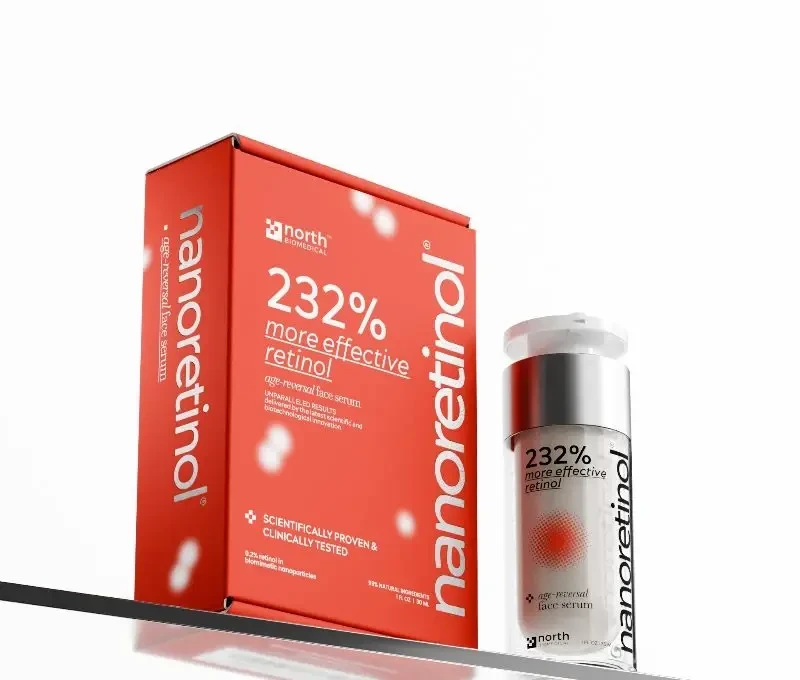
Nanoretinol, from North Biomedical, delivers 0.2% retinol fully stabilised inside biomimetic lipid nanoparticles that the skin recognises as its own, so it reaches its target without the harsh solvents that conventional formulas use to break the barrier down. In laboratory testing it was 232% more effective than conventional retinol in collagen recovery, and in clinical use it increased skin firmness by 61% and elasticity by 56% in 56 days, with side effects that, when present, were milder than those of conventional retinol [7]. Apply it at night and give it the weeks it needs, rather than checking your pores every morning.
Choose the Mirror, Then Step Back
The best magnifying mirror for most people is a double-sided 1x and 5x or 7x model with neutral, high-CRI light that you can dim. Use the magnified side for precise tasks, judge your skin from a normal distance, and put the time you save into a routine that actually changes what the mirror shows.
References
- Flament F, Francois G, Qiu H, et al. “Facial skin pores: a multiethnic study.” Clinical, Cosmetic and Investigational Dermatology. 2015;8:85-93. doi:10.2147/CCID.S74401
- Keuthen NJ, Koran LM, Aboujaoude E, Large MD, Serpe RT. “The prevalence of pathologic skin picking in US adults.” Comprehensive Psychiatry. 2010;51(2):183-186. doi:10.1016/j.comppsych.2009.04.003
- Grant JE, Odlaug BL, Chamberlain SR, Keuthen NJ, Lochner C, Stein DJ. “Skin picking disorder.” American Journal of Psychiatry. 2012;169(11):1143-1149. doi:10.1176/appi.ajp.2012.12040508
- Veale D, Riley S. “Mirror, mirror on the wall, who is the ugliest of them all? The psychopathology of mirror gazing in body dysmorphic disorder.” Behaviour Research and Therapy. 2001;39(12):1381-1393. PubMed: 11758697
- Weinstock MA, Risica PM, Martin RA, et al. “Melanoma early detection with thorough skin self-examination: the ‘Check It Out’ randomized trial.” American Journal of Preventive Medicine. 2007;32(6):517-524. doi:10.1016/j.amepre.2007.02.024
- Kafi R, Kwak HS, Schumacher WE, et al. “Improvement of naturally aged skin with vitamin A (retinol).” Archives of Dermatology. 2007;143(5):606-612. doi:10.1001/archderm.143.5.606
- North Biomedical LLC. “Nanoretinol vs. Conventional Retinol: Efficacy in Collagen and Elastin Recovery.” Clinical Study Summary, 2024. Study summary