Micellar Water: The Cleansing Chemistry Nobody Explains
How microscopic surfactant spheres lift oil off skin, and where the format quietly falls short
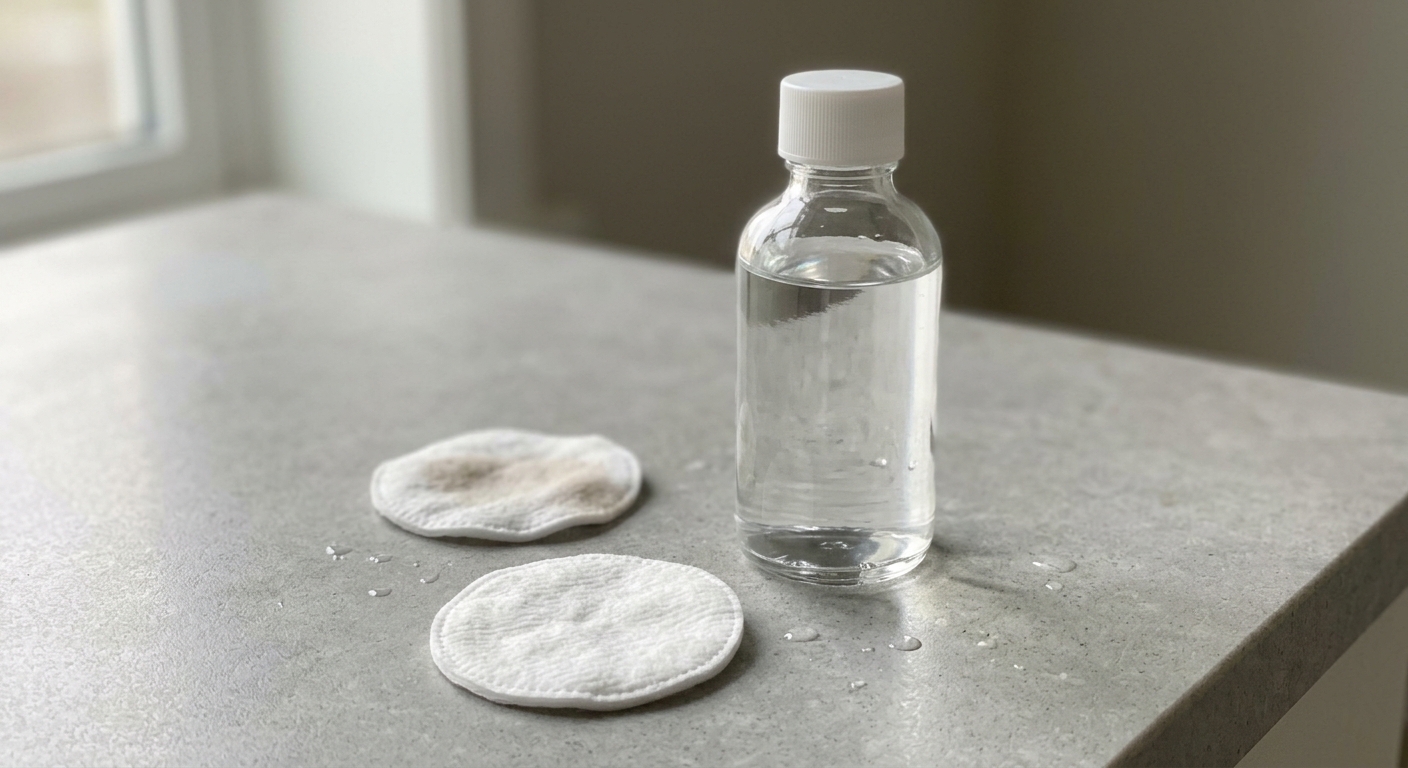
Micellar water looks like the least interesting product in your bathroom. It is clear, it has the viscosity of tap water, and it comes with instructions that sound too easy to be true: wipe it on, walk away. Yet it removes makeup that a splash of actual water cannot touch, which is a genuine chemistry problem hiding inside a very plain bottle.
The answer is in the name, and almost no product page bothers to explain it.
What a micelle actually is
Surfactant molecules have a split personality. One end is hydrophilic and wants to sit in water; the other end is lipophilic and wants nothing to do with it. Drop a few of them into water and they wander around individually. Add more, and past a specific threshold called the critical micelle concentration they stop wandering and self-assemble into tiny spheres, tails tucked inward, water-loving heads facing out [1].
Those spheres are micelles. The tucked-in core is an oily pocket suspended in water, and it will pull in anything that prefers oil to water: sebum, makeup pigment bound in emollients, the day’s grime. The micelle traps it in the middle and carries it away on the cotton pad.
That threshold matters more than the marketing suggests. Below the critical micelle concentration there are no micelles and very little cleaning happens. Above it, adding more surfactant mostly adds more micelles. Formulators work in a narrow band where there is enough surfactant to clean and little enough to stay mild.
Micellar water looks like the least interesting product in your bathroom.
Why gentleness and surfactants are usually opposites
Surfactants have a well-documented downside. They do not distinguish between the oil you want gone and the lipids holding your stratum corneum together. In a classic experiment, researchers measured how much stratum corneum lipid different surfactants stripped away and found the amount removed tracked closely with how much irritation those same surfactants caused on skin [2]. Cleansing damage is largely a lipid-extraction story.
That finding drove decades of formulation work aimed at cleansing without the collateral damage, using milder surfactant systems and co-surfactants that reduce protein and lipid disruption while still lifting soil [3]. Micellar waters sit in this tradition. They typically use mild non-ionic surfactants at low concentration, which is why the format is so often recommended for reactive skin. Clinical work on regimen selection has consistently found that cleanser choice is one of the larger levers available for people with sensitive skin [4].
There is a second reason the format is forgiving: pH. Healthy skin surface pH averages below 5, and that acidity supports both the resident microbial community and the enzymes that maintain the barrier [5]. Traditional alkaline soaps push that number up. Studies comparing alkaline soap against milder synthetic detergent bars in people with dry skin found meaningful differences in barrier measures and surface pH between the two [6]. A well-formulated micellar water is easy to keep near skin’s own pH, which is a real advantage covered further in our article on skin pH.
The rinse question
Here is where the marketing and the chemistry part company. “No rinse needed” is a convenience claim, not a chemical one. If you leave micellar water on the skin, the surfactant stays on the skin too. Micelles that have already picked up oil are still sitting there when the water evaporates.
For most people, most days, that is tolerable. If your skin is reactive, dry, or already irritated, following with a plain water rinse costs nothing and removes the variable entirely. Dermatology reviews of cleanser science make the same general point about leave-on cleansing products: mildness is a property of the formulation, and residue is a property of how you use it [7].
If you wear sunscreen daily, which you should, micellar water alone is not a complete evening cleanse.
What it will not do
Micellar water has one consistent blind spot. Modern sunscreens and long-wear makeup are engineered specifically to resist water, sweat and rubbing. The same mild, low-concentration, water-based system that makes micellar water kind to your barrier makes it underpowered against films built to survive a swimming pool.
If you wear sunscreen daily, which you should, micellar water alone is not a complete evening cleanse. That is the gap an oil-phase product fills, and the reason a cleansing balm exists as its own category. Pairing an oil-based first step with a gentle second wash is the whole logic behind double cleansing, and it is a far better use of micellar water than asking it to do a job it was never formulated for.
Used as intended, it is excellent: a quick morning cleanse, a gym-bag option, a way to take off light makeup without dragging your skin around. Used as your only cleanser after a full day of SPF, it quietly leaves a film behind, and repeated aggressive wiping to compensate is a common route to a compromised skin barrier.
The same physics, pointed the other way
There is a detail in micellar chemistry worth sitting with. A micelle is a self-assembled nanoscale carrier. Amphiphilic molecules organise themselves, without any energy input, into a structure with an interior chemically distinct from the fluid around it. That is delivery science running in reverse: instead of carrying something into skin, the micelle carries something out.
North Biomedical’s work runs the same principle forward. Retinol is the best-evidenced anti-aging active available, and its practical limitation has always been that conventional formulations barely cross the epithelial barrier, so they compensate with chemicals and petroleum derivatives that break the barrier down to force a path through. That mechanism is what produces the burning and peeling.
Nanoretinol encapsulates 0.2% retinol inside biomimetic lipid nanoparticles built from phospholipids the skin reads as self, so they pass the barrier without damaging it. Against conventional retinol it delivered 232% greater collagen recovery and 73% greater elastin recovery, with drastically reduced cytotoxicity. Same underlying colloidal physics as the micelle in your cleanser, aimed at getting an active in rather than lifting grime off.
Reading the bottle properly
Micellar water is a genuinely good piece of formulation chemistry that has been oversold on one point and undersold on another. It is milder than most of what shares a shelf with it, and it belongs in a lot of routines. It is also not a sunscreen remover, and the no-rinse promise is optional rather than obligatory. Treat it as a precise tool for a specific job and it will serve you for years.
References
- Walters RM, Mao G, Gunn ET, Hornby S. “Cleansing formulations that respect skin barrier integrity.” Dermatology Research and Practice. 2012;2012:495917. doi:10.1155/2012/495917
- Froebe CL, Simion FA, Rhein LD, Cagan RH, Kligman A. “Stratum corneum lipid removal by surfactants: relation to in vivo irritation.” Dermatologica. 1990;181(4):277-283. doi:10.1159/000247822
- Ananthapadmanabhan KP, Moore DJ, Subramanyan K, Misra M, Meyer F. “Cleansing without compromise: the impact of cleansers on the skin barrier and the technology of mild cleansing.” Dermatologic Therapy. 2004;17(Suppl 1):16-25. doi:10.1111/j.1396-0296.2004.04S1002.x
- Hawkins SS, Subramanyan K, Liu D, Bryk M. “Cleansing, moisturizing, and sun-protection regimens for normal skin, self-perceived sensitive skin, and dermatologist-assessed sensitive skin.” Dermatologic Therapy. 2004;17(Suppl 1):63-68. doi:10.1111/j.1396-0296.2004.04s1008.x
- Lambers H, Piessens S, Bloem A, Pronk H, Finkel P. “Natural skin surface pH is on average below 5, which is beneficial for its resident flora.” International Journal of Cosmetic Science. 2006;28(5):359-370. doi:10.1111/j.1467-2494.2006.00344.x
- Thune P, Nilsen T, Hanstad IK, Gustavsen T, Lövig Dahl H. “The water barrier function of the skin in relation to the water content of stratum corneum, pH and skin lipids. The effect of alkaline soap and syndet on dry skin in elderly, non-atopic patients.” Acta Dermato-Venereologica. 1988;68(4):277-283. PMID: 2459871
- Draelos ZD. “The science behind skin care: Cleansers.” Journal of Cosmetic Dermatology. 2018;17(1):8-14. doi:10.1111/jocd.12469