Morning Skincare Routine: What Actually Belongs in Daylight
Why sorting your shelf by time of day beats adding another product to it
Open any social feed before 8 a.m. and you will find someone applying nine products before coffee. A toner, an essence, three serums, an eye cream, a moisturizer, a facial oil, and then sunscreen somewhere near the end if there is time. It looks thorough. Most of it is repeating work the step before it already did.
The confusion comes from treating morning and evening as interchangeable slots for whatever active you happen to own. They are not interchangeable. Daylight changes what a molecule does on your face, and several of the most popular anti-aging ingredients either fall apart in it or leave your skin more vulnerable while they sit there. Sorting your shelf by time of day is a bigger upgrade than adding anything new to it.
Morning and Night Are Two Different Jobs
Think of your skin across 24 hours as a building with a day shift and a night shift. The day shift keeps damage out. The night shift repairs whatever got through.
That split is not a metaphor invented by marketers. Ultraviolet exposure drives a specific, well-mapped chain of events: UV activates a family of enzymes called matrix metalloproteinases, which cut apart the type I and III collagen holding your dermis together, and a single UV exposure also suppresses new collagen production for roughly the following day [1]. Sunlight does two damaging things at once. It breaks the collagen you have and it pauses the crew that would replace it.
Your morning routine exists to interrupt that. Your evening routine exists to rebuild.
The Ingredients That Cannot Survive Daylight
Retinoids are the clearest case. Retinyl palmitate, a common retinoid ester, photodegrades quickly under simulated sunlight into breakdown products that generate reactive oxygen species and cause measurable DNA strand damage in laboratory testing [2]. The molecule that repairs your skin overnight turns into an unstable liability in the sun. That is the real reason every retinol label says to apply it in the evening, and it has nothing to do with tradition.
Think of your skin across 24 hours as a building with a day shift and a night shift.
Alpha hydroxy acids have a different problem. In a controlled human study, subjects who applied 10% glycolic acid daily for three and a half weeks showed a significantly lower minimal erythema dose than those using salicylic acid or vehicle alone, meaning their skin burned at a smaller UV dose [3]. Glycolic acid does not degrade in light. It thins the outer barrier enough to let more UV through.
Both belong on the night shift, alongside whatever night cream you use to buffer them.
The One Morning Active With Real Daylight Evidence
Vitamin C is the exception that justifies its slot. In a human study, a stabilized solution of 15% L-ascorbic acid with 1% alpha-tocopherol and 0.5% ferulic acid provided significant protection against UV-induced redness and sunburn-cell formation beyond what sunscreen delivered on its own [4]. Sunscreen absorbs or reflects photons. An antioxidant mops up the free radicals produced by the photons that get through anyway. The two cover different failure modes, which is why layering them adds up instead of doubling up.
The catch is formulation. L-ascorbic acid needs a low pH, around 3.5, to stay stable and cross the stratum corneum, which is why a vitamin C serum that has turned deep orange in the bottle is no longer the product you paid for.
Sunscreen Is the Only Step With Randomized Trial Evidence
Every step in a morning routine gets described as essential. Exactly one has a randomized controlled trial behind it.
At 0.2% retinol in a water-based gel, it stays gentle enough for nightly use, and consistency is what compounds: the retinol you keep using is the only retinol that changes anything.
In Nambour, Australia, 903 adults were randomized to daily sunscreen use or discretionary use and followed for four and a half years. Skin surface casts taken at the end showed 24% less photoaging in the daily group [5]. Not less burning. Less visible aging, measured on skin microtopography, across a span shorter than most people keep a jar of moisturizer.
Nothing else in the morning comes close to that standard of proof. It is the entire argument for treating sunscreen as an anti-aging product rather than a beach product.
Niacinamide, the Quiet Fourth Step
Niacinamide is the rare active that works in daylight and picks no fights with anything else on your face. In a 12-week double-blind, split-face trial in 50 women aged 40 to 60, 5% topical niacinamide significantly improved fine lines, hyperpigmented spots, sallowness, red blotchiness and texture compared with the moisturizer control [6]. It is stable and it does not increase photosensitivity, which makes it the most defensible optional addition to a morning lineup.
A Morning Minimum That Holds Up
Four steps, in this order:
- A gentle cleanse, or just water. Your skin spent the night on a clean pillowcase, not in a coal mine. If you used actives overnight, a water rinse is often enough.
- An antioxidant. Vitamin C where you tolerate it, on clean skin, before anything occlusive goes on top.
- A moisturizer. Whatever keeps your barrier comfortable through the day.
- Sunscreen. The final skincare step, applied generously, every day, including cloudy ones.
Everything past that is optional. Essences, toners, eye creams and facial oils can all be pleasant, and none of them are carrying the load. If you want the fuller picture of how products stack, the order you layer them matters considerably more than how many you own.
Why the Night Shift Decides the Outcome
Here is the uncomfortable arithmetic. A flawless morning routine prevents new damage. It does not rebuild the collagen you already lost. That work happens overnight, and it happens largely through retinoids, which means the strongest anti-aging molecule available without a prescription is also the one you can never wear in the sun.
The historical problem is that conventional retinol charges for its results in irritation. Most formulations lean on solvents and petroleum derivatives that loosen the skin barrier to push the molecule through, which produces the burning, redness and peeling that ends most retinol attempts somewhere around week three.
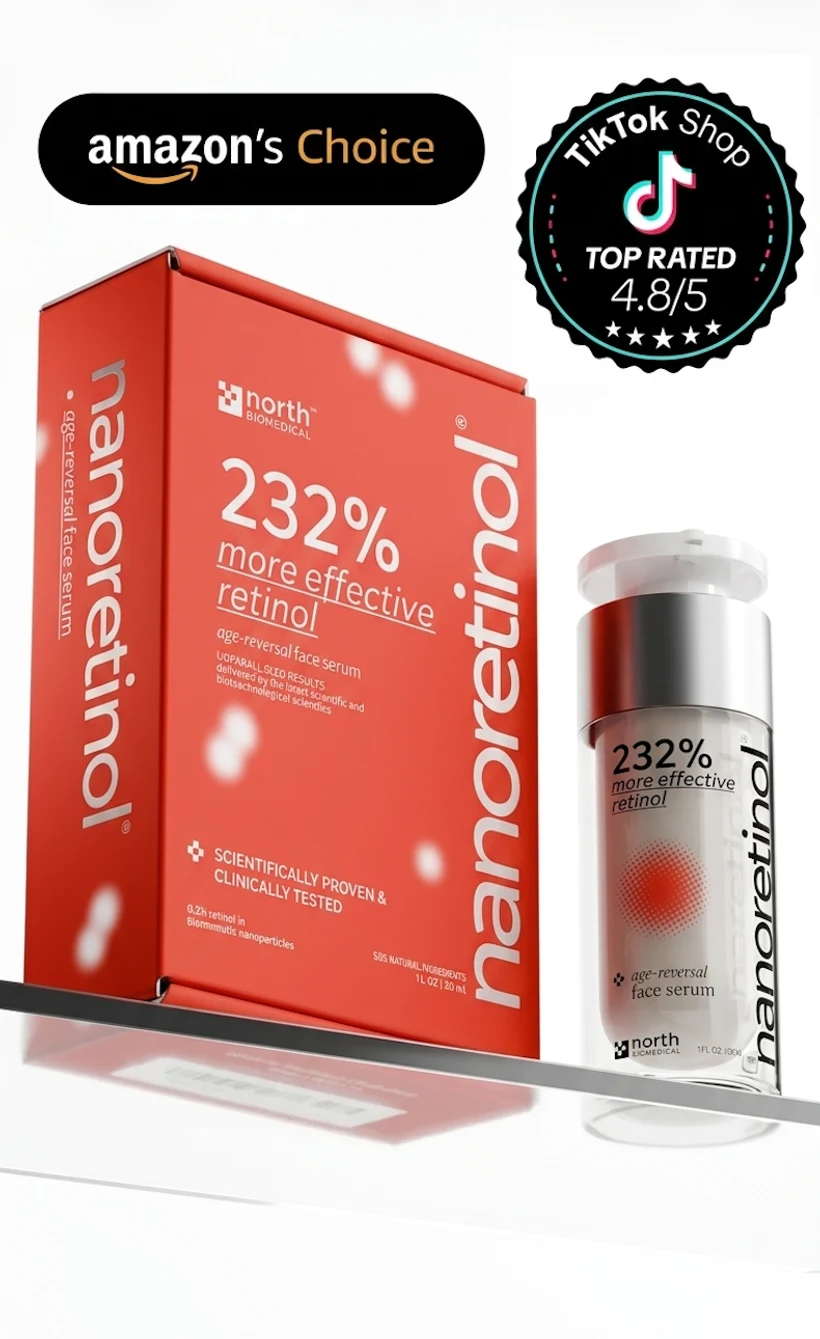
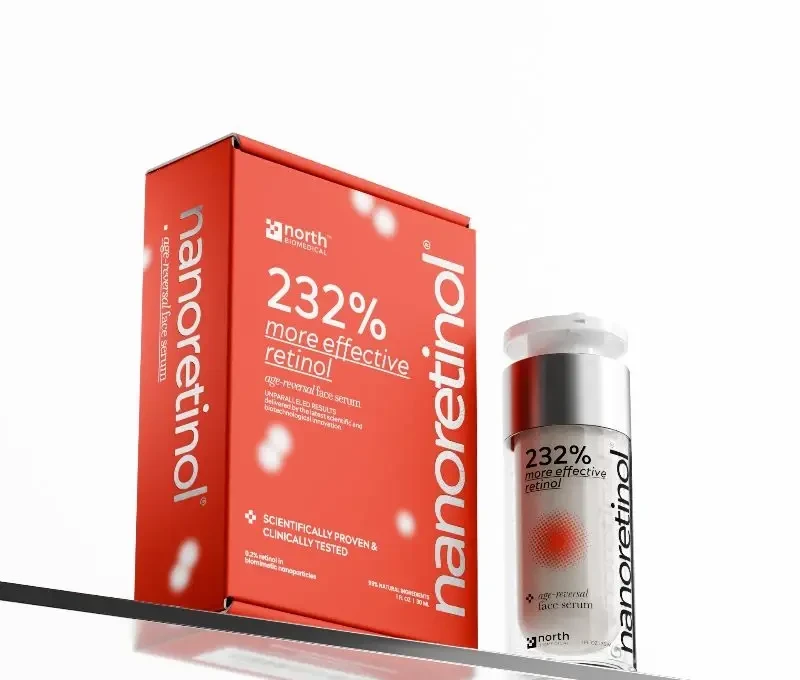
Nanoretinol takes a different route. Its retinol travels inside biomimetic lipid nanoparticles that the skin reads as “self” and allows through the epithelial barrier without that barrier having to be damaged first. In North Biomedical’s clinical study, the encapsulated form proved 232% more effective than conventional retinol in collagen recovery and 73% more effective in elastin recovery, with drastically reduced cytotoxicity. At 0.2% retinol in a water-based gel, it stays gentle enough for nightly use, and consistency is what compounds: the retinol you keep using is the only retinol that changes anything.
Sorting by Time of Day
If you change one thing this week, do not add a product. Move one. Put every acid and every retinoid on the night shift, hold the morning to antioxidant, moisturizer and sunscreen, and let each half of the day do the job it is physically capable of doing. The routine gets shorter, cheaper and measurably better at the thing you bought it for.
References
- Quan T, Qin Z, Xia W, Shao Y, Voorhees JJ, Fisher GJ. “Matrix-Degrading Metalloproteinases in Photoaging.” Journal of Investigative Dermatology Symposium Proceedings. 2009;14(1):20-24. doi:10.1038/jidsymp.2009.8
- Yan J, Xia Q, Cherng SH, Wamer WG, Howard PC, Yu H, Fu PP. “Photo-Induced DNA Damage and Photocytotoxicity of Retinyl Palmitate and Its Photodecomposition Products.” Toxicology and Industrial Health. 2005;21(7-8):167-175. doi:10.1191/0748233705th225oa
- Kornhauser A, Wei RR, Yamaguchi Y, Coelho SG, Kaidbey K, Barton C, Takahashi K, Beer JZ, Miller SA, Hearing VJ. “The Effects of Topically Applied Glycolic Acid and Salicylic Acid on Ultraviolet Radiation-Induced Erythema, DNA Damage and Sunburn Cell Formation in Human Skin.” Journal of Dermatological Science. 2009;55(1):10-17. doi:10.1016/j.jdermsci.2009.03.011
- Murray JC, Burch JA, Streilein RD, Iannacchione MA, Hall RP, Pinnell SR. “A Topical Antioxidant Solution Containing Vitamins C and E Stabilized by Ferulic Acid Provides Protection for Human Skin Against Damage Caused by Ultraviolet Irradiation.” Journal of the American Academy of Dermatology. 2008;59(3):418-425. doi:10.1016/j.jaad.2008.05.004
- Hughes MCB, Williams GM, Baker P, Green AC. “Sunscreen and Prevention of Skin Aging: A Randomized Trial.” Annals of Internal Medicine. 2013;158(11):781-790. doi:10.7326/0003-4819-158-11-201306040-00002
- Bissett DL, Miyamoto K, Sun P, Li J, Berge CA. “Topical Niacinamide Reduces Yellowing, Wrinkling, Red Blotchiness, and Hyperpigmented Spots in Aging Facial Skin.” International Journal of Cosmetic Science. 2004;26(5):231-238. doi:10.1111/j.1467-2494.2004.00228.x