Phenoxyethanol in Skincare: Is This Preservative Safe for Your Skin?
What phenoxyethanol does, why water-based products need it, what the allergy data really show, and the few people who should skip it
Phenoxyethanol sits near the bottom of thousands of ingredient lists, from moisturizers and serums to sunscreens and baby wipes. It also sits near the top of many “ingredients to avoid” lists online, usually next to a scary-sounding claim about toxicity.
Both facts can be true at once: phenoxyethanol is everywhere, and it has a bad reputation. The question is whether the reputation matches the evidence. This guide walks through what phenoxyethanol is, why it is in your products, what the safety and allergy data actually show, and the small group of people who are better off without it.
What Phenoxyethanol Is and Why It Is There
Phenoxyethanol, sometimes listed as 2-phenoxyethanol, is a preservative. It is a clear, slightly oily liquid that stops bacteria, yeasts and molds from growing in a product after you open it. It works against a wide range of microbes, including the Gram-negative bacteria that are hardest to control in water-based formulas, while having only a weak effect on the friendly bacteria that normally live on your skin [1].
Any product that contains water needs a preservative. Water is what microbes need to grow, and every time you dip a finger into a jar or leave a pump open in a warm bathroom, you add a few more of them. A review of contamination and preservation in cosmetics found that high-water products are at real risk of contamination, and that the organisms most often found in spoiled cosmetics include Staphylococcus aureus and Pseudomonas aeruginosa, both of which can cause infections [2].
What the 1% Limit Means
In the European Union, phenoxyethanol is allowed in cosmetics at up to 1% of the formula. The EU’s Scientific Committee on Consumer Safety reviewed it and concluded it is safe for all consumers, including children of all ages, at that maximum concentration [1].
Your skin meets phenoxyethanol at 1% or less, and the animal studies that found harm used exposures about 200 times higher than people get from cosmetics. That gap is the heart of the safety argument. The worrying studies that circulate online describe animals given very large amounts, often by mouth, not people applying a cream that contains a fraction of a percent. In practice, most products use well under the limit, because phenoxyethanol is often paired with a second ingredient that boosts it.
Your skin meets phenoxyethanol at 1% or less, and the animal studies that found harm used exposures about 200 times higher than people get from cosmetics.
How Often Does It Cause Allergy?
This is where the data are most reassuring. The North American Contact Dermatitis Group tested preservatives on more than 50,000 patients who had been referred for suspected contact allergy between 1994 and 2016. Phenoxyethanol tested on its own had one of the lowest positive rates of any preservative, about 0.2%, alongside benzyl alcohol and parabens [3]. By comparison, methylisothiazolinone, a preservative that caused an allergy wave in the 2010s, reached 12.2% in the same group.
That 0.2% figure comes from people who were already being patch tested because a dermatologist suspected an allergy, so the rate in the general population is likely lower still. A safety review by dermatologists and a pharmacologist concluded that phenoxyethanol is a rare sensitizer and one of the best tolerated preservatives in use [1].
Irritation is a separate question from allergy. In a study from a cosmetics research lab, phenoxyethanol at its working concentration caused about the same amount of visible skin irritation as the common parabens. Stinging and tingling depended more on the type of formula and on which preservatives were combined: pairing phenoxyethanol with another preservative, chlorphenesin, increased the sensory irritation noticeably [4]. So if a product stings, the whole formula is usually the cause, not one ingredient on its own.
The Ethylhexylglycerin Partner
Look a line or two below phenoxyethanol on many labels and you will find ethylhexylglycerin. It is a glycerin-derived ingredient that softens skin and makes phenoxyethanol work better, so less of it is needed.
Ethylhexylglycerin is also a rare allergen. Among more than 15,000 patients patch tested in North America between 2013 and 2018, 0.25% reacted to it, a rate similar to parabens, benzyl alcohol and phenoxyethanol [5]. A Belgian clinic series found that many of the creams that caused those reactions were marketed as “hypoallergenic” or “preservative-free” [6]. That is a useful reminder that marketing claims and allergy risk are not the same thing.
Your skin is far more likely to react to a cream full of bacteria than to the 1% of preservative that kept it clean.
The Problem With “Preservative-Free”
Your skin is far more likely to react to a cream full of bacteria than to the 1% of preservative that kept it clean. That is the trade-off behind every “preservative-free” claim on a water-based product.
A 2026 review of contamination in home-use products found contamination rates from 2% to 100% across product types once they were in people’s homes, even when they had been made to good manufacturing standards [7]. The usual culprits were again Pseudomonas, Staphylococcus aureus, fungi and molds. The review names older adults, newborns and people with weakened immune systems as the most vulnerable.
A truly preservative-free product is reasonable only when it is water-free (a balm or an oil), packed in single-use doses, or kept in sealed airless packaging with a short shelf life. For a cream or gel in a jar, a well-chosen preservative is a safety feature, not a compromise. Our guide to non-toxic skincare covers how to weigh other label worries the same way.
Who Should Still Avoid It
- People with a confirmed phenoxyethanol allergy. A positive patch test is the only reliable way to know. If a product keeps giving you an itchy rash where you apply it, a dermatologist can test you for preservatives, fragrances and other usual suspects.
- Anyone with a known ethylhexylglycerin allergy, since the two are so often paired.
- People reacting to many products at once. Those with very reactive skin may do better with short ingredient lists, and our guide to fragrance-free skincare is a good place to start, since fragrance is a far more common allergen than phenoxyethanol.
For everyone else, phenoxyethanol low on a list is not a reason to throw a product away. Like the fatty alcohols explained in our guide to cetyl alcohol, it is one of those label words that sounds harsher than it is.
Why Gentle Formulas Still Need Good Preservation
Retinol shows why the whole formula matters. Most of the redness and peeling people blame on retinol comes from how it is delivered: many conventional products use chemicals and petroleum derivatives that loosen the skin barrier to push retinol through. If your skin is easily irritated, our guide to retinol for sensitive skin explains how to ease in.
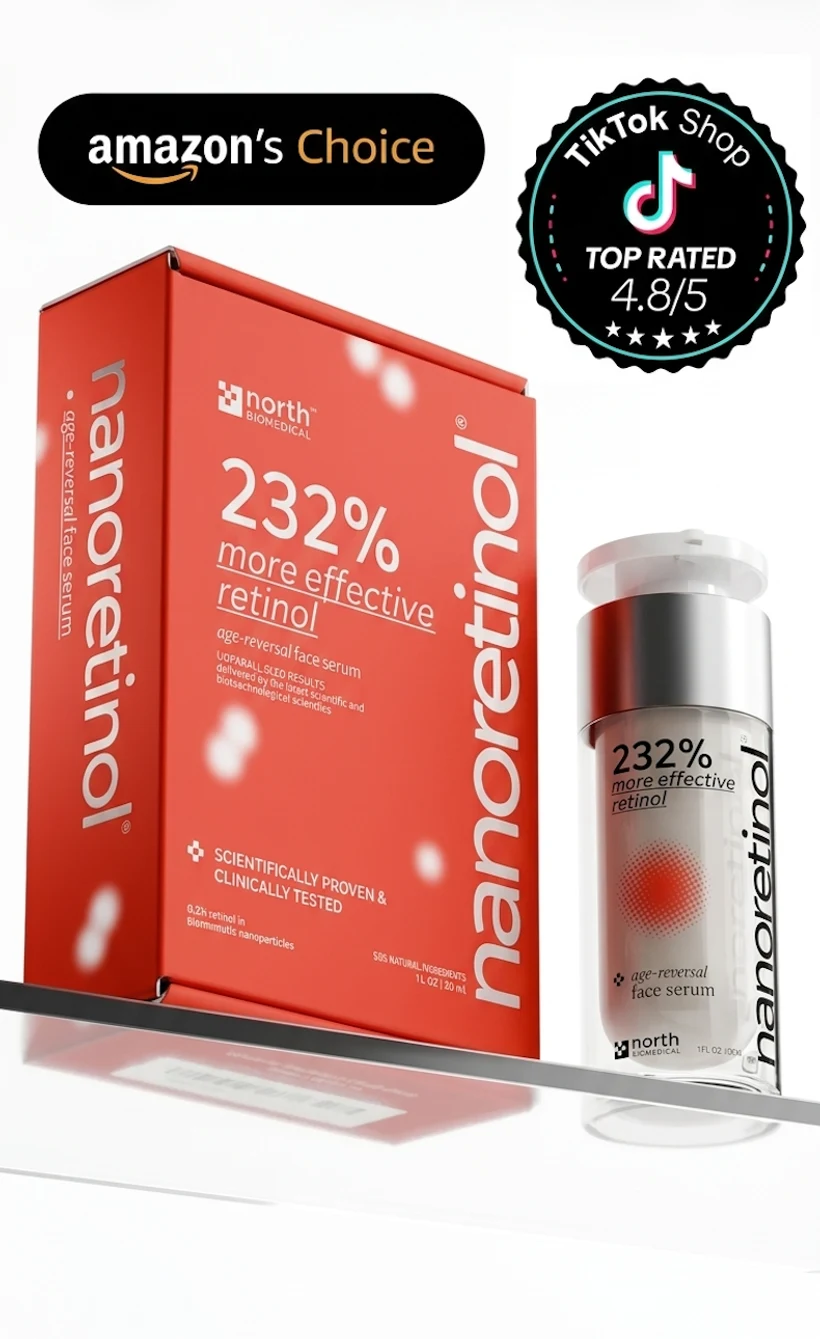
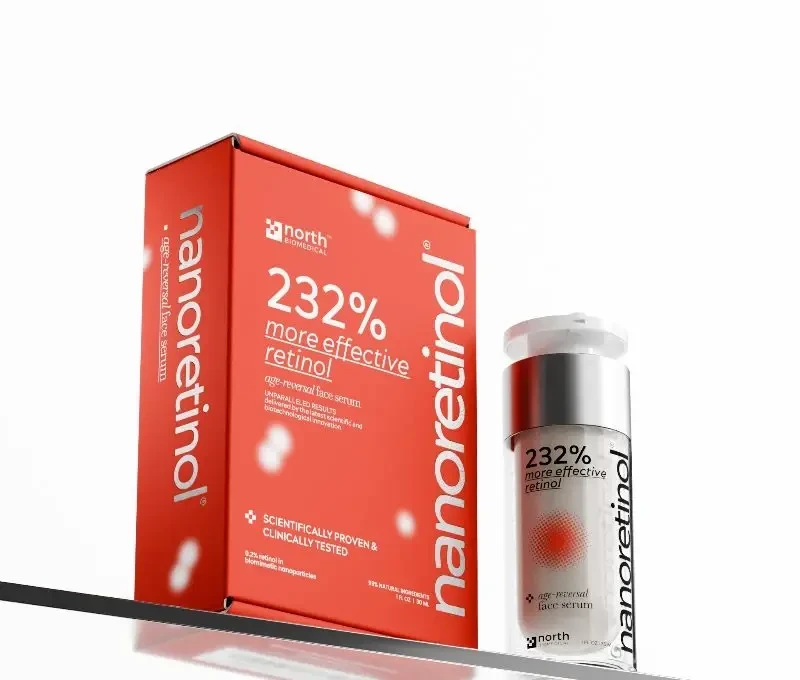
Nanoretinol takes a different route. It is a water-based gel made with 99% natural ingredients, and its 0.2% retinol sits inside biomimetic lipid nanoparticles that pass through the skin barrier without damaging it. Because it is water-based, it is preserved, and phenoxyethanol and ethylhexylglycerin are the last two ingredients on its list. In North Biomedical’s study, Nanoretinol was 232% more effective in collagen recovery than conventional retinol, and users saw a 61% increase in firmness and a 56% increase in elasticity after 56 days of use [8]. It is applied once a day at night, with sunscreen the next morning.
Reading the Label With Confidence
Phenoxyethanol is a low-dose, well-studied preservative that rarely causes allergy and keeps water-based products from becoming a home for bacteria. Judge a product by its whole formula and by how your skin responds over a few weeks, and save real caution for the ingredients you have actually reacted to.
References
- Dréno B, Zuberbier T, Gelmetti C, Gontijo G, Marinovich M. “Safety review of phenoxyethanol when used as a preservative in cosmetics.” Journal of the European Academy of Dermatology and Venereology. 2019;33(Suppl 7):15-24. doi:10.1111/jdv.15944
- Lundov MD, Moesby L, Zachariae C, Johansen JD. “Contamination versus preservation of cosmetics: a review on legislation, usage, infections, and contact allergy.” Contact Dermatitis. 2009;60(2):70-78. doi:10.1111/j.1600-0536.2008.01501.x
- Atwater AR, Petty AJ, Liu B, et al. “Contact dermatitis associated with preservatives: Retrospective analysis of North American Contact Dermatitis Group data, 1994 through 2016.” Journal of the American Academy of Dermatology. 2021;84(4):965-976. doi:10.1016/j.jaad.2020.07.059
- Lee E, An S, Choi D, Moon S, Chang I. “Comparison of objective and sensory skin irritations of several cosmetic preservatives.” Contact Dermatitis. 2007;56(3):131-136. doi:10.1111/j.1600-0536.2007.01001.x
- Warshaw EM, Buonomo M, Maibach HI, et al. “Patch Testing to Ethylhexylglycerin: The North American Contact Dermatitis Group Experience, 2013-2018.” Dermatitis. 2022;33(1):36-41. doi:10.1097/DER.0000000000000709
- Aerts O, Verhulst L, Goossens A. “Ethylhexylglycerin: a low-risk, but highly relevant, sensitizer in ‘hypo-allergenic’ cosmetics.” Contact Dermatitis. 2016;74(5):281-288. doi:10.1111/cod.12546
- Iskandar K, Marchin L, Roques C. “Microbial contamination of medicines, medical devices, cosmetics, child and personal care products: a comprehensive review of secondary contamination risks in home-use settings.” Frontiers in Microbiology. 2026;17:1836448. doi:10.3389/fmicb.2026.1836448
- North Biomedical LLC. “Nanoretinol vs. Conventional Retinol: Efficacy in Collagen and Elastin Recovery.” Clinical Study Summary, 2024. Study summary