Polysorbate 20 in Skincare: What It Does and Whether It Is Safe
How this common emulsifier lets oil and water mix, what the safety data show about irritation and impurities, and when it is worth avoiding
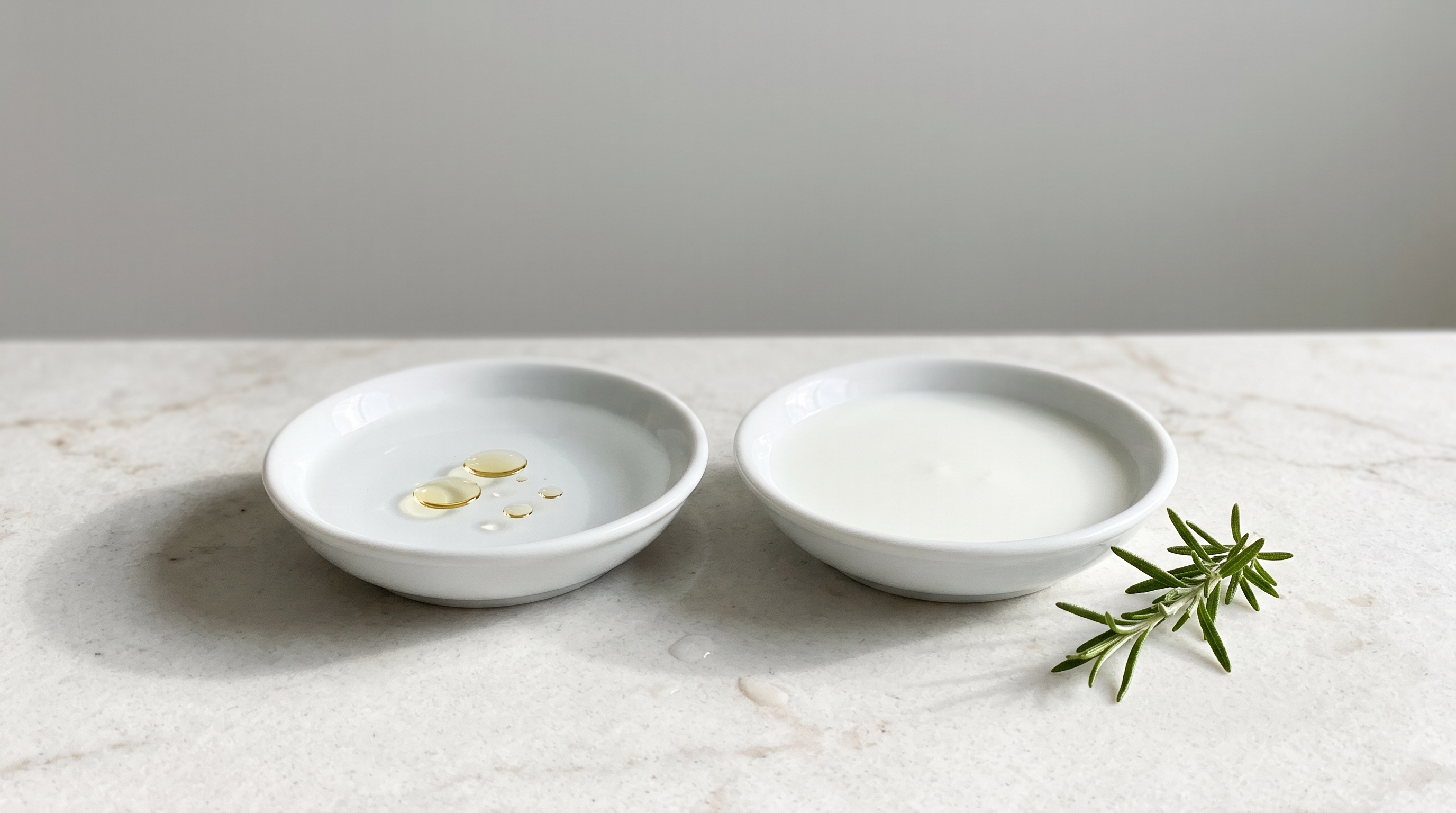
Oil and water do not mix. Shake a bottle of vinaigrette and the two layers separate again within minutes. Yet a clear facial toner can carry rose oil, a light mist can hold vitamin E, and a cleansing oil turns milky and rinses away the moment it touches water. In many of those products, the ingredient doing the work is polysorbate 20.
Polysorbate 20 appears on thousands of ingredient lists, as well as in foods, medicines and vaccines. It also appears on many “ingredients to avoid” lists, usually because of its connection to ethylene oxide. This guide explains what polysorbate 20 is, why formulators use it, what the safety research actually shows, and who might prefer products without it.
What Polysorbate 20 Is
Polysorbate 20 is a nonionic surfactant, which means its molecule has a water-loving end and an oil-loving end but carries no electrical charge. It is built in three steps. Manufacturers start with sorbitol, a sugar alcohol, turn it into sorbitan, attach a fatty acid from coconut or palm oil, and then add chains of ethylene oxide to make the molecule more water-soluble. The chemical name, polyoxyethylene (20) sorbitan monolaurate, describes exactly that.
The polysorbate family shares the same basic structure with about 20 ethylene oxide units. The number in the name tells you which fatty acid is attached: 20 means lauric acid, a short fatty acid, while polysorbate 80 carries the longer oleic acid. The base ingredients without ethylene oxide, called sorbitan esters, have been reviewed by the Cosmetic Ingredient Review panel and judged safe at the concentrations used in cosmetics [1].
Why It Shows Up in Toners, Mists and Cleansing Oils
Chemists rate emulsifiers on a scale called the hydrophilic-lipophilic balance. Polysorbate 20 sits near 17 on that scale, which makes it strongly water-loving. That is ideal for a job called solubilizing: wrapping small amounts of oil, fragrance or oil-soluble vitamins into tiny clusters so they stay evenly spread through a clear, watery product.
You will find it in three main places:
- Toners and mists: It keeps essential oils and fragrance from floating on top.
- Cleansing oils and balms: It lets the oil emulsify with water so it rinses off cleanly instead of leaving a greasy film, which is why the best cleansing oils feel light when you rinse.
- Serums and lotions: It helps stabilize emulsions alongside thicker ingredients such as fatty alcohols and gel polymers.
Your skin takes in far less of a harsh cleanser when a gentle emulsifier from the polysorbate 20 family is blended in, because the mixed clusters are too large.
It usually appears at low levels, near the end of the ingredient list. In richer creams it often works with fatty alcohols like cetyl alcohol, while in clear gels it sits next to thickeners such as carbomer.
Is Polysorbate 20 Safe on Skin?
For most people, yes. Nonionic surfactants like polysorbate 20 are among the gentlest cleansing and emulsifying agents available. They are much milder than charged surfactants such as sodium lauryl sulfate, and they can even soften those harsher ingredients. In one laboratory study, adding a nonionic surfactant from the same ethoxylated family to sodium lauryl sulfate reduced how much of the harsh surfactant penetrated the skin, because the two formed larger mixed clusters that could not slip through as easily [2].
Your skin takes in far less of a harsh cleanser when a gentle emulsifier from the polysorbate 20 family is blended in, because the mixed clusters are too large.
That gentleness is not the same as doing nothing. All surfactants interact with the skin barrier to some degree. A 2026 review of surfactants as penetration enhancers describes how they can loosen the lipid layers between skin cells and alter proteins in the outer layer, which helps other ingredients pass through [3]. At the low levels used in a toner, this effect is small. In a formula built to push an active ingredient deep into the skin, it matters more.
The Oxidation Question
Ethoxylated surfactants share a weakness: when exposed to air, they slowly oxidize. A Swedish multicenter study patch tested 528 dermatitis patients with several widely used ethoxylated surfactants, in both fresh and air-oxidized forms. The oxidized versions caused more irritant reactions than fresh material, and the researchers identified formaldehyde and acetaldehyde among the oxidation products as possible sources of unexpected exposure [4].
Your skin reacts more to an emulsifier like polysorbate 20 after it has been oxidized by air than to the same ingredient fresh from a sealed bottle.
Your skin reacts more to an emulsifier like polysorbate 20 after it has been oxidized by air than to the same ingredient fresh from a sealed bottle.
That finding is a good reason to keep products closed, store them away from heat and light, and respect the period-after-opening symbol on the label. It is not a reason to fear a freshly opened toner.
The 1,4-Dioxane Residue Question
The other common worry is 1,4-dioxane, a byproduct that can form when ethylene oxide is used to make ingredients such as polysorbates, PEGs and some sulfates. 1,4-Dioxane is classified as a probable human carcinogen, so regulators limit how much may remain in finished cosmetics, and laboratories now use validated methods to detect it at trace levels [5].
Responsible manufacturers remove most of it through vacuum stripping during production. The practical risk from a polysorbate used at a fraction of a percent is very small, but it is a real reason some brands choose emulsifiers that are not made with ethylene oxide at all.
Polysorbate 20, Polysorbate 80 and PEG-Free Alternatives
Polysorbate 80 is the close cousin you are most likely to see in medicines and vaccines. Because both polysorbates and PEGs contain chains of ethylene oxide, a small number of people with a true immediate allergy to polyethylene glycol also react to polysorbate 80. Researchers reported in 2019 that this cross-reaction may be more common than doctors had recognized, although it is still uncommon [6].
For brands that want to avoid ethoxylated ingredients, polyglyceryl esters are a popular alternative. They use chains of glycerin instead of ethylene oxide for the water-loving end. The Cosmetic Ingredient Review panel assessed 274 of them in 2023 and concluded they are safe in cosmetics when formulated to be non-irritating [7].
Who Might Want to Avoid It
Polysorbate 20 is a low-risk ingredient for most people. A few groups may still want to check labels:
- Known PEG or polysorbate allergy: Anyone with a confirmed immediate allergy should discuss all ethoxylated ingredients with their allergist.
- Very reactive or broken skin: Even mild surfactants can add to stinging on a damaged barrier.
- Ethoxylation-free shoppers: People who prefer to avoid any ingredient made with ethylene oxide can look for polyglyceryl esters instead.
For everyone else, polysorbate 20 in a well-made toner or micellar water is not a cause for concern.
How Nanoretinol Brings Oil and Water Together
Retinol is an oil-soluble molecule, and conventional retinol products often depend on solvents and surfactants that loosen barrier lipids to drive it into the skin. That mechanism is one reason so many people experience redness, burning and peeling with retinol.
Nanoretinol is a water-based gel that solves the oil-and-water problem differently. Its retinol is carried inside biomimetic lipid nanoparticles that the skin recognizes as its own, and the nanoparticle ingredients list polyglyceryl-10 laurate, a polyglyceryl ester with the same lauric acid tail as polysorbate 20 but no ethylene oxide. Instead of breaking down the barrier, the nanoparticles pass through it and release retinol gradually. In testing, Nanoretinol was 232% more effective in collagen recovery and 73% more effective in elastin recovery than conventional retinol, and over 56 days it increased skin firmness by 61% and elasticity by 56%, with milder side effects [8].
References
- Fiume MM, Bergfeld WF, Belsito DV, et al. “Safety Assessment of Sorbitan Esters as Used in Cosmetics.” International Journal of Toxicology. 2019;38(2_suppl):60S-80S. doi:10.1177/1091581819871877
- Moore PN, Shiloach A, Puvvada S, Blankschtein D. “Penetration of mixed micelles into the epidermis: effect of mixing sodium dodecyl sulfate with dodecyl hexa(ethylene oxide).” Journal of Cosmetic Science. 2003;54(2):143-159. PubMed 12715092
- Yin Z, Chen X, He H, He Y, Zhou L, Jia Y. “Surfactants as transdermal penetration enhancers: structure, mechanism, and application.” International Journal of Pharmaceutics. 2026;688:126417. doi:10.1016/j.ijpharm.2025.126417
- Matura M, Bodin A, Skare L, et al. “Multicentre patch test study of air-oxidized ethoxylated surfactants.” Contact Dermatitis. 2004;51(4):180-188. doi:10.1111/j.0105-1873.2004.00436.x
- Lusianti E, Zannah NS, Purwaningsih S, et al. “Validation and Collaborative Studies of Headspace Gas Chromatography-Mass Spectrometry for Determination of 1,4-Dioxane in Cosmetic Samples.” Journal of AOAC International. 2024;107(5):795-800. doi:10.1093/jaoacint/qsae056
- Stone CA Jr, Liu Y, Relling MV, et al. “Immediate Hypersensitivity to Polyethylene Glycols and Polysorbates: More Common Than We Have Recognized.” Journal of Allergy and Clinical Immunology: In Practice. 2019;7(5):1533-1540.e8. doi:10.1016/j.jaip.2018.12.003
- Fiume MM, Bergfeld WF, Belsito DV, et al. “Safety Assessment of Polyglyceryl Fatty Acid Esters as Used in Cosmetics.” International Journal of Toxicology. 2023;42(2_suppl):5S-101S. doi:10.1177/10915818231174440
- North Biomedical LLC. “Nanoretinol vs. Conventional Retinol: Efficacy in Collagen and Elastin Recovery.” Clinical Study Summary, 2024. Study summary