How to Remove Sun Tan From Your Face: Why It Fades on Its Own Schedule
The pigment is inside your skin cells, not on top of them, which changes everything about what actually works
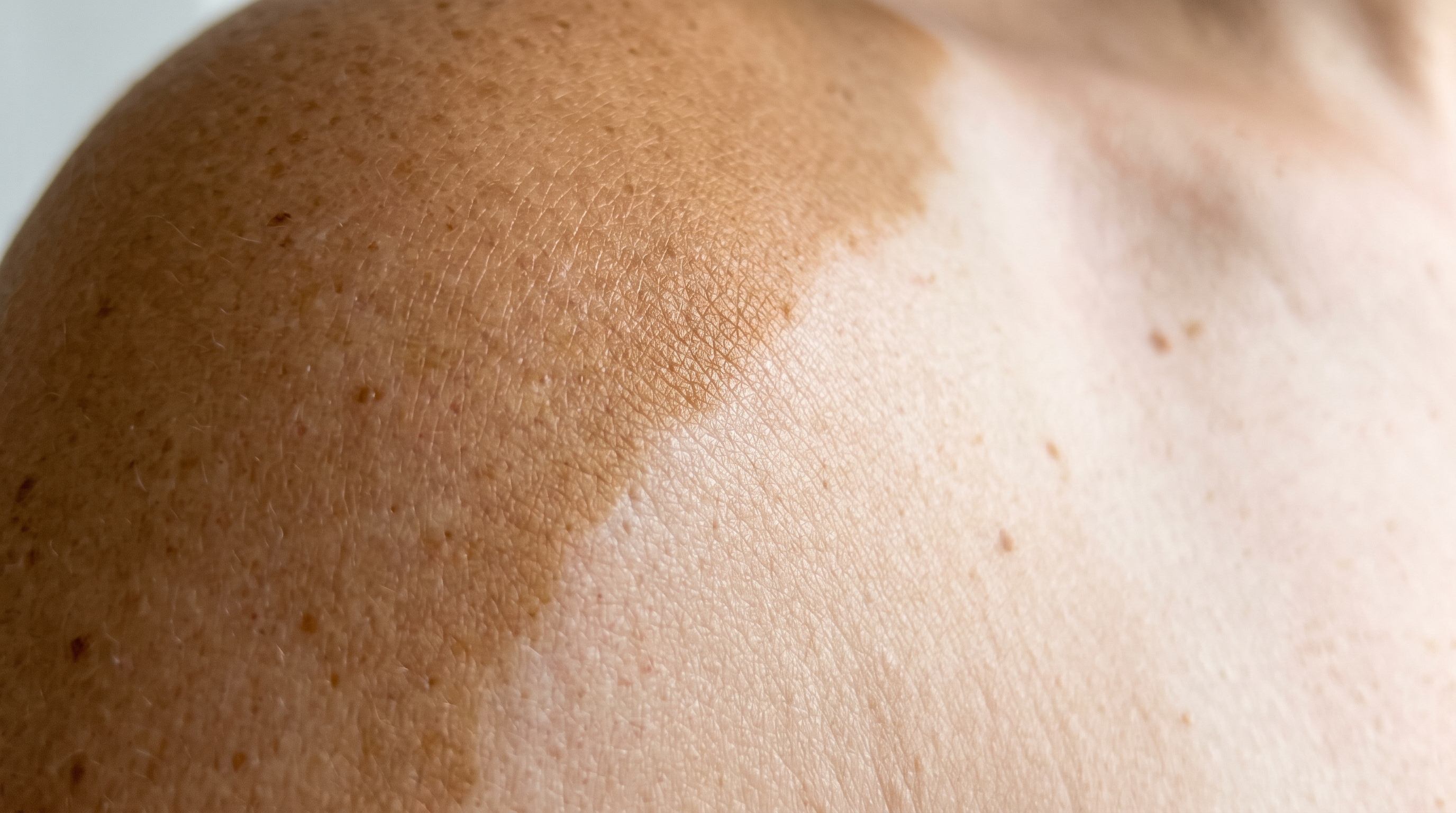
There is a reason every “remove your tan overnight” method fails, and it has nothing to do with the method. A tan is not a stain sitting on the surface of your face. It is pigment manufactured inside your skin and packaged into the cells themselves. You cannot scrub off something that is inside the brick, no matter how hard you go at the wall.
Understanding where the colour actually lives tells you exactly what will help, what will do nothing, and what will leave you with a worse problem than the tan.
You Probably Have Two Different Tans
Sun exposure produces more than one pigment response, on completely different timescales.
Immediate pigment darkening happens within minutes of UVA exposure. It is not new melanin at all; it is oxidation and redistribution of pigment that was already there. It appears fast and it fades within hours [1]. This is the greyish-brown cast you notice in the car mirror on the drive home, and it resolves on its own.
Delayed tanning is the real one. Over the following days, UV exposure triggers melanocytes to manufacture new melanin. That pigment does not stay in the melanocyte. It is packaged into organelles called melanosomes and physically transferred into surrounding keratinocytes, the ordinary cells that make up most of your epidermis [3]. Each melanocyte supplies roughly thirty of them.
That transfer step is the whole story. Once pigment is inside a keratinocyte, the only way it leaves your face is when that keratinocyte leaves your face.
Your tan is not on your skin. It is inside your skin cells, riding them upward until they shed.
The Timeline Nobody Wants to Hear
Keratinocytes are born at the base of the epidermis and migrate upward, flattening and hardening until they are shed from the surface. Classic work re-examining epidermal transit time in normal human skin put the full journey at roughly 40 to 56 days [2].
That number is the honest answer to “how long until my tan is gone”. Not a weekend. Not a single facial. Somewhere between six and eight weeks for the bulk of it, and longer if you are over fifty, because turnover slows with age.
Anything that claims to beat that timeline is either accelerating turnover, interfering with pigment production, or lying.
What Genuinely Speeds It Up
Stop the input first. As long as UV keeps reaching your face, melanocytes keep producing. Daily broad-spectrum sunscreen is not a fading treatment, but nothing else you do will show results while new pigment is being laid down at the same rate it clears. Our guide to UVA versus UVB explains why the ray responsible for most of this is the one you never feel.
Accelerate cell turnover. This is the single most direct lever, because it shortens the transit time of the pigment-carrying cells. Retinoids are the best-evidenced option. In a vehicle-controlled clinical trial of topical tretinoin on facial hyperpigmentation, 68% of treated patients improved compared with 5% on vehicle over 40 weeks, with objective colorimetric confirmation of lightening [4]. That is a slow, real result rather than an overnight one.
Interfere with pigment transfer or synthesis. Niacinamide works at the handoff point rather than the factory: it suppresses melanosome transfer into keratinocytes, with 35% to 68% inhibition measured in co-culture, and it significantly reduced hyperpigmentation compared with vehicle in clinical testing [6]. Tyrosinase inhibitors attack the production step instead, and we compare the main ones by evidence strength in our guide to tyrosinase inhibitors.
Every method that works does one of three things: stops new pigment, slows its production, or moves the cells carrying it out faster.
What Makes It Worse
Here is where most people lose weeks.
Aggressive scrubs and abrasive tools. Physical exfoliation removes cells that were already about to shed anyway, which is why it feels productive and changes almost nothing. What it does reliably produce is inflammation, and inflammation in the skin triggers a separate pigmentary response: post-inflammatory hyperpigmentation, where the melanocytes respond to injury by producing more melanin, not less [5]. You can absolutely trade a fading tan for a persistent brown patch.
Lemon juice and kitchen acids. The same mechanism, plus an added photosensitising risk. Citrus oils on sun-exposed skin can produce a phototoxic reaction that leaves sharply demarcated pigmentation lasting months.
Layering four actives at once. Barrier disruption is inflammation with a nicer name, and it feeds the same pathway.
Assuming it is a tan at all. If the discolouration is patchy rather than even, sits symmetrically across the cheeks, forehead or upper lip, and predated this summer, it may be melasma rather than a tan. Melasma responds badly to heat and irritation and needs a different approach entirely, which our hyperpigmentation treatment guide walks through. A tan is uniform across exposed areas. Melasma has a map.
The Case for Prioritising Turnover
If you only change one thing, change the one that shortens the pigment’s ride to the surface. That is also the intervention that pays you back beyond the tan, because the same retinoid pathway that clears pigmented keratinocytes faster is the one with the deepest evidence base for the sun damage sitting underneath it. A tan is the visible, temporary part of a UV exposure; the collagen degradation happening in the dermis at the same time is the permanent part, and our overview of sun damaged skin covers what that looks like over decades.
The obstacle has always been tolerability. Newly sun-exposed skin is already compromised, and conventional retinol formulations work by getting through the epithelial barrier at the barrier’s expense, which is why so many people start a retinoid after a summer and quit within three weeks of stinging and peeling.
Nanoretinol was built around that specific problem. It delivers a stabilised 0.2% retinol inside biomimetic lipid nanoparticles that the skin recognises as its own and admits without barrier disruption. In North Biomedical’s clinical study summary, that delivery produced 232% greater collagen recovery and 73% greater elastin recovery than conventional retinol, with 61% greater firmness and 56% greater elasticity over 56 days, and with significantly reduced cytotoxicity. Apply it at night, use sunscreen within 24 hours, and let the turnover do the work the scrub cannot.
Giving It the Right Deadline
Set your expectation at six to eight weeks, not six to eight days. Protect the skin so nothing new is being deposited, accelerate turnover so what is there moves out faster, and stay away from anything abrasive that trades a temporary tan for permanent pigment. The colour will go. It goes on the epidermis’s schedule, and the only real choice you have is whether you help that process or interrupt it.
References
- Routaboul C, Denis A, Vinche A. “Immediate pigment darkening: description, kinetic and biological function.” European Journal of Dermatology. 1999;9(2):95-99. PMID: 10066954
- Halprin KM. “Epidermal ‘turnover time’ — a re-examination.” British Journal of Dermatology. 1972;86(1):14-19. doi:10.1111/j.1365-2133.1972.tb01886.x
- Seiberg M. “Keratinocyte-melanocyte interactions during melanosome transfer.” Pigment Cell Research. 2001;14(4):236-242. doi:10.1034/j.1600-0749.2001.140402.x
- Griffiths CE, Finkel LJ, Ditre CM, Hamilton TA, Ellis CN, Voorhees JJ. “Topical tretinoin (retinoic acid) improves melasma. A vehicle-controlled, clinical trial.” British Journal of Dermatology. 1993;129(4):415-421. doi:10.1111/j.1365-2133.1993.tb03169.x
- Davis EC, Callender VD. “Postinflammatory hyperpigmentation: a review of the epidemiology, clinical features, and treatment options in skin of color.” Journal of Clinical and Aesthetic Dermatology. 2010;3(7):20-31. PMID: 20725554
- Hakozaki T, Minwalla L, Zhuang J, Chhoa M, Matsubara A, Miyamoto K, Greatens A, Hillebrand GG, Bissett DL, Boissy RE. “The effect of niacinamide on reducing cutaneous pigmentation and suppression of melanosome transfer.” British Journal of Dermatology. 2002;147(1):20-31. doi:10.1046/j.1365-2133.2002.04834.x