Best Bronzer for Mature Skin: How to Warm Skin That Stopped Making Its Own Colour
Why the shade that looked sun-kissed at thirty reads as a smudge at fifty-five
There is a specific moment that sends women to the makeup counter looking for a new bronzer. You sweep on the one you have always used, glance in the mirror, and instead of looking like you spent an afternoon outdoors you look like you have a stripe of dirt along your cheekbone.
The instinct is to blame the shade and buy a lighter one. That is half an answer. The other half is that bronzer is doing a completely different job on your face than it did twenty years ago, and the product has to change jobs with it.
The colour your skin stopped making
Three separate things drain warmth out of a face over time, and they compound.
The first is circulation. The small vessels that supply the skin do not simply carry on. Work on cutaneous microvasculature found that the dermal vessel network declines with age, with reduced endothelial cell survival driving a measurable loss of the capillary bed [1]. That capillary bed is where the pink in your cheeks came from. Less of it means less red arriving at the surface.
The second is glycation. Sugars bind to long-lived dermal proteins and form advanced glycation end products, and researchers have now isolated specific ones from human skin that are themselves yellow pigments rather than merely markers of damage [2]. Skin does not just lose red as it ages. It gains yellow.
The third is unevenness. A study measuring facial skin colour across four ethnic groups found that colour heterogeneity rose with age in every group, so the surface becomes patchier as well as sallower [3]. Our page on sallow skin covers the yellowing side of this in more detail.
This is why bronzer keeps its place in a mature routine when half the rest of the makeup bag gets retired. It is replacing something the skin used to supply.
The other half is that bronzer is doing a completely different job on your face than it did twenty years ago, and the product has to change jobs with it.
Colour does more work than you think
If this sounds cosmetic in the trivial sense, the perception research says otherwise. When observers were shown patches of facial skin with no shape or feature information at all, the distribution of colour alone changed their judgements of age, health and attractiveness [4]. Separately, skin colouration from dietary carotenoids, the faint golden cast that comes from eating a lot of vegetables, raised attractiveness ratings across cultures [5].
Warm, evenly distributed colour reads as health at a level below conscious assessment. That is the effect a good bronzer borrows.
Warming and contouring are two different jobs
Here is where most bronzer advice goes wrong for older faces, because it was written for younger ones.
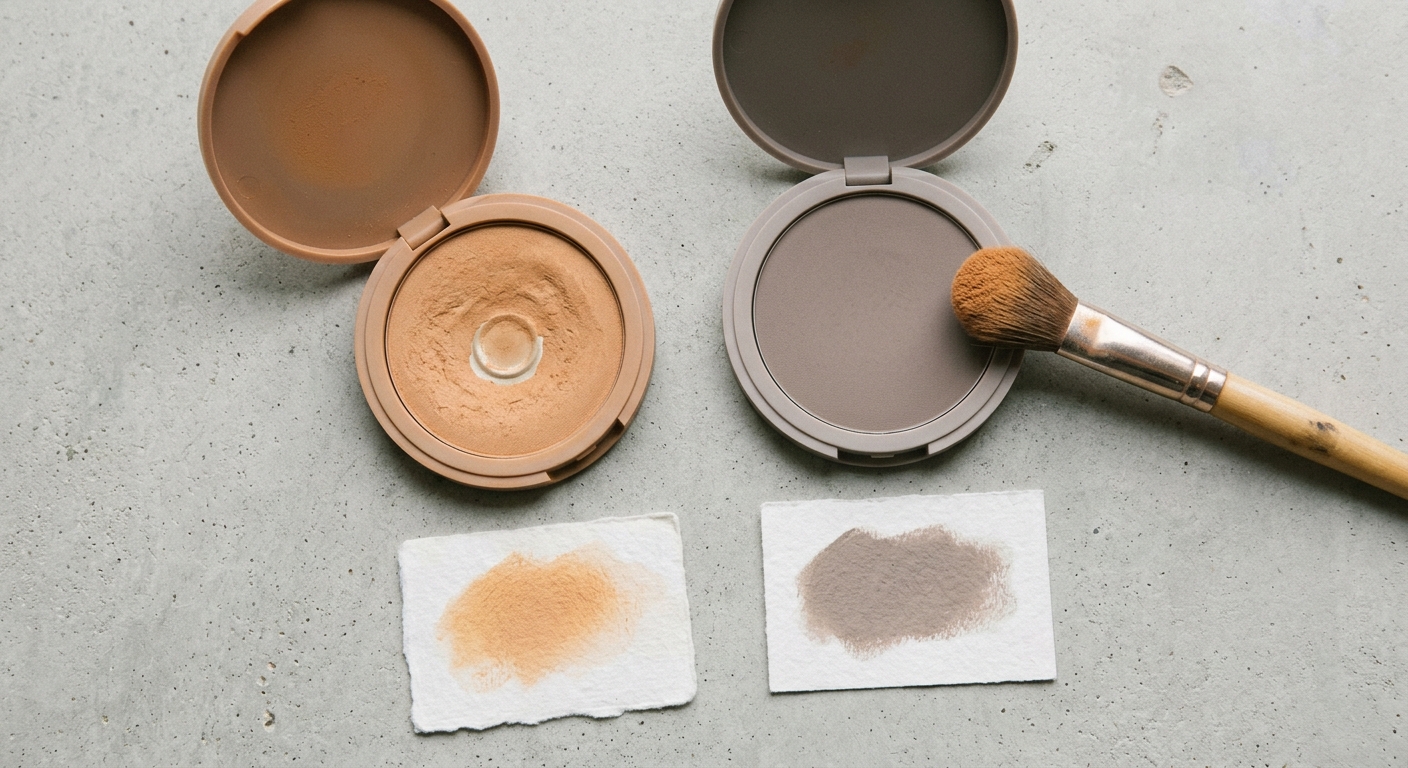
Contouring uses a cool, grey-leaning brown as a fake shadow to carve out structure. It works on a face that has plenty of soft tissue and not much definition. Warming uses a golden or peach-leaning brown as a wash of colour where the sun would naturally hit, along the top of the cheekbone, the temples, the bridge of the nose.
A face that has lost midfacial volume already has shadows. The hollow under the cheekbone, the trough beneath the eye, the slight sinking at the temple are all shadows that arrived without being asked. Painting more grey-brown shadow into that face does not sculpt it. It deepens what is already too deep, which is precisely why a cool matte bronzer reads as dirt rather than definition on mature skin.
The working rule is to warm rather than carve. If a bronzer looks grey, muddy or ashy against your skin in daylight, it is a contour product and it belongs to a different decade.
The two-shade rule
Undertone matters more than depth, and depth still has a ceiling. Stay within roughly two shades of your natural skin tone. Beyond that the product stops reading as your skin catching the light and starts reading as something applied on top of it, which is the exact impression you are trying to avoid.
Beyond that the product stops reading as your skin catching the light and starts reading as something applied on top of it, which is the exact impression you are trying to avoid.
Test on the jaw rather than the back of the hand, since hand skin is usually several shades off, and check it in daylight rather than under the retail lighting that was engineered to sell it. If your skin has gone sallow, avoid anything with an orange base, because yellow on yellow amplifies what you were trying to correct. A bronzer with a slight rosy or neutral warmth counteracts it instead.
Formula, and the shimmer problem
The same logic that governs blush on mature skin applies here. Pressed powder needs a film of sebum to blend into, and sebum output falls with age, so dry pigment tends to catch on the high points of texture and skip the low ones. Cream and liquid bronzers carry colour in an emollient base that fills fine texture rather than sitting across it, which is why they photograph more naturally on skin over fifty.
Shimmer deserves its own warning. Large reflective particles need a smooth surface to look like light. On skin with fine lines, enlarged texture and the fine vellus hair that becomes more visible with age, those particles catch individually and read as glitter sitting above the face. Satin finishes give you luminosity without the particle size that betrays texture. Matte is safest of all if your only concern is warmth. If you are rebuilding the whole base, the best foundation for mature skin guide covers the layer underneath.
Apply with a brush that is smaller than you think, build in two passes, and put the second pass slightly higher than the first.
The part bronzer is compensating for
Every rule above manages an appearance. None of them touches the reason the appearance changed.
Underneath, collagen production itself falls. In chronologically aged skin, fibroblasts produce measurably less collagen, partly because they sit in a degraded matrix that no longer stretches them mechanically, so the cells receive less of the signal that tells them to build [6]. A dermis with less collagen scatters less light back through the surface, and that is a large part of what dullness actually is. Our page on dull skin works through the optics of it.
There is good evidence that this is partly reversible. In a double-blind vehicle-controlled trial, topical tretinoin produced significant improvement in photoaged skin, including fine wrinkling and mottled pigmentation, against vehicle alone [7]. Retinoids remain the most evidenced topical route back toward a dermis that reflects light properly.
The obstacle has always been tolerance. Conventional retinol reaches the dermis by chemically disrupting the skin barrier, and on the thinner, drier skin that prompted the bronzer search in the first place, that produces the flaking and redness that ends most attempts within a month.
Nanoretinol takes a different route. Its 0.2% retinol travels inside biomimetic lipid nanoparticles that the skin recognises as self and admits intact, in a water-based, 99% natural formulation suitable for sensitive skin. Measured against conventional retinol it delivered 232% greater collagen recovery and 73% greater elastin recovery with drastically reduced cytotoxicity, and over 56 days of use produced a 61% increase in firmness and a 56% increase in elasticity. Skin that scatters light properly needs less help from a compact.
At the counter, in daylight
Choose warm over cool, cream over powder unless your skin still runs oily, satin over frost, and stay inside two shades of your own depth. Swatch on the jaw, walk to a window, and look at whether it reads as colour in your skin or colour on it.
Then treat the compact as the fast fix and the skin as the slow one. The best bronzer for mature skin is the one that only has to add a suggestion of warmth, because the rest of it came back on its own.
References
- Chang E, Yang J, Nagavarapu U, Herron GS. “Aging and Survival of Cutaneous Microvasculature.” Journal of Investigative Dermatology. 2002;118(5):752-758. PMID: 11982751
- Fang B, Li L, Winget J, Laughlin T, Hakozaki T. “Identification of Yellow Advanced Glycation End Products in Human Skin.” International Journal of Molecular Sciences. 2024;25(11):5596. doi:10.3390/ijms25115596
- de Rigal J, Des Mazis I, Diridollou S, Querleux B, Yang G, Leroy F, Barbosa VH. “The Effect of Age on Skin Color and Color Heterogeneity in Four Ethnic Groups.” Skin Research and Technology. 2010;16(2):168-178. PMID: 20456097
- Fink B, Grammer K, Matts PJ. “Visible Skin Color Distribution Plays a Role in the Perception of Age, Attractiveness, and Health in Female Faces.” Evolution and Human Behavior. 2006;27(6):433-442. doi:10.1016/j.evolhumbehav.2006.08.007
- Ip FW, Lewis GJ, Lefevre CE. “Carotenoid Skin Colouration Enhances Face and Body Attractiveness: A Cross-Cultural Study.” Quarterly Journal of Experimental Psychology. 2019;72(11):2565-2573. PMID: 31035862
- Varani J, Dame MK, Rittie L, Fligiel SE, Kang S, Fisher GJ, Voorhees JJ. “Decreased Collagen Production in Chronologically Aged Skin: Roles of Age-Dependent Alteration in Fibroblast Function and Defective Mechanical Stimulation.” American Journal of Pathology. 2006;168(6):1861-1868. PMID: 16723701
- Weiss JS, Ellis CN, Headington JT, Tincoff T, Hamilton TA, Voorhees JJ. “Topical Tretinoin Improves Photoaged Skin. A Double-Blind Vehicle-Controlled Study.” JAMA. 1988;259(4):527-532. PMID: 3336176