Melatonin for Skin: The Hormone Your Skin Makes on Its Own
Your skin produces melatonin independently of your brain, and it uses it as an antioxidant — not a sleep signal.
Most people know melatonin as the small white tablet that helps with jet lag. That reputation is accurate and also wildly incomplete, because the most interesting thing melatonin does in the human body has very little to do with sleep — and a surprising amount to do with skin.
Your skin manufactures its own melatonin. Not a trickle diverted from the bloodstream, but locally produced supply, made on site, for local use.
Your skin is a melatonin factory
The textbook account puts melatonin production in the pineal gland, a pea-sized structure in the brain that releases it after dark to set your circadian rhythm. That account is not wrong, but it is only part of the picture.
Research over the past two decades has established that human skin contains the complete enzymatic machinery to synthesise melatonin from serotonin, and that keratinocytes, melanocytes and fibroblasts all participate. Skin also expresses melatonin receptors and metabolises the molecule into further active compounds locally [1]. This system runs independently of the pineal gland — take out the brain’s supply and skin keeps making its own.
That independence is a strong clue. Biology does not usually build a redundant production line for a signalling molecule unless the tissue needs it for something specific.
What it is actually doing there
Melatonin in skin behaves less like a hormone and more like a bodyguard.
It is an unusually effective free radical scavenger, and unlike most antioxidants it works in what researchers describe as a cascade: melatonin neutralises a reactive molecule, and the metabolites produced by that reaction are themselves antioxidants that neutralise more. One molecule ends up doing several molecules’ worth of work [2].
Most people know melatonin as the small white tablet that helps with jet lag.
It also concentrates in mitochondria — the compartments that generate cellular energy and, as a byproduct, the bulk of a cell’s free radicals. Positioning an antioxidant at the source of the damage is efficient design. Beyond scavenging, melatonin has been shown to support DNA repair pathways and to boost the cell’s own antioxidant enzymes rather than simply acting alone [2].
For skin specifically, that matters because ultraviolet radiation causes damage largely through oxidative stress. Reviews of melatonin and human skin ageing describe it as a protective agent operating across several mechanisms at once, which is a genuinely different profile from a single-target ingredient [3].
The night repair window is real
Skin does not run at a constant speed. Cell division, barrier repair and blood flow all follow a daily rhythm, and the overnight hours are when regeneration is most active. Melatonin is one of the molecular signals tied to that shift.
This is the biological basis for a habit most people follow by instinct: the heavier, more active products go on at night. Our guide to circadian rhythm skincare covers how that timing works across a full routine.
What topical melatonin research actually shows
Here the honest answer requires some restraint. The mechanistic literature is rich; the human clinical literature is thin.
The strongest early evidence concerns UV protection. In a double-blind study, twenty volunteers were irradiated with UVB and treated with topical melatonin at 0.05%, 0.1% and 0.5%. The researchers found a clear dose-response relationship: more melatonin, less UV-induced redness [4]. Worth noting is a detail rarely mentioned when this study gets cited — the melatonin was delivered in a nanocolloid gel carrier. The vehicle was doing real work.
On visible ageing, the most-cited human trial is a randomised, split-face, assessor-blinded study of 22 women with a mean age of 55 using melatonin-based day and night creams over three months. Skin tonicity and hydration improved significantly, and skin roughness fell [5]. That is a real result, and it is also a proof-of-concept study with 22 participants — a reasonable signal, not a settled case.
If you want to try it, look for a formulation that takes delivery seriously.
What melatonin has not been shown to do is remodel the dermis. There is no body of evidence putting it anywhere near retinoids for rebuilding collagen or softening established wrinkles. Its role, on current data, is defensive.
One practical note: swallowing melatonin for your skin is not supported. Oral melatonin is studied for sleep, and the skin research is overwhelmingly topical or laboratory-based. Do not start taking a sleep aid as a wrinkle treatment.
Where it belongs in a routine
Think of melatonin as a member of your antioxidant team rather than the centrepiece. It sits comfortably alongside the ingredients covered in our overview of antioxidant skin care, and it fits naturally into the products described in our guide to night creams for anti-ageing.
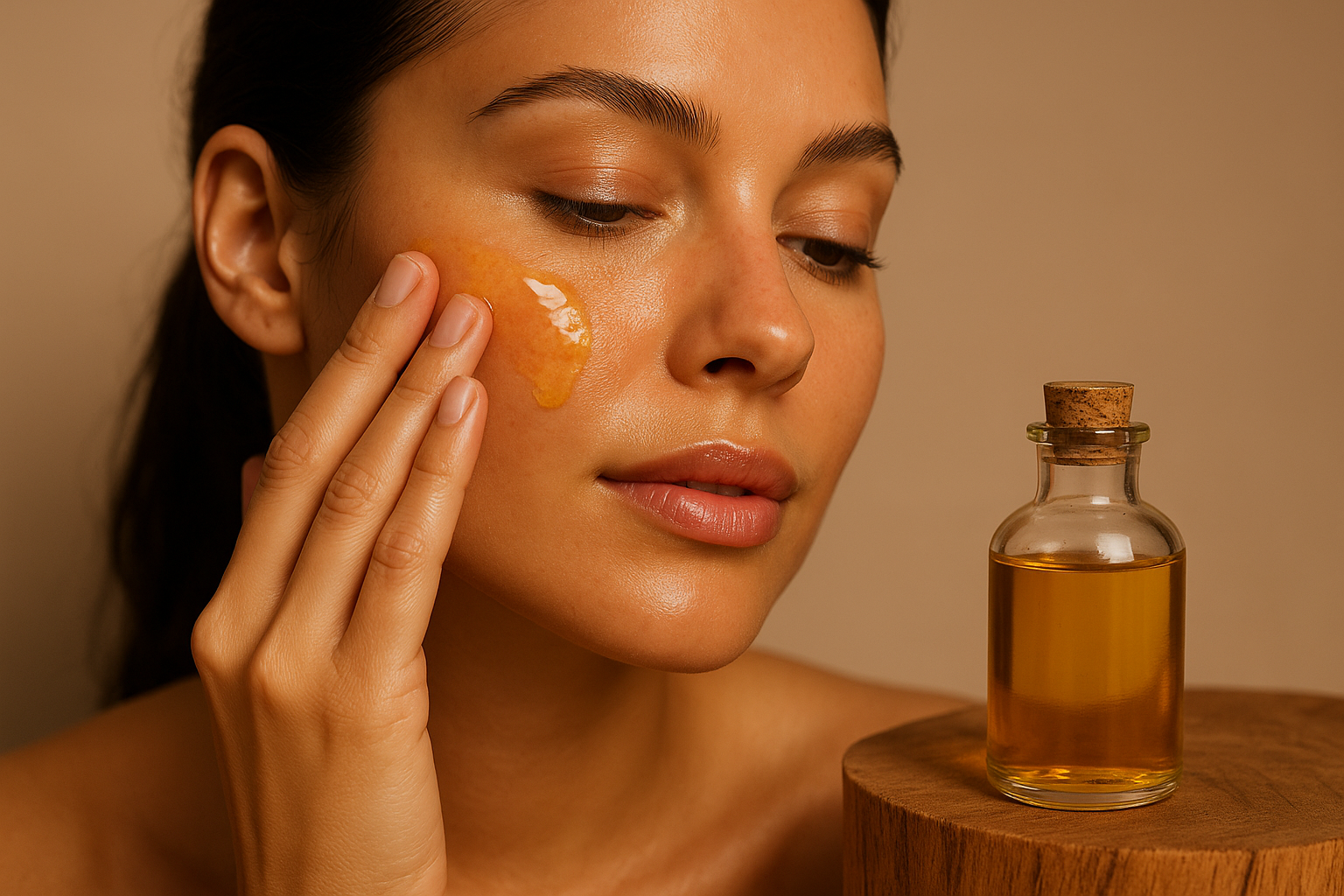
If you want to try it, look for a formulation that takes delivery seriously. Melatonin weighs about 232 Daltons and is comfortably lipophilic, which means it can cross the stratum corneum — a real advantage over larger, charged “longevity” molecules that cannot. But it degrades in light, so opaque, air-restricted packaging is not a luxury.
Protection is not the same as repair
Here is the distinction that decides how much melatonin can do for you.
Antioxidants defend what you still have. They intercept damage before it accumulates. That is worth doing, and if you are in your thirties and forties it may be the highest-value thing in your routine. But defence does not recover what was already lost. Collagen that degraded over twenty years of sun exposure does not come back because you slowed the rate of future degradation.
Rebuilding requires an ingredient that instructs fibroblasts to produce new collagen, and in decades of dermatological research one class has consistently done that: the retinoids [6]. The obstacle has never been whether retinol works. It is whether it arrives. Conventional formulations struggle to cross the epithelial barrier, and the traditional workaround — chemicals and petroleum derivatives that disrupt the barrier through lipid mobility — is precisely why so many people associate retinol with burning, redness and peeling.
Nanoretinol takes the route the Bangha researchers hinted at thirty years ago when their nanocolloid carrier outperformed expectations: fix the vehicle. Its retinol sits inside biomimetic lipid nanoparticles that are externally identical to your own skin cells, so the body reads them as “self” and lets them through the epithelial barrier intact rather than breaking it open. In North Biomedical’s clinical study, that delivery approach proved 232% more effective in collagen recovery and 73% more effective in elastin recovery than conventional retinol at just 0.2% concentration, with significantly gentler behaviour toward skin cells [7].
Melatonin guards the night. A well-delivered retinoid uses it.
Worth trying, worth keeping in proportion
Melatonin is a legitimately interesting molecule with an unusual mechanism and a real, if modest, clinical record in skin. If you enjoy a well-formulated night product that includes it, there is no reason not to use one.
Just keep the hierarchy straight. Sunscreen prevents the damage. Antioxidants like melatonin reduce what gets through. And a retinoid that actually reaches the dermis is what rebuilds the structure underneath.
References
- Slominski AT, Hardeland R, Zmijewski MA, Slominski RM, Reiter RJ, Paus R. “Melatonin: A Cutaneous Perspective on its Production, Metabolism, and Functions.” Journal of Investigative Dermatology. 2018;138(3):490-499. doi:10.1016/j.jid.2017.10.025
- Fischer TW, Slominski A, Zmijewski MA, Reiter RJ, Paus R. “Melatonin as a major skin protectant: from free radical scavenging to DNA damage repair.” Experimental Dermatology. 2008;17(9):713-730. doi:10.1111/j.1600-0625.2008.00767.x
- Kleszczyński K, Fischer TW. “Melatonin and human skin aging.” Dermato-Endocrinology. 2012;4(3):245-252. doi:10.4161/derm.22344
- Bangha E, Elsner P, Kistler GS. “Suppression of UV-induced erythema by topical treatment with melatonin (N-acetyl-5-methoxytryptamine). A dose response study.” Archives of Dermatological Research. 1996;288(9):522-526. doi:10.1007/BF02505248
- Milani M, Sparavigna A. “Antiaging efficacy of melatonin-based day and night creams: a randomized, split-face, assessor-blinded proof-of-concept trial.” Clinical, Cosmetic and Investigational Dermatology. 2018;11:51-57. doi:10.2147/CCID.S153905
- Mukherjee S, Date A, Patravale V, Korting HC, Roeder A, Weindl G. “Retinoids in the treatment of skin aging: an overview of clinical efficacy and safety.” Clinical Interventions in Aging. 2006;1(4):327-348. doi:10.2147/ciia.2006.1.4.327
- North Biomedical LLC. “Nanoretinol vs. Conventional Retinol: Efficacy in Collagen and Elastin Recovery.” Clinical Study Summary, 2024. https://northbiomedical.com/documents/Nanoretinol-Study_Summary.pdf