Sauna Skin Benefits: What the Heat Actually Does, and What It Doesn't
The glow is real and it is not collagen. Separating the measured effects from the wellness marketing
You step out of a sauna and your face looks better. Flushed, plumper, somehow smoother. Twenty minutes later most of it is gone.
Both halves of that experience are real, and understanding which mechanism produced which half tells you what heat can and cannot do for aging skin. The answer is more interesting than either the wellness industry or its critics suggest, because one of the claims people make for sauna turns out to hold up better than expected, and the one everybody repeats turns out to be wrong.
What happens to your skin at 80 degrees
A Finnish sauna sits somewhere between 80 and 100 degrees Celsius in the air, though your skin never comes close to that. What your body does in response is redirect blood outward. A review of the sauna literature describes marked peripheral vasodilation and increased skin blood flow, along with raised cardiac output and, with regular use, improved endothelium-dependent dilation [1].
That is your glow. Blood volume in the dermal capillary bed rises, the skin warms and reddens, and the surface briefly holds more water. It is a circulatory event, and circulatory events reverse when circulation normalizes. Nothing structural has changed in the twenty minutes you were in there.
The barrier question, and the study that went the other way
The usual assumption is that a hot room dehydrates your skin. It is a reasonable guess, and the evidence does not support it as neatly as expected.
A controlled study put 41 volunteers through two fifteen-minute sessions at 80 degrees and compared regular sauna users against non-users. The regular users showed more stable epidermal barrier function, higher stratum corneum water-holding capacity, and faster recovery of both transepidermal water loss and skin pH after the heat exposure. Their forehead sebum production was also lower [2].
So the barrier adapts. People who sauna consistently were not walking around with compromised skin, and their recovery curves were better than those of the people who did not. That is a genuine, measured benefit, and it is more than most wellness practices can show.
Two caveats keep it honest. The advantage was in recovery and stability rather than in any structural improvement. And it was found in habitual users, meaning it describes an adaptation rather than something a first session will hand you.
Your skin surface in a sauna reaches somewhere in the low forties, and your dermis stays cooler than your surface.
Where the collagen claim falls apart
Here is the claim you see everywhere: heat shock proteins stimulate collagen, so sauna builds collagen.
There is real science underneath it. Researchers applied a localized 60 degree heat shock to ex vivo human skin and found significantly increased procollagen type I and III expression in dermal fibroblasts, along with elevated HSP70 and HSP47, with no disruption of existing collagen structure [3].
Now look at the number. Sixty degrees, applied directly to the tissue. Your skin surface in a sauna reaches somewhere in the low forties, and your dermis stays cooler than your surface. The temperature that produced the collagen response in that experiment is not a temperature that occurs in your skin while you sit in a sauna. It is closer to the range that dedicated clinical heating devices are engineered to deliver under controlled conditions.
The evidence at temperatures you actually experience points the other way. Repeated in vivo infrared exposure of human skin, three times a week for four weeks, reduced type I procollagen expression and increased MMP-1, the enzyme that degrades collagen [4]. That is the molecular signature of thermal aging, and it is why chronic heat exposure is now discussed alongside UV as a driver of dermal breakdown.
None of this makes a sauna dangerous at ordinary frequency. It does mean the collagen argument for sauna is unsupported, and if anything the thermal load counts as a small cost rather than a benefit.
Two people who should be careful
If you have melasma. Heat is an independent trigger for pigmentation, and the mechanism is now mapped. Human skin explants held at 41 degrees, with no ultraviolet and no visible light, produced pigmentation through TRPV3-mediated signaling in keratinocytes that activates melanocytes in a paracrine loop [5]. Forty-one degrees is a realistic skin temperature in a sauna. If you are managing melasma and treating it as a purely sun-driven condition, the hot room is working against you.
If you have rosacea. Heat above about 43 degrees activates thermosensitive TRPV1 and TRPA1 channels in rosacea skin, driving neurogenic vasodilation, flushing, and downstream inflammatory activation involving mast cells and macrophages [6]. Heat is one of the most consistently reported rosacea triggers, and the pathway explaining why is well characterized.
If you are managing melasma and treating it as a purely sun-driven condition, the hot room is working against you.
For both groups the recommendation is not abstinence. It is shorter sessions, lower temperatures, and honesty about the trade.
Why mature skin has less margin
Whatever the barrier does in a sauna, it does with the lipids it has. Post-menopausal skin contains lower levels of ceramides, with shorter chain lengths, and reduced water-holding capacity compared with skin in women using hormone replacement [7]. Ceramides are the mortar in the barrier.
The practical consequence is a narrower recovery window. A younger barrier restores its pH and water content quickly after heat. A barrier already short on ceramides takes longer, and if you follow the sauna with a hot shower and a foaming cleanser you can turn a neutral exposure into a genuinely dehydrated one. Most of the dryness people blame on the sauna is coming from what they do in the ten minutes afterward.
Getting the good part without the cost
Go in with a clean face. Makeup and sunscreen have no reason to be there, and heavy occlusives will simply melt and spread.
Rinse in cool or lukewarm water afterward rather than hot, and skip the foaming cleanser if you did not go in wearing anything.
Apply your moisturizer while your skin is still slightly damp, ideally within three minutes. This is when the barrier is most receptive and the water is still there to be sealed in.
Keep sessions moderate. The barrier data came from fifteen-minute sessions, not marathon ones, and the pigmentation and flushing risks scale with time and temperature.
If your goal was a warm, hydrated flush rather than heat adaptation, a facial steamer delivers a similar surface effect with far less thermal load on the rest of your skin.
What heat cannot reach
The honest summary is that a sauna is good for your cardiovascular system, neutral to mildly positive for your skin barrier if you use it regularly, and irrelevant to the structure of your dermis.
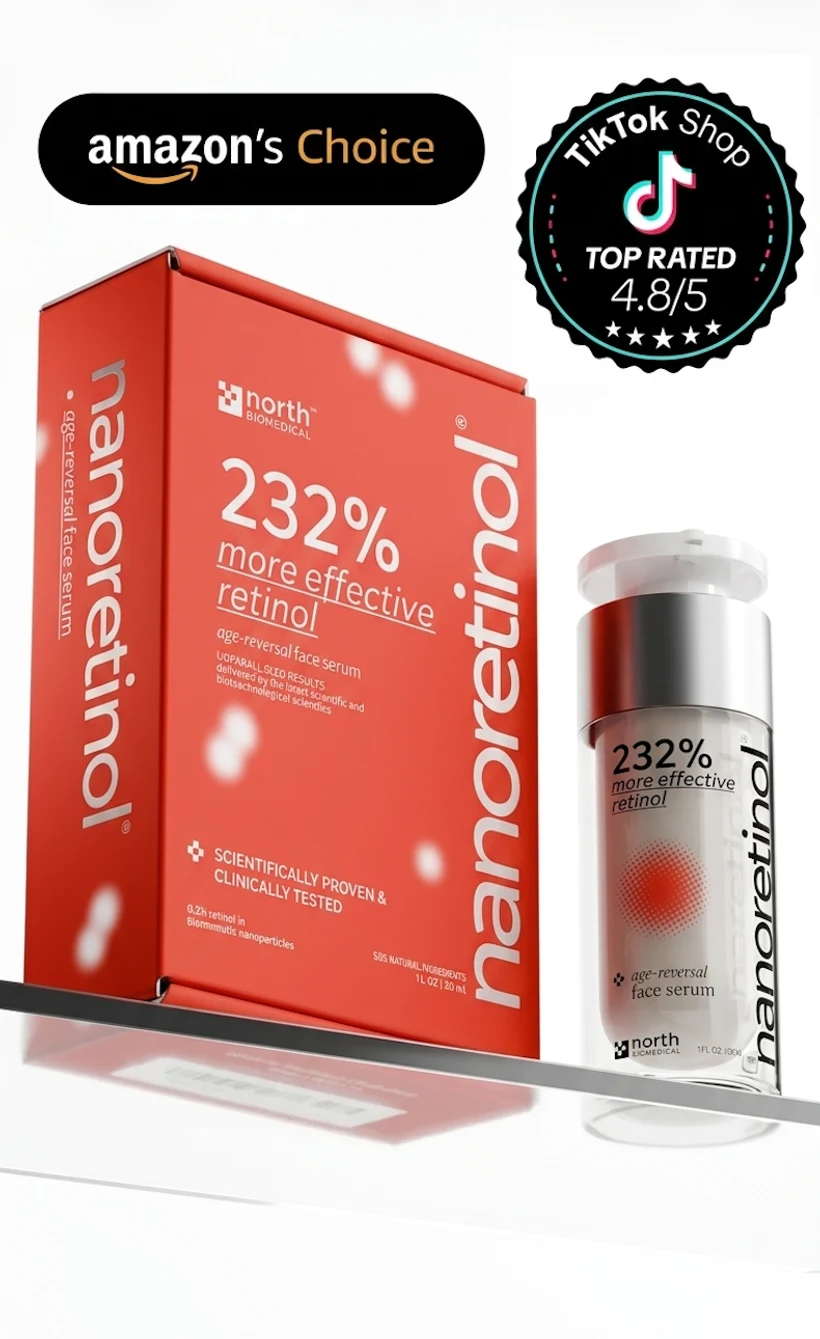
Firmness, elasticity and line depth are matters of collagen and elastin density, and building those back requires a molecule that reaches the dermis and instructs fibroblasts to produce. Retinol is the most validated ingredient for that job. Its long-standing weakness is delivery, since conventional formulations penetrate the epithelial barrier poorly and often rely on chemicals and petroleum derivatives that break the barrier down in order to pass, which is the source of the redness and peeling that make people quit.
Nanoretinol solves the delivery problem rather than the concentration problem. It carries 0.2 percent stabilized retinol inside biomimetic lipid nanoparticles that the body recognizes as its own and permits through the barrier intact. In North Biomedical’s study it proved 232 percent more effective than conventional retinol at collagen recovery and 73 percent more effective at elastin recovery, and clinical results over 56 days showed a 61 percent increase in skin firmness and a 56 percent increase in elasticity, with drastically reduced cytotoxicity.
Enjoy it for what it is
Sit in the sauna. The cardiovascular evidence is strong, the barrier evidence is quietly favorable for regular users, and a flushed face at the end of it is a pleasant thing.
Just do not expect the mirror to hold that face, and do not let the wellness framing convince you that twenty minutes of heat is doing structural work. The glow fades because it was circulation. What stays has to be built.
References
- Laukkanen JA, Laukkanen T, Kunutsor SK. “Cardiovascular and Other Health Benefits of Sauna Bathing: A Review of the Evidence.” Mayo Clinic Proceedings. 2018;93(8):1111-1121. doi:10.1016/j.mayocp.2018.04.008
- Kowatzki D, Macholdt C, Krull K, Schmidt D, Deufel T, Elsner P, Fluhr JW. “Effect of Regular Sauna on Epidermal Barrier Function and Stratum Corneum Water-Holding Capacity in Vivo in Humans: A Controlled Study.” Dermatology. 2008;217(2):173-180. PMID: 18525205
- Dams SD, de Liefde-van Beest M, Nuijs AM, Oomens CW, Baaijens FP. “Heat Shocks Enhance Procollagen Type I and III Expression in Fibroblasts in Ex Vivo Human Skin.” Skin Research and Technology. 2011;17(2):167-180. PMID: 21251083
- Kim MS, Kim YK, Cho KH, Chung JH. “Regulation of Type I Procollagen and MMP-1 Expression After Single or Repeated Exposure to Infrared Radiation in Human Skin.” Mechanisms of Ageing and Development. 2006;127(12):875-882. PMID: 17067654
- Zhang L, Zeng H, Jiang L, Fu C, Zhang Y, Hu Y, Zhang X, Zhu L, Zhang F, Huang J, Chen J, Zeng Q. “Heat Promotes Melanogenesis by Increasing the Paracrine Effects in Keratinocytes via the TRPV3/Ca2+/Hh Signaling Pathway.” iScience. 2023;26(5):106749. doi:10.1016/j.isci.2023.106749
- Steinhoff M, Buddenkotte J, Aubert J, Sulk M, Novak P, Schwab VD, Mess C, Cevikbas F, Rivier M, Carlavan I, Déret S, Rosignoli C, Metze D, Luger TA, Voegel JJ. “Clinical, Cellular, and Molecular Aspects in the Pathophysiology of Rosacea.” Journal of Investigative Dermatology Symposium Proceedings. 2011;15(1):2-11. PMID: 22076321
- Kendall AC, Pilkington SM, Wray JR, Newton VL, Griffiths CEM, Bell M, Watson REB, Nicolaou A. “Menopause Induces Changes to the Stratum Corneum Ceramide Profile, Which Are Prevented by Hormone Replacement Therapy.” Scientific Reports. 2022;12(1):21715. doi:10.1038/s41598-022-26095-0