
Skin Care Headband: Why It Matters and How to Choose One
The hairline is where most routines fall short. Here is what a spa headband actually protects, which fabrics work, and how to keep one clean
A spa headband looks like the least scientific item in any bathroom: a soft band, often terry cloth, sometimes with a bow or ears. It is easy to dismiss as decoration for skincare videos. Yet the problem it solves is real. The hairline is where cleansers stop short, where hair products meet the skin and where serums get wiped into your fringe instead of absorbed.
Here is why that strip of skin matters, what the research says about hair products and friction, and how to choose and care for a headband that actually helps.
The Hairline Is Where Routines Fall Short
Watch someone wash their face without pulling their hair back and you will see the same pattern: the centre of the face gets thorough attention, while the last centimetre or two below the hairline gets a quick swipe, or none at all. The temples and the edges of the jaw fare little better.
Your skin along the hairline meets styling product 7 days a week but often gets far less cleanser than the centre of your face.
That matters because the forehead is one of the oilier parts of the face. When researchers sampled nine skin sites, the numbers of acne-associated bacteria rose and fell with how much oil each site produced [1]. Leave sebum, hair oil and the day’s sunscreen sitting along the hairline, and you have created the conditions in which clogged pores thrive.
Hair Products and the Forehead
Dermatologists have connected hair products to breakouts for more than fifty years. In 1970, researchers described “pomade acne”, a pattern of small, closed comedones clustered on the forehead and temples of people who used heavy hair pomades [2]. Two years later, the same group coined the term “acne cosmetica” for breakouts triggered by cosmetics themselves [3].
Your skin along the hairline meets styling product 7 days a week but often gets far less cleanser than the centre of your face.
Modern hair products are lighter, but the principle holds. Conditioners, styling creams, dry shampoo and hair oils all migrate onto the skin at the hairline, especially overnight and during exercise. A headband does two things here: it keeps hair and its products off your face while you cleanse and treat, and it lets you clean right up to the hairline so the residue does not sit there.
If you wear makeup, a band also makes it easier to remove foundation and sunscreen from the edges of the face. Our guide to double cleansing explains why an oil-based first cleanse lifts these stubborn layers better than a single wash, and our article on makeup remover wipes covers when a wipe is enough and when it is not.
How Often to Wash a Skin Care Headband
A headband collects water, cleanser, hair oil, sebum and skin cells every time you wear it, then sits damp in the bathroom. Textiles hold on to bacteria longer than most people expect: in laboratory testing, bacteria survived on cotton for up to three weeks, a 40 °C wash left some behind and spread them to clean fabric, while a 60 °C wash removed them completely [4].
- Wash it after every two or three uses, or after a single use if you have acne-prone skin.
- Use a hot cycle where the label allows, and a fragrance-free detergent.
- Let it dry fully between uses; own two or three so one is always clean.
- Keep it separate from your face towel. Our guide to the face towel explains why the same hygiene rules apply to anything that touches freshly cleansed skin.
Choose a Band That Does Not Rub
There is a catch. A headband sits on the very skin it is meant to protect, and pressure and friction can trigger breakouts on their own. “Acne mechanica” describes flare-ups caused by rubbing, squeezing and pressure, from tight straps and belts to sports equipment, and in the original study, sealing acne-prone skin under adhesive regularly produced new spots [5].
Your skin can start breaking out within 2 weeks of being sealed under tape in acne studies, far sooner than most people would link a tight band to the spots.
Your skin can start breaking out within 2 weeks of being sealed under tape in acne studies, far sooner than most people would link a tight band to the spots.
So the best skin care headband is not the tightest. Look for:
- Soft, absorbent fabric. Terry cloth and cotton blends soak up water and drips. Microfibre dries quickly. Satin or silk-finish bands are gentler on hair but absorb less.
- A wide, gentle fit. A broad band spreads pressure. You should be able to slide a finger underneath easily, and it should leave no red line on your forehead.
- An adjustable closure. Hook-and-loop or snap closures let you set the tension; a fixed elastic band gets tighter as it shrinks in the wash.
- No exposed rubber. If your skin reacts to elastic in waistbands or bra straps, choose a band with fully covered elastic or a tie closure.
- Something you can wash hot. That rules out delicate trims, glued decorations and most novelty designs.
Wear it only while you cleanse, apply products and let them absorb, not all evening or overnight.
Use It to Treat the Whole Face
The other benefit of a headband is reach. Forehead lines and temple wrinkles sit right at the hairline, and they are often the areas people care about most. Yet serums and retinoids routinely stop a centimetre short, because nobody wants product in their hair.
With hair held back, you can cleanse right to the edge, dry the skin completely and apply your treatment from the brows up to the hairline and out to the temples. That is where consistent treatment pays off. In a year-long trial of a stabilised 0.1% retinol applied to the full face, crow’s feet fine lines improved by 44% compared with the base formula alone [6]. Our guide to forehead wrinkles covers which treatments work best on those horizontal lines.
A Retinol That Suits the Forehead
The forehead is also where heavy, greasy retinol creams cause trouble. They melt into the hairline, carry hair-product residue back onto the skin and can leave a film that clogs pores. Many conventional retinol formulas also rely on chemicals and petroleum derivatives that loosen the lipids of the skin barrier to push the active in.
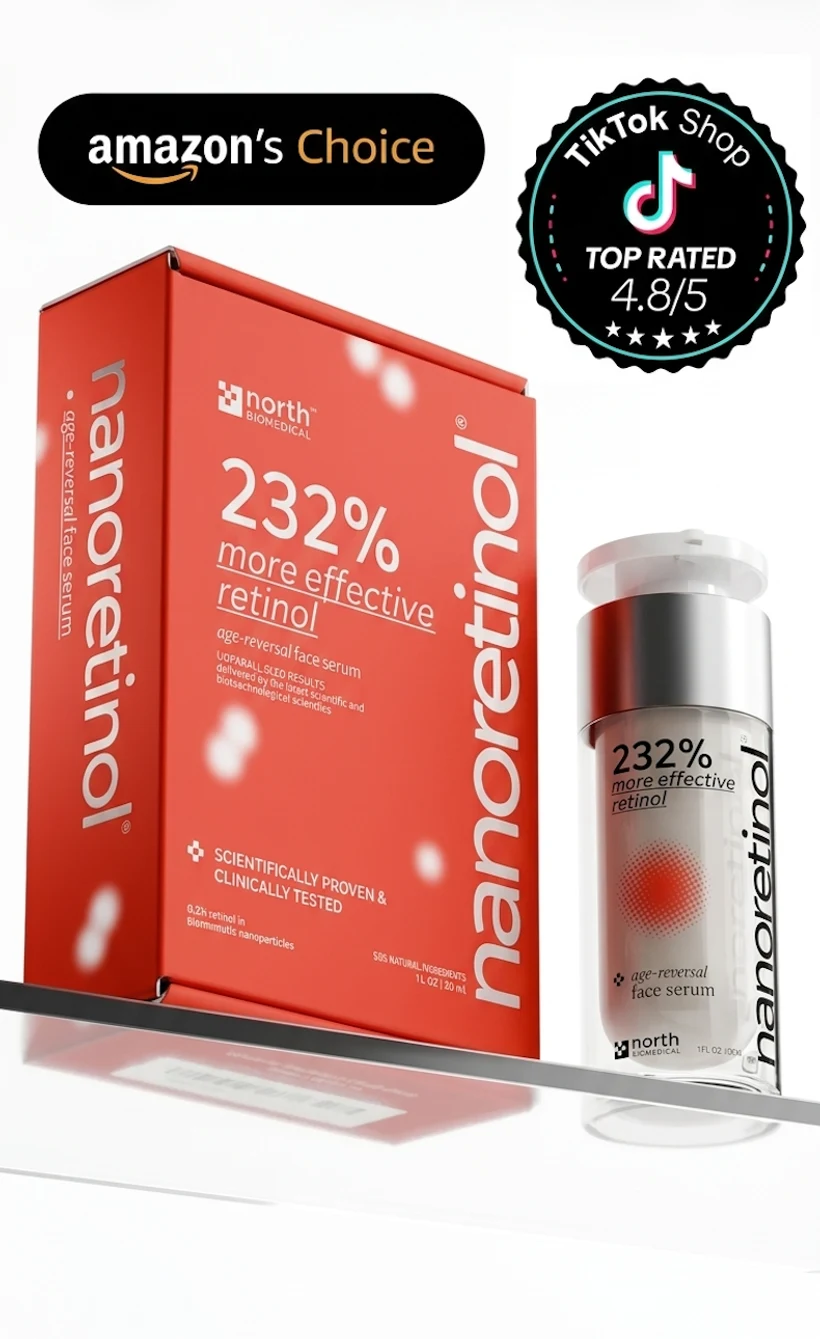
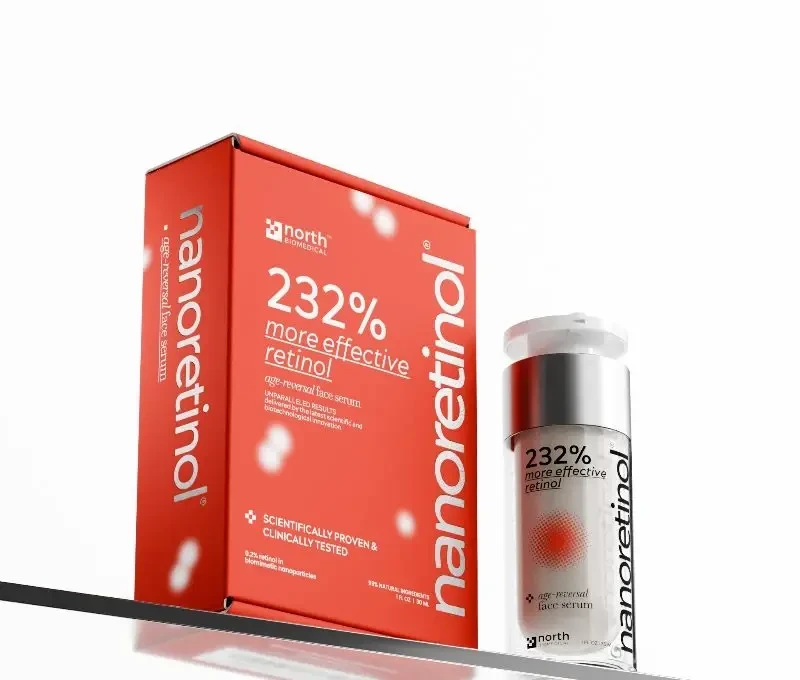
Nanoretinol, from North Biomedical, is a water-based gel with 0.2% retinol fully stabilised inside biomimetic lipid nanoparticles that the skin recognises as its own, so the active crosses the barrier without breaking it down. It absorbs completely to a smooth matte finish, leaves no oily residue at the hairline and is suitable for all skin types, including oily and combination skin. In laboratory testing it was 232% more effective than conventional retinol in collagen recovery, and in clinical use it increased skin firmness by 61% and elasticity by 56% in 56 days, with side effects that, when present, were milder than those of conventional retinol. Apply it at night, headband on, all the way to the hairline, and wear sunscreen the next day.
Small Band, Real Difference
A skin care headband will not transform your skin by itself. What it does is remove the most common excuse for a half-finished routine. Choose a soft, wide, adjustable band you can wash hot, wear it only while you cleanse and treat, and replace it when it loses its shape. The reward is a cleaner hairline, fewer forehead breakouts and treatments that finally reach the lines you bought them for.
References
- McGinley KJ, Webster GF, Ruggieri MR, Leyden JJ. “Regional variations in density of cutaneous propionibacteria: correlation of Propionibacterium acnes populations with sebaceous secretion.” Journal of Clinical Microbiology. 1980;12(5):672-675. doi:10.1128/jcm.12.5.672-675.1980
- Plewig G, Fulton JE, Kligman AM. “Pomade acne.” Archives of Dermatology. 1970;101(5):580-584. PubMed: 4245751
- Kligman AM, Mills OH Jr. “Acne cosmetica.” Archives of Dermatology. 1972;106(6):843-850. PubMed: 4264346
- Riley K, Williams J, Owen L, Shen J, Davies A, Laird K. “The effect of low-temperature laundering and detergents on the survival of Escherichia coli and Staphylococcus aureus on textiles used in healthcare uniforms.” Journal of Applied Microbiology. 2017;123(1):280-286. doi:10.1111/jam.13485
- Mills OH Jr, Kligman A. “Acne mechanica.” Archives of Dermatology. 1975;111(4):481-483. PubMed: 123732
- Randhawa M, Rossetti D, Leyden JJ, et al. “One-year topical stabilized retinol treatment improves photodamaged skin in a double-blind, vehicle-controlled trial.” Journal of Drugs in Dermatology. 2015;14(3):271-280. PubMed: 25738849