
Triethanolamine in Skincare: Why It's There and Is It Safe?
The pH adjuster behind countless gels, creams and cleansers: what it does, where the nitrosamine worry comes from, and what patch-test data really show
Triethanolamine has one of the more alarming names on a skincare label. Many ingredient-checker apps flag it, and online lists link it to cancer, allergies and toxic chemicals. Yet it has been used in creams, gels, cleansers and shaving products for decades, and regulators still allow it.
The real story is more interesting than either the scare or the shrug. This guide explains what triethanolamine does, where the concern comes from, and what the evidence says about using it on your skin.
What Triethanolamine Is
Triethanolamine, often shortened to TEA and sometimes listed as trolamine, is a small organic molecule made from ammonia and ethylene oxide. It belongs to the ethanolamine family, alongside monoethanolamine and diethanolamine. Chemically it is a weak base, the opposite of an acid, and that one property explains almost everything it does in skincare.
Why Formulators Use It
The Cosmetic Ingredient Review describes triethanolamine mainly as a pH adjuster and surfactant [1]. In practice, it has three common jobs.
- Neutralizing gel thickeners. Carbomer, the polymer behind most clear gels, is acidic and stays thin until a base is added. Triethanolamine neutralizes it, and the liquid snaps into a clear gel. This is why it turns up in aloe gels, eye gels and many a gel moisturizer.
- Making mild soaps in creams. Combined with fatty acids such as stearic acid, it forms triethanolamine soaps that act as emulsifiers, holding oil and water together in creams and shaving foams.
- Fine-tuning pH. It nudges acidic formulas toward the range skin tolerates well.
Your skin meets triethanolamine mostly as a quiet pH helper, added in small amounts so that an acidic formula feels gentle instead of stinging.
That pH work matters. Healthy skin sits on the acidic side, and products far from that range can disturb the barrier. Our guide to skin pH explains why that acid mantle is worth protecting.
Your skin meets triethanolamine mostly as a quiet pH helper, added in small amounts so that an acidic formula feels gentle instead of stinging.
What the Safety Reviews Concluded
The Cosmetic Ingredient Review expert panel assessed triethanolamine and 31 related ingredients in 2013. It concluded they are safe as used when formulated to be non-irritating, with one firm condition: they should not be used in products where nitrosamines can form [1]. That condition is the heart of the controversy.
The Nitrosamine Question
Nitrosamines are a family of chemicals, several of which cause cancer in animals. One of them, N-nitrosodiethanolamine, can form when ethanolamines meet nitrosating agents, such as nitrites, which can come from certain preservatives or contaminated raw materials.
Diethanolamine is the main culprit, because it reacts readily. Triethanolamine reacts far less easily, but commercial grades can contain traces of diethanolamine as an impurity. Several lines of evidence help put the risk in proportion.
First, laboratory work shows that conditions matter. A Korean study found that nitrosamine formation from triethanolamine and nitrite rose under strongly acidic conditions, heat and ultraviolet light, and that vitamin E reduced it. The authors recommended cool, dark storage and antioxidants in formulas [2].
Second, real products were tested. When the same research group measured nitrosamines and ethanolamines in cosmetics sold in Korea, levels ranged from undetectable to about 597 micrograms per kilogram. Even at the highest levels found, their risk calculations showed no apparent safety concern, though they advised keeping these compounds as low as technically possible [3].
Third, animal work looked for formation in the body. A study by Dow Chemical scientists applied triethanolamine repeatedly to the skin of mice and found no measurable nitrosamine in their blood, gut contents or urine [4].
Your skin is far more likely to be irritated by triethanolamine than truly allergic to it, and only 0.4% of 85,098 patients reacted in patch tests.
This is why formulators avoid pairing triethanolamine with nitrosating preservatives, and why reputable manufacturers use high-purity grades.
The Mouse Studies
The US National Toxicology Program tested triethanolamine by applying it to the skin of mice five days a week for two years, at doses of up to 2,000 milligrams per kilogram of body weight. Female mice developed more liver adenomas, a usually benign tumor, and the skin at the application site became irritated and inflamed in a dose-related way [5]. An earlier mouse study had been complicated by a bacterial liver infection in the colony, which is why it was repeated.
These doses are enormous compared with the small amounts in a cosmetic, and this strain of mouse is prone to liver tumors. The Cosmetic Ingredient Review panel, which weighed the animal data, still considers triethanolamine safe in cosmetics formulated to be non-irritating [1].
Allergy and Irritation
Your skin is far more likely to be irritated by triethanolamine than truly allergic to it, and only 0.4% of 85,098 patients reacted in patch tests.
That figure comes from the German IVDK contact-allergy network, which patch tested triethanolamine over many years. Just 323 people reacted, and the pattern of many of those reactions looked more like mild irritation than genuine allergy. The researchers found no product type linked to a higher risk and called the sensitization risk very low [6]. Its relatives are a different story: monoethanolamine, a stronger base, is a known allergen in metalworkers exposed to cutting fluids.
True allergy does happen, but it is rare enough to make case reports. One example is a patient in Portugal who developed allergic contact dermatitis from triethanolamine in an ultrasound gel [7].
Should You Avoid It?
- Most people do not need to. In a well-made product, triethanolamine is a minor helper at a low level.
- People with very reactive or damaged skin may notice stinging from high-pH products in general, so a gentle, pH-balanced formula matters more than any single ingredient.
- If you prefer a cautious approach, choose products that use other neutralizers, such as sodium hydroxide or aminomethyl propanol, or that are thickened with natural gums instead. Our guide to non-toxic skincare covers which ingredient concerns are worth acting on and which are not.
What This Means for Retinol Users
Retinol users have more reason than most to care about how a formula treats the barrier. Many conventional retinol formulas rely on chemicals and petroleum derivatives that loosen the skin barrier’s lipids to push retinol through, and that disruption, not the retinol itself, is a large part of why they cause redness, burning and peeling.
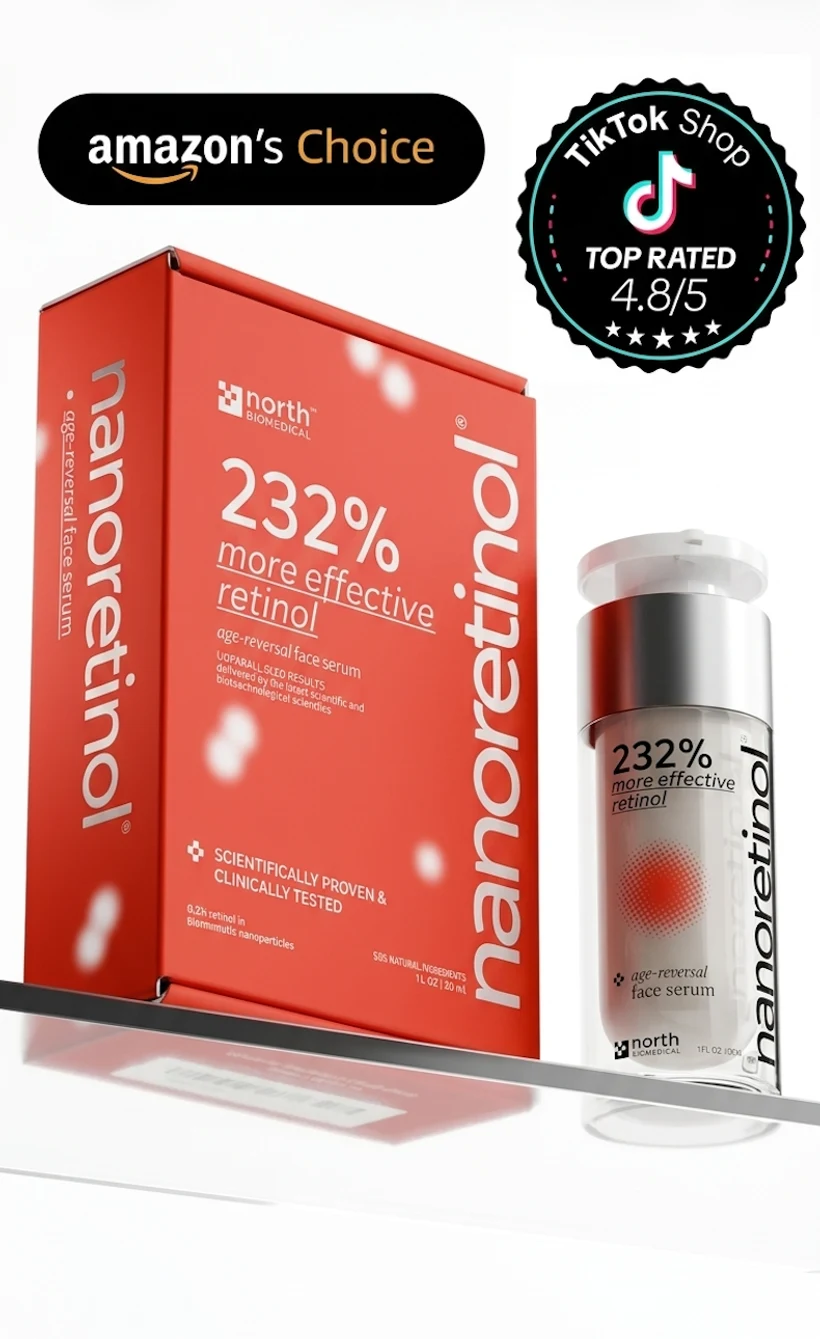
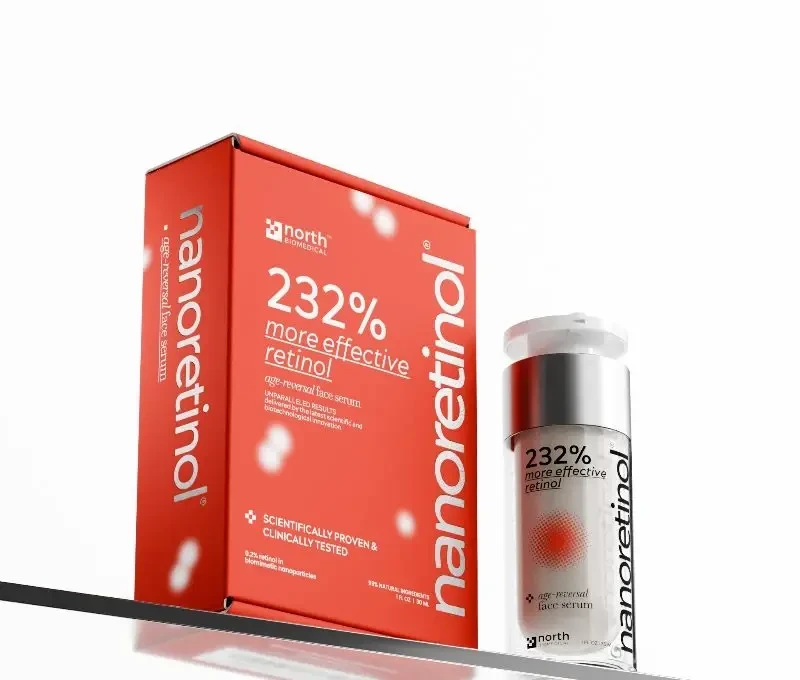
Nanoretinol is a water-based, gel-like formula made with 99% natural ingredients and thickened with xanthan gum and sodium polyacrylate. Its 0.2% retinol sits inside biomimetic lipid nanoparticles that the skin recognizes as its own, so the retinol crosses the barrier without damaging it, and it is suitable for sensitive skin. In North Biomedical’s study, Nanoretinol was 232% more effective in collagen recovery and 73% more effective in elastin recovery than conventional retinol, with a 61% increase in firmness and a 56% increase in elasticity after 56 days of use [8]. It is applied once daily at night, with sunscreen the next morning.
Reading the Label Calmly
Triethanolamine is a pH adjuster with a scary name and a manageable risk profile. The nitrosamine concern is real chemistry, but it is controlled by good formulation, and patch-test data show allergy is uncommon. If your skin is reactive, focus on gentle, pH-balanced products overall rather than hunting for one ingredient to blame.
References
- Fiume MM, Heldreth B, Bergfeld WF, et al. “Safety assessment of triethanolamine and triethanolamine-containing ingredients as used in cosmetics.” International Journal of Toxicology. 2013;32(3 Suppl):59S-83S. doi:10.1177/1091581813488804
- Lim DS, Lim SK, Kim MK, et al. “Formation and inhibition of N-nitrosodiethanolamine in cosmetics under pH, temperature, and fluorescent, ultraviolet, and visual light.” Journal of Toxicology and Environmental Health, Part A. 2018;81(9):241-253. doi:10.1080/15287394.2018.1440172
- Lim DS, Roh TH, Kim MK, et al. “Risk assessment of N-nitrosodiethylamine (NDEA) and N-nitrosodiethanolamine (NDELA) in cosmetics.” Journal of Toxicology and Environmental Health, Part A. 2018;81(12):465-480. doi:10.1080/15287394.2018.1460782
- Saghir SA, Brzak KA, Markham DA, Bartels MJ, Stott WT. “Investigation of the formation of N-nitrosodiethanolamine in B6C3F1 mice following topical administration of triethanolamine.” Regulatory Toxicology and Pharmacology. 2005;43(1):10-18. doi:10.1016/j.yrtph.2005.04.002
- National Toxicology Program. “NTP toxicology and carcinogenesis studies of triethanolamine (CAS No. 102-71-6) in B6C3F1 mice (dermal studies).” National Toxicology Program Technical Report Series. 2004;(518):5-163. PubMed: 15213765
- Lessmann H, Uter W, Schnuch A, Geier J. “Skin sensitizing properties of the ethanolamines mono-, di-, and triethanolamine. Data analysis of a multicentre surveillance network (IVDK) and review of the literature.” Contact Dermatitis. 2009;60(5):243-255. doi:10.1111/j.1600-0536.2009.01506.x
- Almeida FT, Caldas R, Pereira T. “Allergic contact dermatitis caused by triethanolamine in an ultrasound gel.” Contact Dermatitis. 2020;82(1):64-65. doi:10.1111/cod.13391
- North Biomedical LLC. “Nanoretinol vs. Conventional Retinol: Efficacy in Collagen and Elastin Recovery.” Clinical Study Summary, 2024. Study summary