Under Eye Filler: What It Fixes, What It Can't, and How to Decide
A clear-eyed look at hyaluronic acid tear trough filler — the science, the results, the risks, and the part it leaves untouched.
If you have stood in front of a bathroom mirror, pressed a fingertip just below your lash line, and watched a decade lift off your face, you already understand the appeal of under eye filler. That small pool of shadow — the tear trough — is one of the first places the face announces its age, and a syringe of gel seems to erase it in minutes. But the fastest fix is not always the right one, and the area beneath your eyes is the least forgiving real estate on the entire face. Here is what under eye filler actually does, what the evidence says about it, and the part of the problem it quietly leaves behind.
What under eye filler actually is
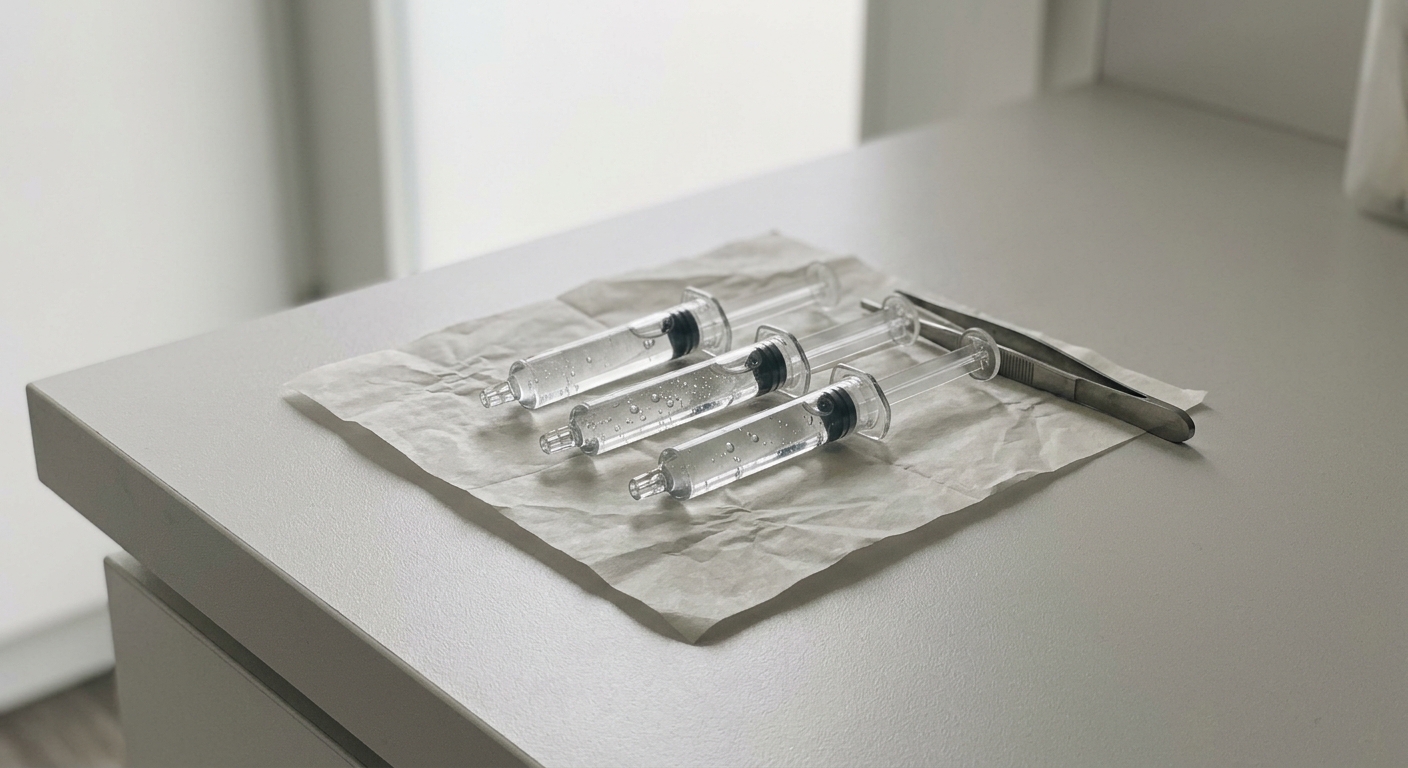
“Under eye filler” almost always means a hyaluronic acid (HA) gel injected into the hollow between the lower eyelid and the cheek. Hyaluronic acid is a sugar molecule your skin already makes; the injectable version is cross-linked so it holds its shape and draws in water, physically propping up the depression that casts that tired shadow. The goal is not to add drama but to erase a groove — to make light fall evenly across the lower lid instead of pooling in a valley.
The tear trough forms for structural reasons. As we age, the fat pads that cushion the eye deflate and descend, the ligament that tethers the lid to the bone becomes more visible, and the overlying skin thins. Filler addresses the first part of that equation — the lost volume — and does it well when placed correctly.
Does it actually work?
The published evidence is genuinely encouraging on satisfaction. A 2024 systematic review and meta-analysis pooling 31 studies and 2,556 patients found an overall satisfaction rate of about 91% for HA correction of the tear trough [1]. A separate multicenter, randomized, evaluator-blinded trial of an HA filler designed for the infraorbital hollow confirmed measurable, blinded-rater improvement in the treated area versus no treatment [2]. When the problem is a true volume deficit and the injector is skilled, filler delivers.
The skin under your eyes is the thinnest on your body — a fraction of a millimeter — and as it loses collagen it becomes crepey, loose, and finely wrinkled.
That last clause matters more here than anywhere else on the face. The under-eye region is a high-risk zone, and the difference between a beautiful result and a visible problem often comes down to how deep and how much.
What it can’t touch
Here is the part most before-and-after photos never explain. Filler restores volume. It does nothing for the quality of the skin sitting on top of that volume. The skin under your eyes is the thinnest on your body — a fraction of a millimeter — and as it loses collagen it becomes crepey, loose, and finely wrinkled. Fill the hollow underneath, and that thin, crinkled surface is still thin and crinkled; sometimes it is simply lit more clearly.
This is why some people leave a filler appointment with the shadow gone but the “tired” look only half-solved. The groove was a volume problem. The crepiness is a skin problem, and no amount of gel underneath rebuilds the collagen that makes skin look firm and smooth. If your main concern is texture rather than a deep hollow, it is worth reading about crepey eyelids and under-eye wrinkles before you book anything.
The risks are real — and specific to this area
Under-eye skin is thin enough that filler placed too superficially can show through as a bluish-gray tint, a phenomenon called the Tyndall effect. Because HA attracts water, over-correction can also read as puffiness rather than youth, and product placed in the wrong plane can migrate or linger for far longer than the “6 to 12 months” marketing suggests. A review of periocular filler complications catalogs the full range — from these cosmetic issues to rare but serious vascular events — and stresses that prevention comes down to conservative dosing, correct depth, and an injector who knows the anatomy of the vessels around the eye [3]. This is not a place to shop on price. If you also carry genuine tear trough hollows or puffy eye bags, a proper in-person assessment matters even more, because the wrong candidate can be made to look worse.
If you also carry genuine tear trough hollows or puffy eye bags, a proper in-person assessment matters even more, because the wrong candidate can be made to look worse.
Why the skin itself keeps aging
The reason the under-eye area gives away age in the first place is collagen. In a classic study measuring skin across the adult lifespan, researchers found that skin collagen declines by roughly 1% per year throughout adult life [4]. On skin already this thin, that steady loss shows up early and obviously. Filler pauses the shadow; it does not touch the underlying decline. The moment volume dips again, the skin has quietly lost even more of its scaffolding.
That is the case for treating skin quality directly, whether or not you ever choose filler. The two work on different problems: one adds structure beneath the skin, the other rebuilds the skin.
The at-home lane: rebuilding what filler ignores
The most studied ingredient for actually rebuilding collagen in the skin is a retinoid. In a controlled study of naturally aged skin, topical retinol produced measurable increases in collagen and visible improvement in fine wrinkling — not by inflating the area, but by prompting the skin to make more of its own structural protein [5]. That is precisely the lever filler cannot pull. For the eye area specifically, it is worth understanding how to use retinol around the eyes safely, because potency without tolerability tends to end in irritation on such delicate skin.
The catch with conventional retinol is delivery. Traditional formulas struggle to cross the skin barrier without damaging it, which is exactly why so many people find them too harsh for the under-eye zone. This is the problem North Biomedical set out to solve with Nanoretinol, a 0.2% retinol wrapped in biomimetic lipid nanoparticles that the skin recognizes as “self” and lets pass without breaking down the barrier. Because delivery — not raw concentration — is what limits results, that low percentage does more work where it counts: in North Biomedical’s clinical testing, Nanoretinol showed 232% greater collagen recovery than conventional retinol while proving significantly gentler on skin cells. Its light, water-based formula is designed to be tolerable enough for the delicate eye-contour area, applied at night as directed.
None of this is an argument against filler. It is an argument for understanding what you are actually buying. Filler is a volume tool. If your hollow is deep and your skin is otherwise firm, it can be an excellent one. But if what bothers you is the thin, crepey, crinkled texture that makes eyes look older, no syringe fixes that — the skin has to be rebuilt from within.
Deciding for yourself
Ask what you are really trying to correct. If it is a shadow cast by lost volume, filler from a skilled injector is a reasonable option, provided you accept the risks unique to this area. If it is texture, crepiness, and fine lines, your time and money are better spent rebuilding collagen with a well-delivered retinoid and diligent sun protection. Most people, honestly, are looking at some of both — and the smartest plan usually starts with the skin, not the syringe. Imaging also shows under-eye filler persisting far longer than most patients are told, which how long filler lasts covers in detail.
References
- Liu X, Gao Y, Ma J, Li J. “The Efficacy and Safety of Hyaluronic Acid Injection in Tear Trough Deformity: A Systematic Review and Meta-analysis.” Aesthetic Plastic Surgery. 2024;48(3):478-490. doi:10.1007/s00266-023-03613-7
- Biesman BS, Green JB, George R, et al. “A Multicenter, Randomized, Evaluator-Blinded Study to Examine the Safety and Effectiveness of Hyaluronic Acid Filler in the Correction of Infraorbital Hollows.” Aesthetic Surgery Journal. 2024;44(9):1001-1013. doi:10.1093/asj/sjae073
- Zein M, Tie-Shue R, Pirakitikulr N, Lee WW. “Complications after cosmetic periocular filler: prevention and management.” Plastic and Aesthetic Research. 2020;7:44. doi:10.20517/2347-9264.2020.133
- Shuster S, Black MM, McVitie E. “The influence of age and sex on skin thickness, skin collagen and density.” British Journal of Dermatology. 1975;93(6):639-643. doi:10.1111/j.1365-2133.1975.tb05113.x
- Kafi R, Kwak HS, Schumacher WE, et al. “Improvement of naturally aged skin with vitamin A (retinol).” Archives of Dermatology. 2007;143(5):606-612. doi:10.1001/archderm.143.5.606