Vitamin C Cleanser: Does a Vitamin C Face Wash Actually Brighten Skin?
Vitamin C is one of the best-studied brightening antioxidants, but a face wash gives it about a minute. Here is what a vitamin C cleanser can realistically do and how to build a routine that works
Vitamin C has earned its place in skincare. As a topical antioxidant, it helps protect skin against sun-driven damage, supports collagen production and reduces melanin formation, which is why it shows up in so many brightening products [1]. So it makes sense that a vitamin C cleanser sounds like an easy upgrade: wash your face, get your vitamin C, done.
The catch is that vitamin C is one of the hardest ingredients in skincare to deliver. It breaks down quickly, it only penetrates under specific conditions, and a face wash gives it far less time than the products it was tested in. Here is what that means for your skin, and when a vitamin C face wash is still a sensible buy.
Why vitamin C is hard to get into the skin
The pure form, L-ascorbic acid, is water-soluble and unstable. Exposed to air, light and water, it oxidizes and turns yellow, then brown, and loses its activity [2, 3]. Your skin also does not let it in easily. In the key absorption studies, run on pig skin, which is a close model of human skin, L-ascorbic acid only entered the skin when the formula was more acidic than pH 3.5, and absorption peaked at a 20% concentration [4].
Even under ideal conditions, it took repeated contact. Skin levels saturated after three daily applications of a leave-on solution, and once applications stopped, they fell by half in about four days [4]. Even in ideal lab conditions, vitamin C needed 3 days of leave-on contact to fill the skin’s reservoir, far longer than the 60 seconds a cleanser sits on your face.
What a 60-second rinse actually delivers
A cleanser is designed to lift oil, sunscreen and debris off the skin and then leave with the water. Most of whatever it contains goes down the drain with it. Cleansers can deposit some ingredients during washing, mainly humectants, lipids and occlusives that help skin feel comfortable afterward [5], but a meaningful antioxidant reservoir is a different job.
Even in ideal lab conditions, vitamin C needed 3 days of leave-on contact to fill the skin’s reservoir, far longer than the 60 seconds a cleanser sits on your face.
The pH problem makes this harder. A wash acidic enough to push L-ascorbic acid into the skin would sting and strip, so vitamin C cleansers are almost always formulated close to the skin’s natural pH. That is kinder to the barrier, since high-pH cleansers swell the outer layer and disturb its lipids [5], but it also means the vitamin C in the bottle is rarely the form or the pH that was used in the absorption research.
Your cleanser’s vitamin C was probably never designed to reach deep into your skin, and a 1-minute wash gives it far less contact than the leave-on products behind the research.
Which forms of vitamin C appear in cleansers
Check the ingredient list, because “vitamin C” on the front can mean very different things:
- Sodium ascorbyl phosphate (SAP). A stable derivative that converts to vitamin C in the skin. It has the most relevant data for cleansing-adjacent concerns: in lab tests it was strongly antibacterial against acne bacteria, and in an open 12-week study of 60 people, a 5% SAP lotion was rated excellent or good in 76.9% of cases [6]. That was a leave-on lotion, but SAP is a reasonable ingredient to see in a wash for oily, breakout-prone skin.
- Ascorbyl glucoside and other stable derivatives. Derivatives were developed to solve vitamin C’s stability problem [3], but they must be converted to active vitamin C in the skin, and there is little published evidence for them in rinse-off products.
- Magnesium ascorbyl phosphate and ascorbyl palmitate. In the absorption studies, neither raised skin levels of active vitamin C [4].
- Orange, lemon or kakadu plum extract. These contribute small, variable amounts of vitamin C plus fragrance compounds that can irritate sensitive skin.
- L-ascorbic acid. Rare in cleansers because it degrades quickly in a watery, near-neutral formula.
When a vitamin C cleanser still makes sense
None of this makes a vitamin C face wash a bad product. It makes it a cleanser first. Choose one if:
Your skin only gets the brightening benefit when vitamin C stays on it for hours rather than being rinsed off after 1 minute.
- Gentle mornings: you want a pleasant, mild morning wash and like the fresh feel of a brightening formula.
- Oily or breakout-prone skin: the formula uses sodium ascorbyl phosphate in a mild base.
- Serum users: you already use a vitamin C serum and want a matching routine, as long as you do not expect the wash to do the serum’s work.
Skip it, or choose carefully, if your skin is sensitive to fragrance or citrus extracts, or if the cleanser is the only place vitamin C appears in your routine and brightening is your goal.
What to look for on the label
- A mild surfactant base. Words like “gentle”, “low-foam” or “cream cleanser”, and a pH close to 5 to 6, protect the barrier [5].
- A stable form. Sodium ascorbyl phosphate or ascorbyl glucoside, rather than fruit extracts alone.
- Opaque, air-restrictive packaging. A tube or pump protects any vitamin C from light and air better than an open jar [3].
- No added fragrance if your skin flushes or stings easily.
- No exfoliating acid stacked on top if you already use one elsewhere. If exfoliation is what you are after, our guide to glycolic acid cleansers explains how acid washes compare.
Where vitamin C should actually go in your routine
Your skin only gets the brightening benefit when vitamin C stays on it for hours rather than being rinsed off after 1 minute. A well-formulated morning serum, applied after cleansing and under sunscreen, is the format behind the clinical research, and our roundup of the best vitamin C serums covers what concentration and pH to look for. Dullness is often a texture and turnover problem as well as a pigment problem, which our guide to dull skin unpacks in more detail.
A simple, evidence-based routine looks like this:
- Morning: gentle cleanser (vitamin C optional), leave-on vitamin C serum, moisturizer, broad-spectrum SPF 30 or higher.
- Evening: gentle cleanser, then a retinoid.
The evening half of a brightening routine
Vitamin C defends and brightens by day; retinol renews skin and rebuilds collagen by night. In one comparative study, four weeks of retinol increased epidermal thickness and boosted procollagen production, and 12 weeks of a retinol formulation significantly reduced facial wrinkles [7]. Our comparison of vitamin C vs retinol explains how the two divide the work between morning and evening.
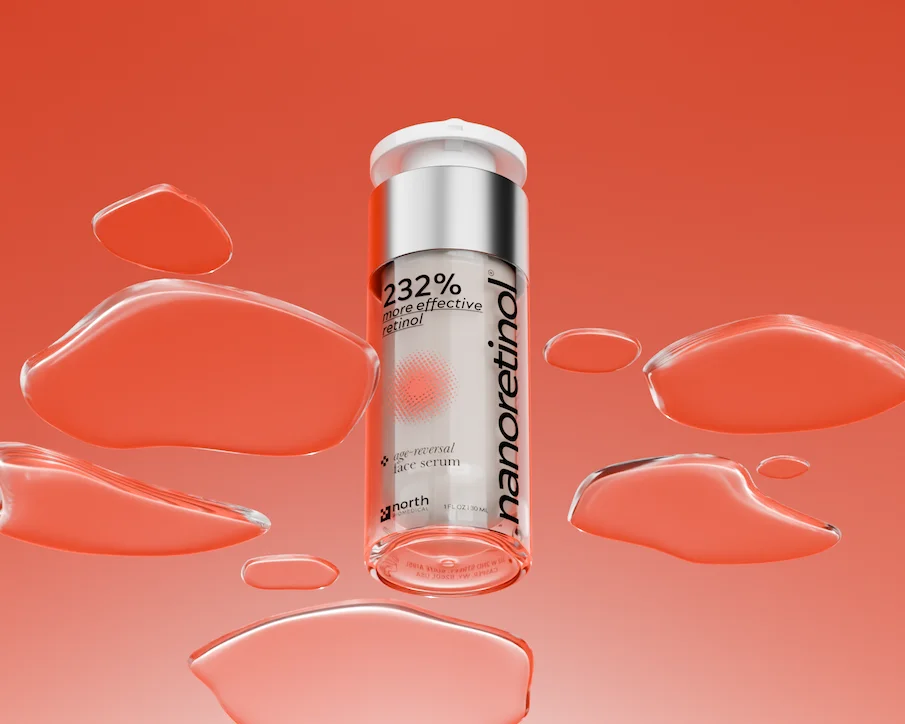
Retinol’s drawback is irritation: redness, peeling and burning that push many people to give up. Nanoretinol was developed to remove that trade-off. It delivers 0.2% stabilized retinol in biomimetic lipid nanoparticles that the skin recognizes as its own, so the retinol reaches skin cells without breaking down the epithelial barrier. In North Biomedical’s study summary, Nanoretinol was 232% more effective in collagen recovery and 73% more effective in elastin recovery than conventional retinol, with minimal and milder side effects [8].
Wash with whatever cleanser your skin likes, keep the vitamin C on your skin in the morning, and let a gentle retinol handle the night shift.
References
- Al-Niaimi F, Chiang NYZ. “Topical Vitamin C and the Skin: Mechanisms of Action and Clinical Applications.” Journal of Clinical and Aesthetic Dermatology. 2017;10(7):14-17. PubMed:29104718
- Telang PS. “Vitamin C in dermatology.” Indian Dermatology Online Journal. 2013;4(2):143-146. doi:10.4103/2229-5178.110593
- Stamford NP. “Stability, transdermal penetration, and cutaneous effects of ascorbic acid and its derivatives.” Journal of Cosmetic Dermatology. 2012;11(4):310-317. doi:10.1111/jocd.12006
- Pinnell SR, Yang H, Omar M, et al. “Topical L-ascorbic acid: percutaneous absorption studies.” Dermatologic Surgery. 2001;27(2):137-142. doi:10.1046/j.1524-4725.2001.00264.x
- Ananthapadmanabhan KP, Moore DJ, Subramanyan K, Misra M, Meyer F. “Cleansing without compromise: the impact of cleansers on the skin barrier and the technology of mild cleansing.” Dermatologic Therapy. 2004;17(Suppl 1):16-25. doi:10.1111/j.1396-0296.2004.04s1002.x
- Klock J, Ikeno H, Ohmori K, et al. “Sodium ascorbyl phosphate shows in vitro and in vivo efficacy in the prevention and treatment of acne vulgaris.” International Journal of Cosmetic Science. 2005;27(3):171-176. doi:10.1111/j.1467-2494.2005.00263.x
- Kong R, Cui Y, Fisher GJ, et al. “A comparative study of the effects of retinol and retinoic acid on histological, molecular, and clinical properties of human skin.” Journal of Cosmetic Dermatology. 2016;15(1):49-57. doi:10.1111/jocd.12193
- North Biomedical LLC. “Nanoretinol vs. Conventional Retinol: Efficacy in Collagen and Elastin Recovery.” Clinical Study Summary, 2024. Study summary