Almond Oil for Skin: What an Oleic-Rich Oil Can and Can't Do
The bottle in your bathroom is mostly oleic acid — and that one fact explains both why it feels so good and why it behaves badly on some skin
Walk into almost any pharmacy and you will find sweet almond oil on a low shelf, usually near the baby aisle, usually costing less than a sandwich. It has been rubbed into skin for centuries. It absorbs faster than olive oil, smells faintly of marzipan, and leaves a finish most people describe as soft rather than greasy.
What the bottle never tells you is which skin it suits — because almond oil is not a neutral moisturizer. It has a distinct chemical signature that makes it genuinely useful for some people and quietly counterproductive for others.
Two Very Different Oils Share the Name
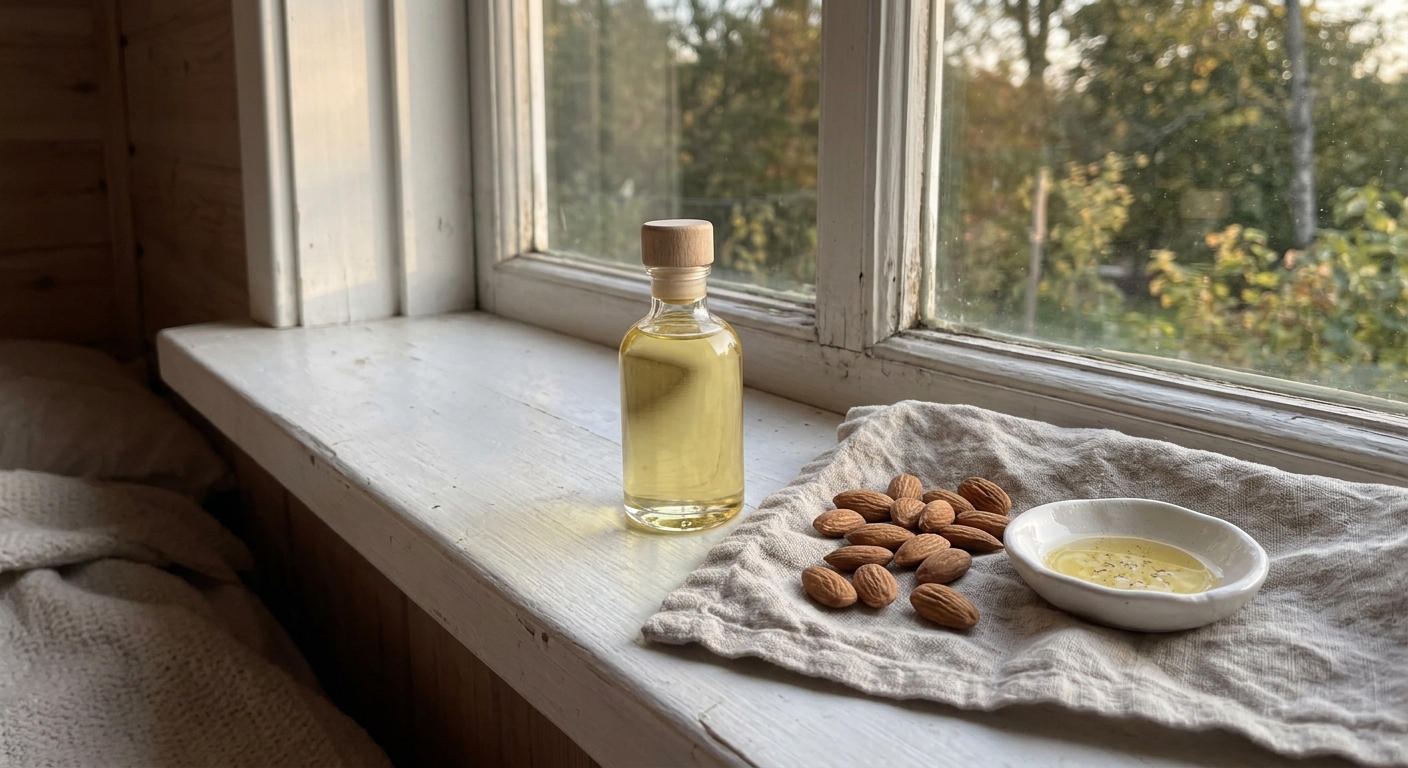
The oil sold for skincare is sweet almond oil, cold-pressed from the kernels of Prunus amygdalus var. dulcis. It is a fixed oil: heavy, non-volatile, made of triglycerides, and safe to apply undiluted.
Bitter almond oil is an entirely different product. It comes from Prunus amygdalus var. amara, it is a volatile essential oil, and in unrefined form it yields benzaldehyde and hydrogen cyanide from the amygdalin the kernel contains [1]. It has to be industrially processed before it is safe for any topical use, and it should never be treated as interchangeable with the carrier oil.
Reviews of almond oil’s traditional and clinical uses describe emollient, anti-inflammatory, and mild occlusive effects, alongside a long history in massage and post-partum skincare [1]. Those are real properties. They are also modest ones, and the reason comes down to a single number.
The Fatty Acid Ratio That Decides Everything
Sweet almond oil is roughly 60–78% oleic acid and 15–30% linoleic acid, with a small palmitic fraction and a useful load of alpha-tocopherol (vitamin E). That makes it firmly oleic-dominant — chemically closer to olive oil than to the lighter, linoleic-rich oils such as sunflower, grapeseed, or safflower.
What the bottle never tells you is which skin it suits — because almond oil is not a neutral moisturizer.
This matters more than any marketing claim on the label, because oleic and linoleic acid do opposite things to the mortar between your skin cells. Linoleic acid is a building block your skin uses to make ceramides and maintain the lipid lamellae that keep water in. Oleic acid, in contrast, is a known penetration enhancer: it disorders those lipid layers to let things through.
The clearest demonstration is a controlled human study that applied olive oil to one forearm and sunflower seed oil to the other in adult volunteers for four weeks. The oleic-rich olive oil significantly reduced stratum corneum integrity and produced mild erythema; the linoleic-rich sunflower oil preserved barrier function and improved hydration [2]. Broader reviews of plant oils in dermatology reach the same conclusion: linoleic-rich oils tend to support the skin barrier, while oleic-rich oils can degrade it, particularly on skin that is already compromised [3][4].
Almond oil sits on the oleic side of that line. Not as extreme as olive oil, but on the same side.
What the Evidence Actually Supports
The honest summary is that almond oil has a small evidence base, and most of it addresses comfort rather than structural change.
Photoaging. In hairless mice, pre-treatment with almond oil before UVB exposure reduced measured wrinkle formation and histological damage compared with untreated controls [5]. That is a real result and a reasonable signal that the oil’s tocopherol content offers some antioxidant buffering — but it is a rodent model with pre-treatment before a controlled UV dose, which is not how anyone uses oil in daily life. It is not evidence that almond oil reverses sun damage on human skin.
Stretch marks. A randomized trial in nulliparous women compared sweet almond oil, aloe vera gel, and a control group for striae gravidarum. The almond oil group, which received the oil with massage, developed fewer stretch marks than controls [6]. The confound is unavoidable and the authors are clear about it: massage is itself an intervention, and the study cannot separate the oil from the fifteen minutes of mechanical stimulation applied with it.
The almond oil group, which received the oil with massage, developed fewer stretch marks than controls.
Comfort and inflammation. This is where almond oil is on firmest ground. Like other emollient plant oils, it fills the gaps between corneocytes, slows water loss, and reduces the itch and tightness of dry skin, with mild anti-inflammatory activity attributed to its unsaponifiable fraction [3][4].
Who It Suits, and Who Should Skip It
Almond oil is a sensible choice for dry, non-reactive skin, for body use, for cuticles and elbows, and as a slip medium for massage. It is inexpensive, stable enough when stored away from light, and pleasant to use.
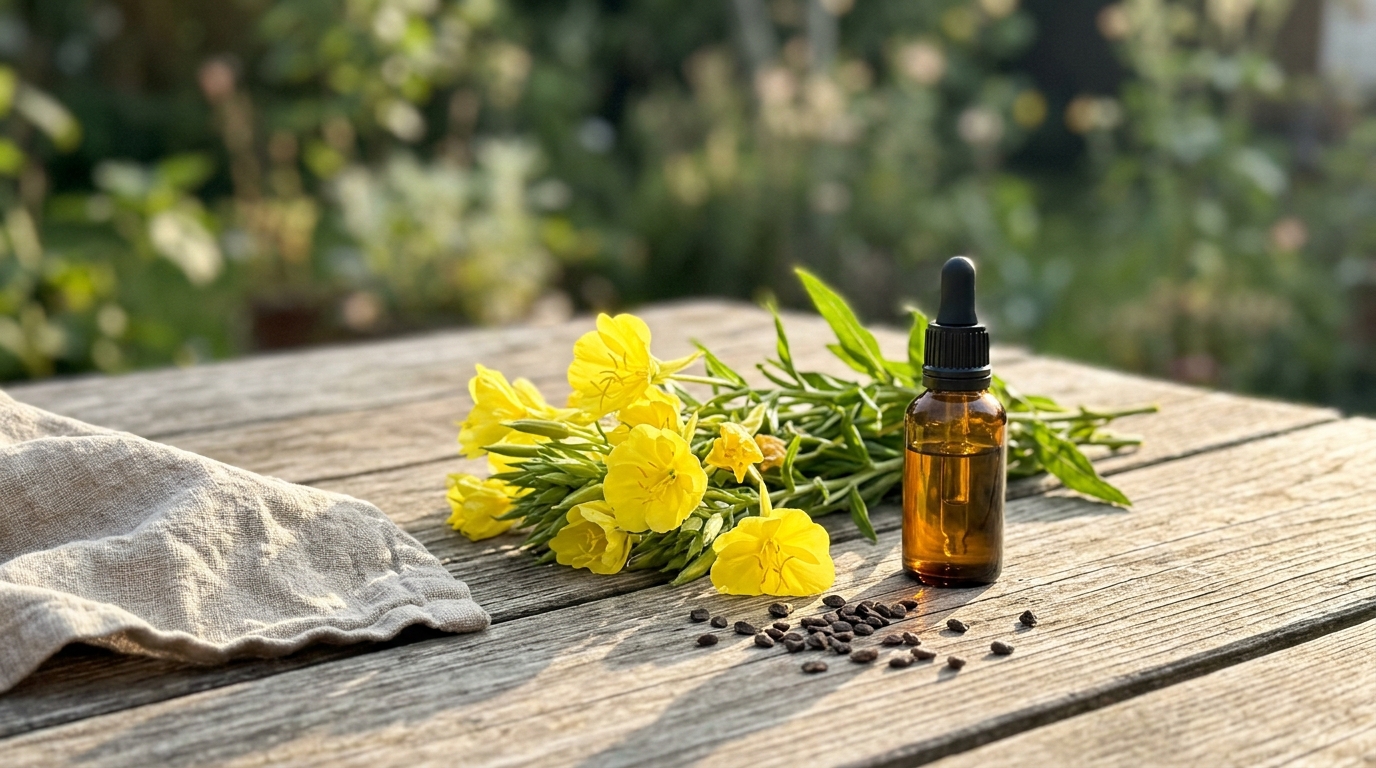
It is a poor choice if your barrier is already impaired — active eczema, over-exfoliated skin, retinoid-irritated skin, or the tight, stinging kind of dryness that flares in winter. In that state, an oleic-rich oil is more likely to add to the problem than to solve it. A linoleic-rich oil or a structurally inert one like jojoba is the safer pick. Evening primrose oil is another option in that category, and the rare one that also supplies gamma-linolenic acid directly.
On the face, oleic-rich oils also sit heavily on skin prone to congestion. If your pores clog easily, almond oil is not the oil to experiment with. And the obvious caution: anyone with a tree nut allergy should avoid it entirely, including in massage settings where the product may not be listed.
The Ceiling Every Oil Runs Into
Here is the structural limit. Fine lines, laxity, and crepey texture are not caused by a shortage of oil on the surface. They are caused by the loss of collagen and elastin in the dermis, several hundred microns below where any triglyceride is doing its work. An emollient improves how light reflects off the surface and how the skin feels — which is why oil makes skin look temporarily better — but it sends no signal to the fibroblasts that build new matrix.
Retinoids do send that signal. In a controlled comparison of topical retinol and retinoic acid on human skin, both increased epidermal thickness and the molecular markers of dermal remodeling, with retinol producing comparable histological changes and better tolerability [7]. That is a different category of effect from an emollient, and it is why almost every serious anti-aging routine ends up built around a retinoid rather than an oil.
The catch is that conventional retinol has always struggled with the same barrier that oleic acid pries open by brute force — most of the dose never reaches the cells that matter, and the formulations that push it through tend to irritate.
Nanoretinol takes the opposite approach. It encapsulates 0.2% retinol in biomimetic lipid nanoparticles that the skin reads as “self” and admits through the epithelial barrier without damaging it. In North Biomedical’s clinical study, that delivery route produced 232% greater collagen recovery and 73% greater elastin recovery than conventional retinol, with markedly lower cytotoxicity. The water-based gel absorbs to a matte finish, so it layers under an oil rather than competing with it.
Using It Well
Treat almond oil as what it is: a comfortable, affordable emollient with a specific chemistry. Use it on dry body skin, on hands, and after bathing while skin is still damp. Patch test before facial use. Keep it away from a barrier that is already struggling, and don’t ask it to do the work of an active.
The most useful routine puts each ingredient where its physics apply — an active that reaches the dermis, and an emollient that seals the surface it leaves behind.
References
- Ahmad Z. “The uses and properties of almond oil.” Complementary Therapies in Clinical Practice. 2010;16(1):10-12. doi:10.1016/j.ctcp.2009.06.015
- Danby SG, AlEnezi T, Sultan A, Lavender T, Chittock J, Brown K, et al. “Effect of olive and sunflower seed oil on the adult skin barrier: implications for neonatal skin care.” Pediatric Dermatology. 2013;30(1):42-50. doi:10.1111/j.1525-1470.2012.01865.x
- Vaughn AR, Clark AK, Sivamani RK, Shi VY. “Natural Oils for Skin-Barrier Repair: Ancient Compounds Now Backed by Modern Science.” American Journal of Clinical Dermatology. 2018;19(1):103-117. doi:10.1007/s40257-017-0301-1
- Lin TK, Zhong L, Santiago JL. “Anti-Inflammatory and Skin Barrier Repair Effects of Topical Application of Some Plant Oils.” International Journal of Molecular Sciences. 2017;19(1):70. doi:10.3390/ijms19010070
- Sultana Y, Kohli K, Athar M, Khar RK, Aqil M. “Effect of pre-treatment of almond oil on ultraviolet B-induced cutaneous photoaging in mice.” Journal of Cosmetic Dermatology. 2007;6(1):14-19. doi:10.1111/j.1473-2165.2007.00293.x
- Hajhashemi M, Rafieian M, Rouhi Boroujeni HA, Miraj S, Memarian S, Keivani A, et al. “The effect of Aloe vera gel and sweet almond oil on striae gravidarum in nulliparous women.” The Journal of Maternal-Fetal & Neonatal Medicine. 2018;31(13):1703-1708. doi:10.1080/14767058.2017.1325865
- Kong R, Cui Y, Fisher GJ, Wang X, Chen Y, Schneider LM, et al. “A comparative study of the effects of retinol and retinoic acid on histological, molecular, and clinical properties of human skin.” Journal of Cosmetic Dermatology. 2016;15(1):49-57. doi:10.1111/jocd.12193