Avocado Oil for Skin: What the Fatty Acids Actually Do
The kitchen oil has real emollient credentials, one significant limitation, and a ratio problem nobody mentions
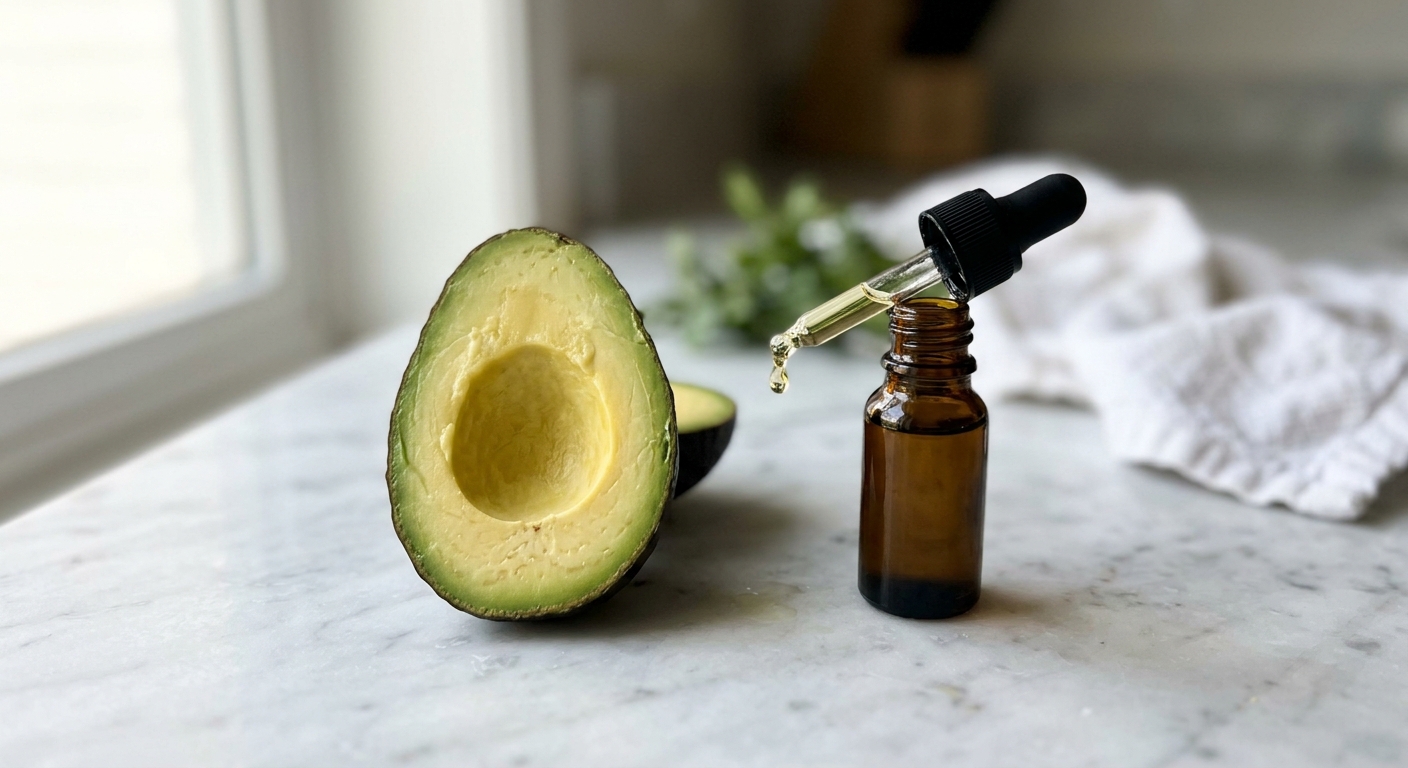
Avocado oil reached bathroom shelves the way olive oil and coconut oil did before it, by way of the kitchen. It is green, it is expensive, it smells faintly of the fruit, and it feels genuinely luxurious on dry skin. Somewhere inside that sensory experience a belief forms: something this rich must be repairing something underneath.
Part of that belief is correct. Avocado oil is one of the better emollients you can put on a dry, tight, winter-worn face. But the same chemistry that makes it feel so cushioning is the chemistry that limits it, and for a specific group of people it works against them. The whole story comes down to two fatty acids and the ratio between them.
What Avocado Oil Is Actually Made Of
Cold-pressed avocado oil is dominated by oleic acid, a monounsaturated fat. A 2025 review of compositional data across cultivars and extraction methods reports oleic acid ranging from 42.0% to 75.0% of total fatty acids, with linoleic acid trailing at 7.8% to 19.0% [1]. A directly measured commercial sample came in at 54.33% oleic and 11.54% linoleic [2]. Whichever bottle you buy, you are buying an oleic oil.
That distinction matters more than the marketing suggests. Linoleic acid is an essential fatty acid your body cannot synthesize, and it is a structural component of the specialized ceramides that hold the outermost skin layer together. Oleic acid is not structural. It is larger, kinked, and fluid at skin temperature, and it inserts itself between the tightly packed lipids of the stratum corneum rather than joining them.
The Oleic Acid Problem
The most rigorous human evidence here does not use avocado oil. It uses olive oil, which sits at a comparable oleic fraction, and the result is worth knowing before you decant anything into a dropper bottle.
In two randomised forearm-controlled trials, adults applied olive oil twice daily for four to five weeks. Barrier integrity in the treated area fell significantly, and the skin developed mild erythema. Sunflower seed oil, which is linoleic-dominant, did the opposite over the identical period: it preserved barrier integrity and improved hydration. The authors concluded that topical olive oil damages the skin barrier and discouraged its use on dry skin [3].
A directly measured commercial sample came in at 54.33% oleic and 11.54% linoleic.
Avocado oil was not the oil tested, so the honest reading is mechanistic rather than direct. The fatty acid responsible for the effect is the fatty acid avocado oil is built from. If your barrier is already compromised, a heavily oleic oil is not the obvious repair tool, and a damaged skin barrier needs lipids that match what it has lost rather than lipids that dissolve into the gaps.
What It Is Genuinely Good At
None of that makes avocado oil a bad product. It makes it a specific one.
As an occlusive emollient it performs beautifully. It slows water loss, it softens roughened skin immediately, and it carries a meaningful natural antioxidant load: alpha-tocopherol, the most biologically active form of vitamin E, measures roughly 79 to 190 mg per kilogram in avocado oil [2]. That tocopherol content is part of why the oil resists rancidity well compared with more delicate seed oils.
On hands, cuticles, elbows, shins, and dry patches that are not acne-prone, it is a legitimately excellent choice, and it layers well as a final step over a water-based serum. Readers comparing options across the category will find it sits in the richer, heavier half of the face oils worth using on aging skin, closer to olive than to the light, dry-touch feel of squalane.
The Wound-Healing Evidence, Read Honestly
Avocado oil does have collagen data attached to it, and it is routinely oversold. In a controlled rat study, a semisolid 50% avocado oil formulation produced 100% wound contraction by day 14 against 91.63% for a petroleum jelly control. Collagen density in the healing tissue reached 41.89% versus 34.08% in controls, and tensile strength measured 1.68 g/mm² against 1.17 g/mm² [4].
Collagen density in the healing tissue reached 41.89% versus 34.08% in controls, and tensile strength measured 1.68 g/mm² against 1.17 g/mm².
Those are real numbers from a real experiment. They are also rat numbers, from open wounds, over fourteen days. Wound repair and the slow remodelling of chronologically aged dermis are different biological programmes. No human trial has shown avocado oil thickening the dermis of an intact adult face, and claiming otherwise means borrowing credibility from rodents.
Who Should Skip It
Oleic acid has an uncomfortable history in comedogenicity testing. In the classic rabbit-ear assay, both oleic acid and its peroxidised derivatives produced substantial comedones, with follicular hyperkeratosis and sebaceous proliferation at treated sites, and the effect scaled with the degree of lipid peroxidation [5].
Two practical conclusions follow. If you are acne-prone or congestion-prone, a heavily oleic oil is a poor bet for facial use. And because oxidation state amplifies the problem, any bottle you do use belongs somewhere cool and dark, tightly capped, replaced rather than nursed once it smells sharp.
The Limit Worth Understanding
Here is the sentence that explains why an oil, any oil, hits a ceiling. Visible aging is largely a story about collagen, and photodamaged human skin produces 56% less type I collagen than sun-protected skin from the same person. When that skin was treated with topical tretinoin, collagen I formation rose by 80%, while vehicle-treated skin declined by 14% [6].
That is a retinoid changing what fibroblasts do. Emollients, including very good ones, work on the outermost layer: they smooth, soften, reduce water loss, and improve how light reflects off the surface. Every one of those effects is worth having, and none of them is collagen synthesis.
Where Nanoretinol Fits
The reason most people never get the collagen benefit is not that retinol fails. It is that conventional retinol barely crosses the epithelial barrier, and the formulations that force it through rely on chemicals and petroleum derivatives that break the barrier down, which produces the burning and peeling that ends most retinol experiments by week three.
Nanoretinol takes a different route. Its 0.2% retinol is encapsulated in biomimetic lipid nanoparticles that the body reads as self and admits through the barrier intact, the same class of nanotechnology used in modern drug delivery. Against conventional retinol it proved 232% more effective in collagen recovery and 73% more effective in elastin recovery, with drastically reduced cytotoxicity [7]. The base is water-based and 99% natural, which means it layers cleanly under an oil rather than competing with it.
Using Avocado Oil Well
Treat it as what it is. Apply it at night as the last step, over anything water-based, on skin that is dry rather than congested. Keep it on the body if your face breaks out. Patch test for a week before committing your whole face to it, particularly if your barrier is currently unhappy. And set the expectation correctly: you are buying comfort, softness, and a decent antioxidant, not a change in the dermis.
A Very Good Blanket
Avocado oil is a comfort product with genuine chemistry behind the comfort, and there is nothing wrong with wanting that. The mistake is asking it to do structural work. A blanket makes a cold room bearable. It does not insulate the walls.
References
- Fernando D, Madja AR, Azizah N, Hastuti AAMB, Rohman A. “Distinguishing avocado oil quality based on fatty acid profile using PCA: A review of influencing factors and research gaps.” Journal of Food and Drug Analysis. 2025;33(4):348-367. doi:10.38212/2224-6614.3561
- Aktar T, Adal E. “Determining the Arrhenius Kinetics of Avocado Oil: Oxidative Stability under Rancimat Test Conditions.” Foods. 2019;8(7):236. doi:10.3390/foods8070236
- Danby SG, AlEnezi T, Sultan A, Lavender T, Chittock J, Brown K, Cork MJ. “Effect of olive and sunflower seed oil on the adult skin barrier: implications for neonatal skin care.” Pediatric Dermatology. 2013;30(1):42-50. doi:10.1111/j.1525-1470.2012.01865.x
- de Oliveira AP, de Souza Franco E, Barreto RR, Cordeiro DP, de Melo RG, de Aquino CMF, et al. “Effect of Semisolid Formulation of Persea Americana Mill (Avocado) Oil on Wound Healing in Rats.” Evidence-Based Complementary and Alternative Medicine. 2013;2013:472382. doi:10.1155/2013/472382
- Motoyoshi K. “Enhanced comedo formation in rabbit ear skin by squalene and oleic acid peroxides.” British Journal of Dermatology. 1983;109(2):191-198. PMID: 6223652
- Griffiths CEM, Russman AN, Majmudar G, Singer RS, Hamilton TA, Voorhees JJ. “Restoration of collagen formation in photodamaged human skin by tretinoin (retinoic acid).” New England Journal of Medicine. 1993;329(8):530-535. doi:10.1056/NEJM199308193290803
- North Biomedical LLC. “Nanoretinol vs. Conventional Retinol: Efficacy in Collagen and Elastin Recovery.” Clinical Study Summary, 2024. Study summary