Best Lipstick for Older Women: Formulas That Stay Put
Why color feathers into the lines around your mouth, and what to change about the formula and the skin underneath
The complaint is remarkably consistent. A shade someone wore for fifteen years suddenly travels. It creeps upward into the skin above the lip within an hour, the edges blur, and the whole thing reads messy by lunch. The formula on the shelf did not change.
The Canvas Changed, and It Changed Measurably
Histological work comparing young and aged upper lips found that the lip complex elongates with age while the vermilion itself flattens and thins, and the border between lip and facial skin loses its definition [2]. That border is the dam. When it is crisp, pigment stays behind it. When it softens, pigment has somewhere to go.
Underneath that, the whole perioral region is remodeling. Repeated contraction of the orbicularis oris muscle, resorption of the underlying bone and fat pads, and progressive loss of dermal collagen and elastin combine to etch vertical lines radiating out from the lip margin [1]. Those lines behave like channels, and an emollient carrying pigment behaves like a fluid.
This is worth understanding before you spend another sixty dollars on a formula that will do the same thing, because the fix has two halves and only one of them lives in a makeup bag.
Lips Cannot Self-Moisturize
Lip vermilion is a genuinely unusual tissue. Its epidermis runs roughly three to five cell layers thick against about sixteen on the rest of the face, and it carries very few sebaceous glands and effectively no sweat glands [3]. There is no oil film being replenished from below and no natural barrier layer worth the name.
Two consequences follow. Lips dry out faster than any other facial surface, and a drying formula sitting on them has nothing to buffer it. Any dryness then exaggerates the vertical texture, which widens the channels the color is about to run into. This is why matte formulas that look flawless in the first ten minutes often look worst by hour three.
The Lines Doing the Damage
A study developing a gender-specific photonumeric scale for perioral wrinkles found their severity associated with female gender, with aging, and with smoking [4]. The sex difference is anatomical, driven partly by fewer and smaller sebaceous glands and thinner perioral dermis in women.
Ultraviolet exposure generates reactive oxygen species that activate matrix metalloproteinases, and those enzymes degrade dermal collagen and elastin faster than the tissue rebuilds them.
The mechanism behind the lines themselves is well characterized. Ultraviolet exposure generates reactive oxygen species that activate matrix metalloproteinases, and those enzymes degrade dermal collagen and elastin faster than the tissue rebuilds them [6]. Every year of unprotected sun on the upper lip is deposited into the same account. Our guides to lip lines and wrinkles around the mouth go deeper on how that damage accumulates.
What to Look for in the Formula
Once you know the failure mode, formula selection gets specific.
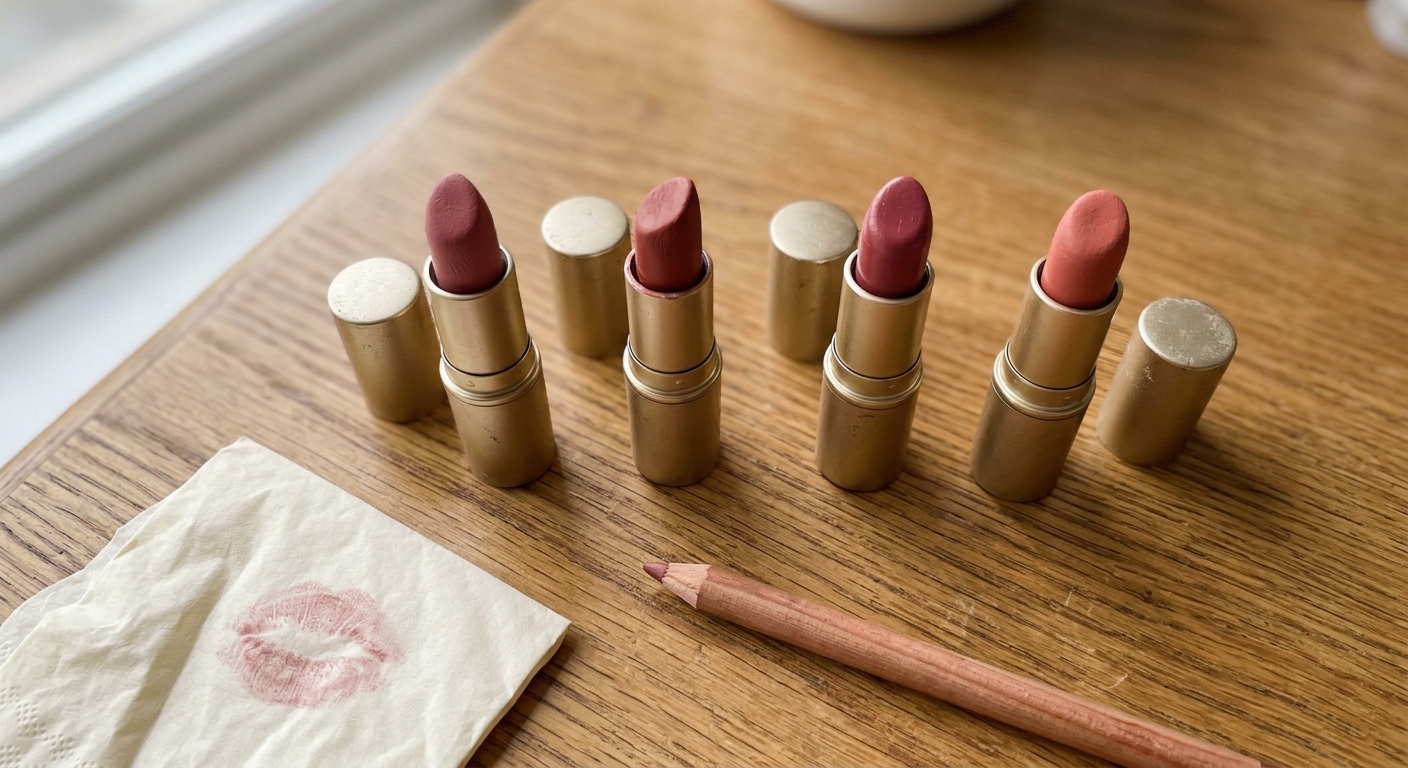
Choose a cream or satin bullet over a liquid matte. Traditional bullet lipsticks carry a higher wax content, and wax raises the viscosity of the film so it resists migrating into a channel. Liquid mattes photograph beautifully and dry down into a thin, brittle film that both accentuates texture and cracks along it.
Watch the pigment-to-emollient ratio. Highly pigmented, heavily emollient formulas carry the most color into the most mobile vehicle, which is the worst combination for bleeding. Sheerer washes of color migrate too, but the migration is invisible.
Skip high-shine gloss as a top layer. Gloss is almost pure emollient and it moves constantly.
Consider the shade honestly. Deep reds, berries and plums show a millimeter of migration that a rose or a soft brick simply hides. If you love a dark shade, it needs the full application sequence below rather than a swipe.
It is a water-based, 99% natural gel at 0.2% retinol, applied at night to the skin around the mouth.
Look for a formula that carries some hydration. Given how little the vermilion produces on its own, a lipstick doing double duty solves the dryness that widens the lines.
The Application Sequence That Buys You the Day
Prime the skin around the mouth, not only the lips. A light film of primer or a thin layer of foundation over the perioral skin gives migrating pigment something absorbent to stop against.
Line the entire lip with a waxy pencil in a shade close to your natural lip, then fill the whole lip with the pencil rather than only outlining. Pencil is the highest-wax product in the routine, and a full base of it under color is the single most effective anti-bleed step available.
Apply lipstick from the bullet, blot with a tissue, then apply a second thin layer. Two thin layers hold far better than one thick one. Do not add gloss on top if bleeding is your problem.
The Half of This That Makeup Cannot Fix
All of the above manages a symptom. The channels remain, and they get deeper.
Topical retinoids are the ingredient class with real evidence against them. The landmark double-blind, vehicle-controlled trial of topical tretinoin on photoaged skin showed statistically significant clinical improvement in fine wrinkling compared with vehicle [5], and the mechanism is the direct counter to the one described above: retinoids increase collagen synthesis in the dermis and suppress the matrix metalloproteinase activity that degrades it. For a fuller treatment plan, see our guide to getting rid of lip wrinkles and the related work on thinning lips.
The obstacle has always been tolerance. Perioral skin is thin, mobile and already dry, which makes it one of the least forgiving places on the face to apply a conventional retinol that has to disrupt the barrier to get through.
Nanoretinol is built to remove that obstacle. Its retinol is encapsulated in biomimetic lipid nanoparticles that the skin recognizes as self and lets through the epithelial barrier intact, so the delivery does not depend on damaging the tissue. North Biomedical’s clinical study recorded 232% greater collagen recovery and 73% greater elastin recovery than conventional retinol, along with a 61% increase in skin firmness and a 56% increase in elasticity over 56 days, with drastically reduced cytotoxicity in cellular assays. It is a water-based, 99% natural gel at 0.2% retinol, applied at night to the skin around the mouth. Keep it away from the eyes themselves, use sunscreen the following day, and give the perioral area the same slow introduction you would give any retinoid.
Buy the Formula, Then Fix the Canvas
The right lipstick for mature lips is a satin or cream bullet, applied over a full base of waxy liner, blotted and layered twice, in a shade forgiving enough that a millimeter of travel goes unnoticed. That combination works from the first application.
The lines it is compensating for respond to a different intervention on a different timescale. Run both. In six months the makeup has less work to do.
References
- Morera Serna E, Serna Benbassat M, Terré Falcón R, Murillo Martín J. “Anatomy and Aging of the Perioral Region.” Facial Plastic Surgery. 2021;37(2):176-193. doi:10.1055/s-0041-1725104
- Penna V, Stark GB, Eisenhardt SU, Bannasch H, Iblher N. “The Aging Lip: A Comparative Histological Analysis of Age-Related Changes in the Upper Lip Complex.” Plastic and Reconstructive Surgery. 2009;124(2):624-628. doi:10.1097/PRS.0b013e3181addc06
- Shang J, Feng X, Chen Y, Gu Z, Liu Y. “Human Lip Vermilion: Physiology and Age-Related Changes.” Journal of Cosmetic Dermatology. 2024;23(8):2676-2680. doi:10.1111/jocd.16317
- Chien AL, Qi J, Cheng N, Do TT, Mesfin M, Egbers R, Xie W, Chow C, Chubb H, Sachs D, Voorhees J, Kang S. “Perioral Wrinkles Are Associated with Female Gender, Aging, and Smoking: Development of a Gender-Specific Photonumeric Scale.” Journal of the American Academy of Dermatology. 2016;74(5):924-930. doi:10.1016/j.jaad.2015.11.042
- Weiss JS, Ellis CN, Headington JT, Tincoff T, Hamilton TA, Voorhees JJ. “Topical Tretinoin Improves Photoaged Skin: A Double-Blind Vehicle-Controlled Study.” JAMA. 1988;259(4):527-532. PMID: 3336176
- Pittayapruek P, Meephansan J, Prapapan O, Komine M, Ohtsuki M. “Role of Matrix Metalloproteinases in Photoaging and Photocarcinogenesis.” International Journal of Molecular Sciences. 2016;17(6):868. doi:10.3390/ijms17060868