Best Makeup for Mature Skin: Start With What Changed Underneath
Which products need to change after 50, which ones never did, and why the two minutes before makeup outrank the makeup.
The complaint arrives in almost identical words from women twenty years apart in age. The foundation that used to look like skin now looks like foundation. It settles into places it never used to settle. It looks worse at 4pm than it did at 8am.
Most advice responds to that by naming a different foundation. That is the wrong altitude to solve it from, because the canvas changed and only some of the products need to change with it.
Three things changed, and essentially only three
Skin aging is a long list of small changes, but for makeup purposes it collapses into three.
The first is collagen. The classic measurement work found skin collagen density declining with age in both sexes, with skin thickness following it down [1]. Less collagen means less of the scaffolding that keeps the surface taut and flat, so the surface acquires more places for a pigment to pool.
The second is elasticity. Measured with a cutometer across age groups and facial regions, skin elasticity falls steadily with age, and it does not fall evenly across the face [2]. That unevenness is why one cheek can behave differently from the area around the mouth.
The third is dryness, and it is the one most people underestimate. A study measuring transepidermal water loss, stratum corneum hydration, surface pH and casual sebum content across ages found the shifts that make older skin drier at the surface [3]. Falling sebum is the change that quietly breaks the most products, because almost every powder formula on the market was designed assuming a skin surface that produces oil.
Matte, long-wear, transfer-proof formulas are engineered around oil control that mature skin no longer needs, and they set into topography rather than moving with it.
Texture is a measurable quantity, not an opinion
It is easy to treat “texture” as a vague complaint. It is measurable. Optical three-dimensional devices quantify skin surface topography in vivo, resolving the depth and distribution of the micro-relief that makeup either sits flat on or falls into [4].
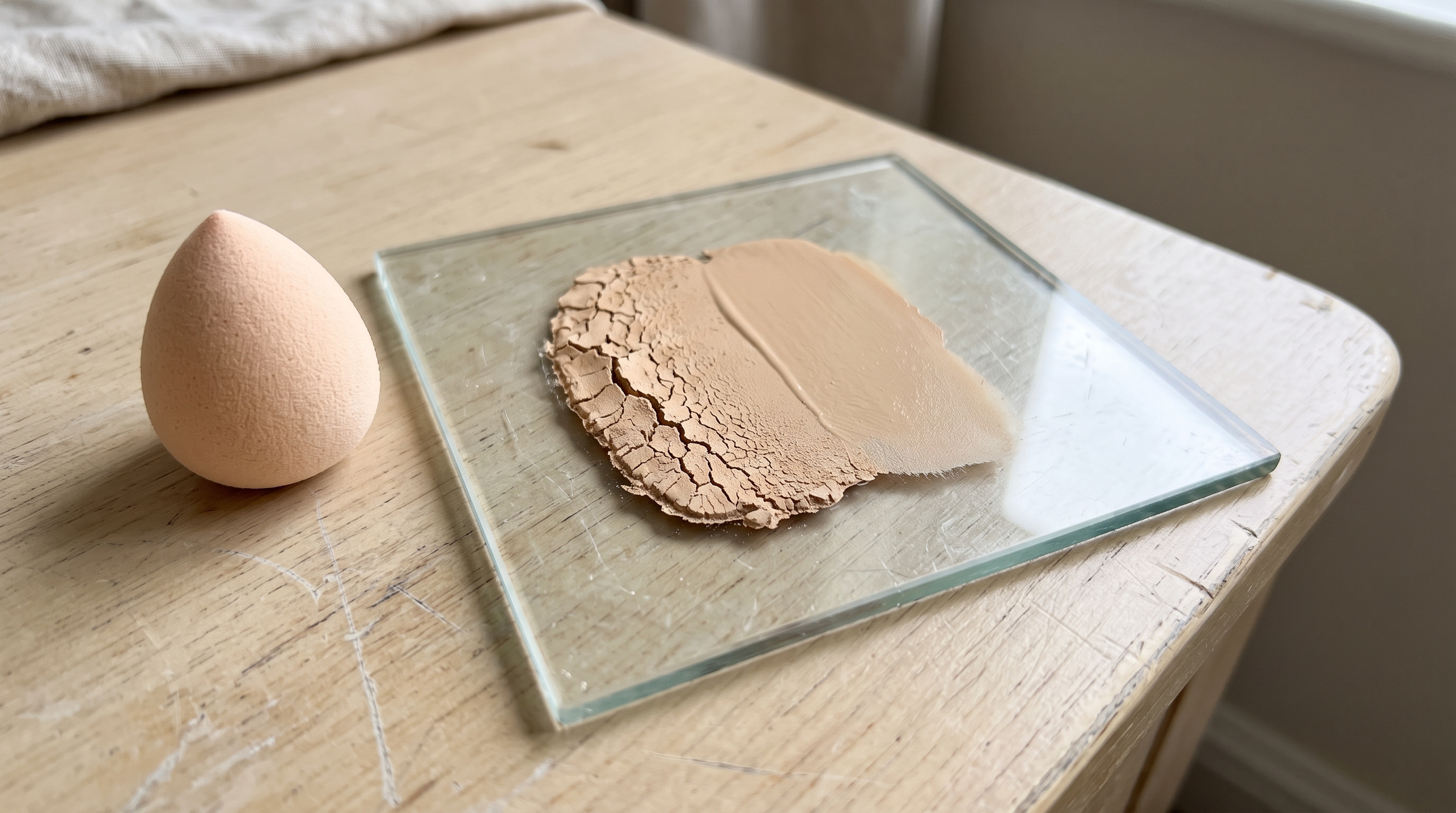
That matters practically. When a product “settles into fine lines,” what physically happened is that a pigmented film flowed into a measurable channel and dried there, where it now casts a shadow and reads darker than the skin beside it. Products that dry down hard and set firmly do this more. Products that stay flexible do it less. The fix follows directly from the mechanism, and it has nothing to do with coverage level.
Which products actually need to change
Only some categories care about any of this.
Foundation cares most. Matte, long-wear, transfer-proof formulas are engineered around oil control that mature skin no longer needs, and they set into topography rather than moving with it. Luminous, flexible, hydrating bases are the category that suits the changed surface, which the detailed foundation guide covers in depth.
Concealer cares most of all, because the under-eye is where thin skin, high movement and a dry surface all meet at once. Thick, high-coverage, fast-setting concealers crease there reliably. Thinner, more emollient ones survive the day. Less product creases less, which is the opposite of everyone’s instinct. The concealer guide goes through the formula families.
Powder cares. Heavy setting powder over a dry surface is the single most aging step in most routines. If powder is used at all, it should be a light dusting confined to the center of the face.
Primer cares, and mostly in one direction. Silicone blurring primers fill topography, which helps, and they also give a slick surface that some foundations slide around on. Hydrating primers usually serve mature skin better, as the primer guide explains.
North Biomedical’s clinical study found the system 232% more effective than conventional retinol in collagen recovery and 73% more effective in elastin recovery, at 0.2% retinol.
Blush, bronzer, brow products and lipstick barely care at all. Cream formulas outperform powder ones on dry skin, and that is the whole adjustment. Color choice is not an age question.
The two minutes before makeup outrank the makeup
If a single change has to carry the most weight, it is hydration timing.
Moisturizer applied and then immediately covered has not finished absorbing, and foundation applied on top of a wet surface will move, pill and separate through the day. Applying moisturizer, then doing something else for a full five minutes, then applying base, fixes more makeup problems than any product swap. On very dry skin, a hydrating serum under the moisturizer buys another measure of the same thing.
The reason is mechanical. A hydrated stratum corneum is plumper and its micro-relief is shallower, so there are physically fewer channels for pigment to flow into. You are reducing the depth of the topography before you apply anything pigmented to it. This is also why makeup looks best on the days your skincare has been consistent, and why the same routine fails during a dry spell. The dedicated guide to makeup settling into wrinkles works through the application-order details.
Does any of it register with other people
It does, and the effect is not uniform. Research on how cosmetics influence perceived age found that makeup shifts age perception, with the direction and size of the effect depending on the wearer’s age and on how the makeup was applied [5]. Makeup does real work, and more of it is not automatically better work.
The variable makeup cannot reach
Everything above manages the surface. None of it changes the collagen and elastin that produced the surface, which is the honest limit of a cosmetics article.
That boundary is where topical retinoids earned their reputation. The double-blind vehicle-controlled trial of topical tretinoin on photoaged skin was the study that established a topical could produce measurable improvement rather than a cosmetic illusion [6]. The catch has always been tolerability. Conventional retinol is fat-soluble and penetrates poorly, so formulations rely on solvents and penetration enhancers that increase lipid mobility in the stratum corneum, loosening the barrier to force the active through. On mature skin that is already dry and thinner, that is felt as burning and peeling, and most people stop.
Nanoretinol was developed to remove that trade-off. It encapsulates retinol in biomimetic lipid nanoparticles that the skin recognizes as “self” and permits through the epithelial barrier, so the delivery mechanism does not require damaging the barrier. North Biomedical’s clinical study found the system 232% more effective than conventional retinol in collagen recovery and 73% more effective in elastin recovery, at 0.2% retinol [7]. In clinical use over 56 days it produced a 61% increase in skin firmness and a 56% increase in skin elasticity. Those two measurements are the ones that describe the canvas, which makes them the ones that eventually change what your foundation does.
Where to start this week
Change the concealer first, because the under-eye is where the difference is most visible and where the current product is most likely wrong. Add the five-minute pause between moisturizer and base, which costs nothing. Cut the powder to a dusting. Leave the blush and the lipstick alone.
Then judge the results at 4pm rather than at 8am, because the morning was never the part that was failing.
References
- Shuster S, Black MM, McVitie E. “The Influence of Age and Sex on Skin Thickness, Skin Collagen and Density.” British Journal of Dermatology. 1975;93(6):639-643. doi:10.1111/j.1365-2133.1975.tb05113.x
- Ryu HS, Joo YH, Kim SO, Park KC, Youn SW. “Influence of Age and Regional Differences on Skin Elasticity as Measured by the Cutometer.” Skin Research and Technology. 2008;14(3):354-358. doi:10.1111/j.1600-0846.2008.00302.x
- Wilhelm KP, Cua AB, Maibach HI. “Skin Aging. Effect on Transepidermal Water Loss, Stratum Corneum Hydration, Skin Surface pH, and Casual Sebum Content.” Archives of Dermatology. 1991;127(12):1806-1809. doi:10.1001/archderm.1991.04520010052006
- Jacobi U, Chen M, Frankowski G, Sinkgraven R, Hund M, Rzany B, Sterry W, Lademann J. “In Vivo Determination of Skin Surface Topography Using an Optical 3D Device.” Skin Research and Technology. 2004;10(4):207-214. doi:10.1111/j.1600-0846.2004.00075.x
- Russell R, Batres C, Courrèges S, Kaminski G, Soppelsa F, Morizot F, Porcheron A. “Differential Effects of Makeup on Perceived Age.” British Journal of Psychology. 2019;110(1):87-100. doi:10.1111/bjop.12337
- Weiss JS, Ellis CN, Headington JT, Tincoff T, Hamilton TA, Voorhees JJ. “Topical Tretinoin Improves Photoaged Skin. A Double-Blind Vehicle-Controlled Study.” JAMA. 1988;259(4):527-532. doi:10.1001/jama.1988.03720040019020
- North Biomedical LLC. “Nanoretinol vs. Conventional Retinol: Efficacy in Collagen and Elastin Recovery.” Clinical Study Summary, 2024. Study summary