Best Face Moisturizer for Dry Skin: How to Choose by Ingredient
Dry skin is a measurable deficiency, and only a short list of ingredients has been shown to correct it
Stand in front of the moisturizer shelf and the choice looks impossible. Forty tubs, all promising deep hydration, ranging from 8 dollars to 300. Most people end up choosing by texture, by scent, or by whichever jar looks most expensive.
That is a shame, because dry facial skin is one of the few skincare complaints with genuinely objective measurements behind it. Researchers can quantify how much water sits in your outer layer and how fast it escapes. Decades of that work have narrowed the field of ingredients that reliably help to a surprisingly short list. Once you know what is on it, the shelf gets much easier to read.
Dry Skin and Dehydrated Skin Are Not the Same Complaint
Two measurements define the problem. The first is stratum corneum hydration, or how much water is held in the outermost layer of skin. The second is transepidermal water loss, the rate at which water evaporates out through the surface.
Those two numbers can move independently, and that is the whole point. Work on non-invasive barrier assessment established that lipid-deficient dry skin, the kind that arrives with age, shows low water content while water loss stays low or normal. Barrier-damaged skin behaves differently, leaking water at an elevated rate [1]. One is a supply problem. The other is a leak.
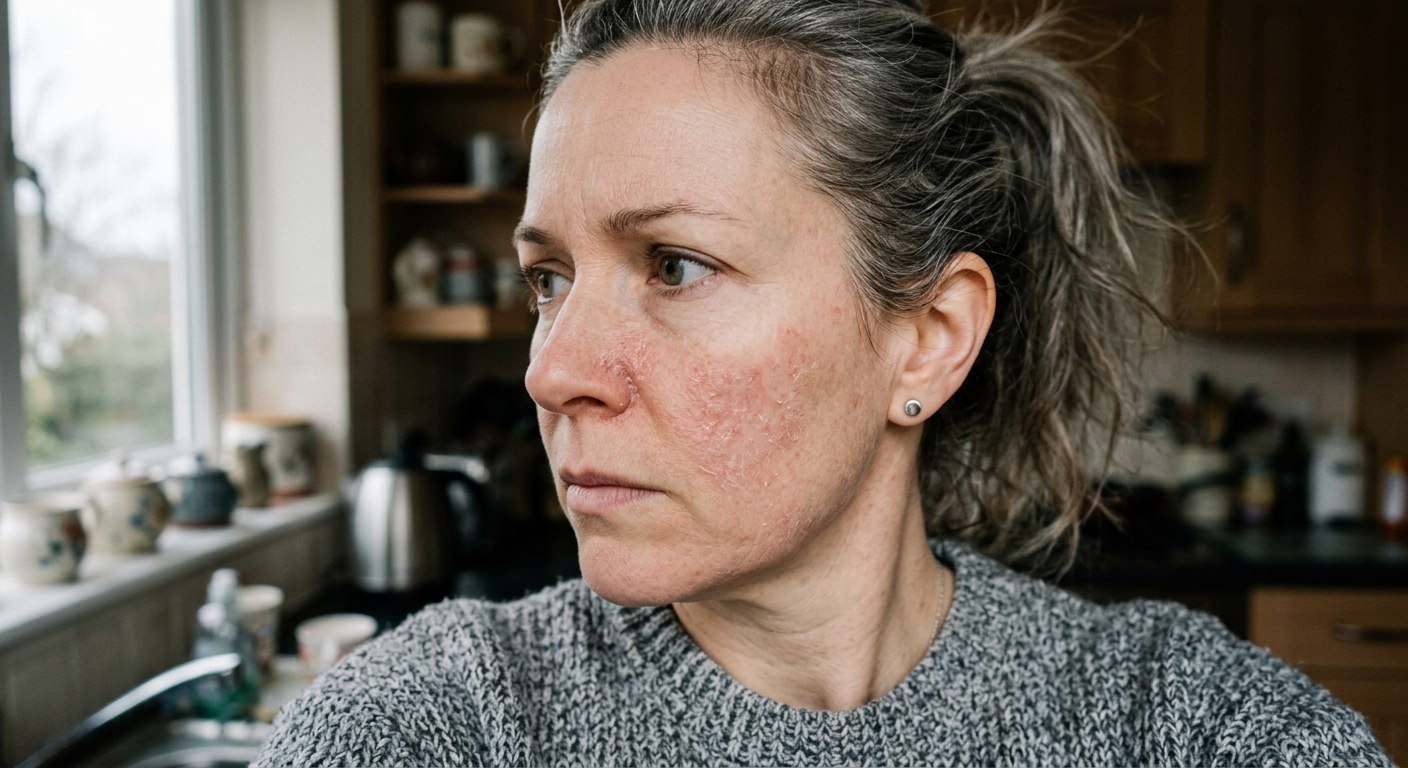
You can approximate the distinction at home. If your skin feels tight and looks dull but stays comfortable under a basic cream, you are likely short on water. If it stings when you apply almost anything, flakes in patches, and reacts to products you used happily last year, you are dealing with a compromised barrier and should treat barrier repair as the first job rather than hydration.
Why Aging Skin Runs Out of Its Own Moisturizer
Skin manufactures its own moisturizing system: a mix of ceramides, cholesterol and fatty acids that forms the mortar between surface cells, plus a set of water-binding compounds known collectively as natural moisturizing factor. Production of both declines with age.
The scale of the result is easy to underestimate. A systematic review and meta-analysis of xerosis in older adults pooled the available data and found a prevalence of 53%, making dry skin the single most common skin condition of later life [2]. This is closer to a default state than to a disorder.
If your skin feels tight and looks dull but stays comfortable under a basic cream, you are likely short on water.
For women, one transition accelerates the process sharply. Researchers who profiled the stratum corneum lipids of post-menopausal women found reduced ceramide levels and shorter ceramide chain lengths, both correlated with falling oestradiol. Women on hormone replacement did not show the same deficit [3]. That finding matters practically: skin that changed noticeably in your late 40s or 50s did not become lazy or dirty. It lost part of its raw material.
The Three Jobs a Moisturizer Has to Do
Every effective moisturizer is doing some combination of three things, and the good ones do all three.
Humectants pull water into the outer layer, either from the deeper skin or from humid air. Glycerin is the most studied. In a double-blind study, a cream containing 20% glycerin measurably raised instrument-assessed hydration and improved barrier function compared with its own vehicle, and reduced sensitivity to an irritant [4]. Hyaluronic acid works on the same principle with a much larger molecule.
Emollients fill the gaps between surface cells, which is what makes skin feel smooth rather than rough. Ceramides do this while also replacing the exact lipid class that aging skin stops making enough of.
Occlusives slow evaporation by forming a film. In a within-person randomised trial of 54 participants, topical petrolatum significantly increased hydration and reduced measured water loss [5].
That last point is the most common self-inflicted mistake. A watery hydrating gel used alone, in dry indoor air, can pull moisture out of skin faster than it delivers it. Humectants need something on top of them.
The Ingredients Worth Paying For
Four names carry most of the evidence.
Glycerin is cheap, well tolerated, and supported by controlled data at meaningful concentrations [4]. Its presence high in an ingredient list is a good sign.
A head-to-head trial found 40% urea cream produced faster and greater improvement in xerosis than 12% ammonium lactate lotion.
Ceramides address the specific deficit. A qualitative review of multiple clinical trials found that ceramide-dominant formulations consistently improved hydration and reduced water loss [6].
Urea does double duty as a humectant and a mild keratolytic that loosens flakes. A head-to-head trial found 40% urea cream produced faster and greater improvement in xerosis than 12% ammonium lactate lotion [7]. Note the concentration. Formulations that strong are intended for feet, hands and body; facial products use far lower levels.
Petrolatum remains the reference occlusive [5]. It is unfashionable and it works.
What you will not find is convincing evidence that a 200-dollar cream outperforms a well-formulated 20-dollar one. Price tracks packaging, fragrance and marketing far more reliably than it tracks measured hydration.
What the Label Will Not Tell You
Ingredient lists are ordered by concentration only down to 1%, after which manufacturers can arrange things freely. A cream can advertise ceramides that appear below the preservative in vanishingly small amounts.
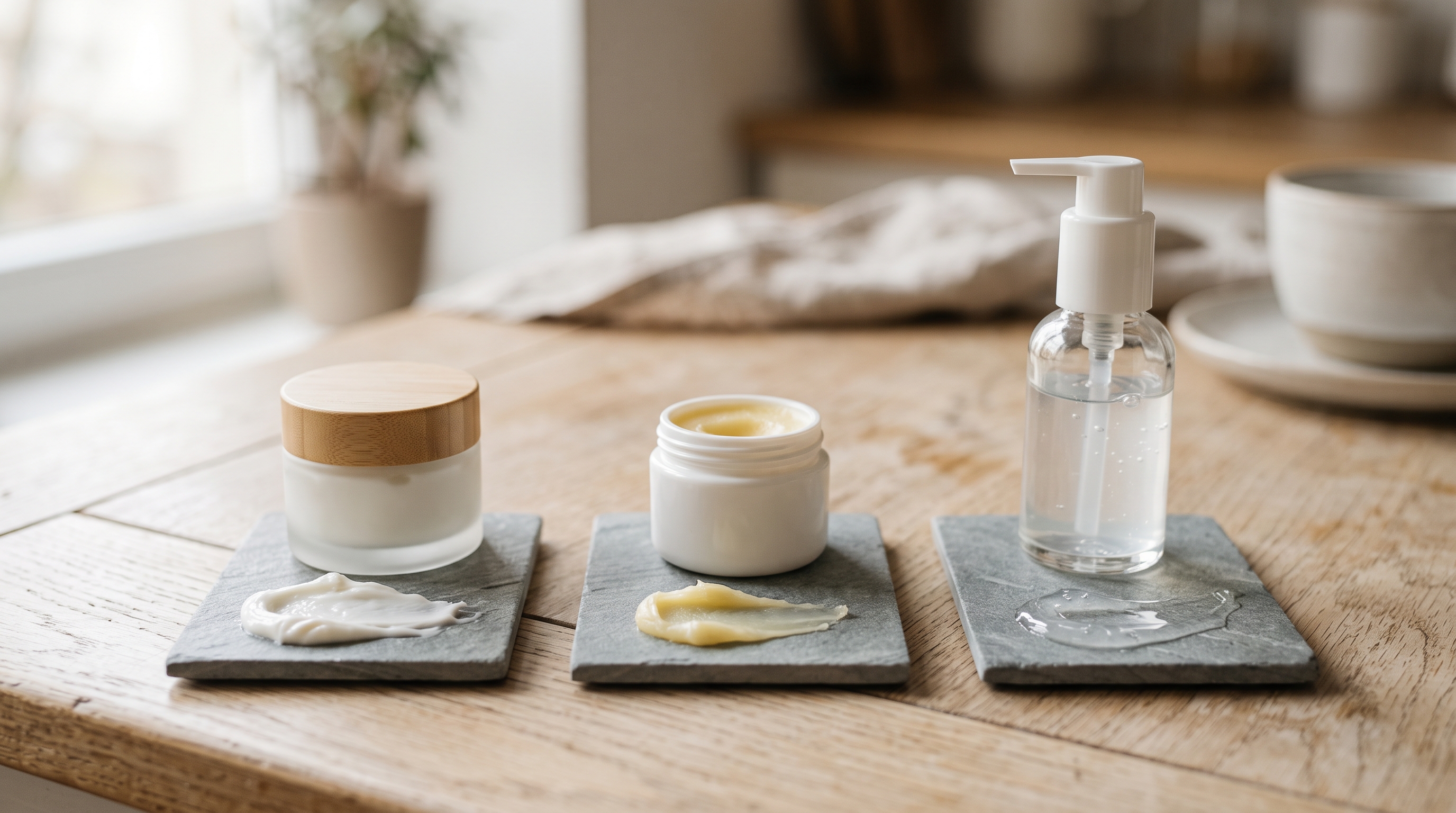
Two practical heuristics help. First, look for at least one ingredient from each of the three categories in the first six or seven entries. Second, match the format to the deficit: thin lotions suit skin that mainly needs water, while balms and thicker creams suit skin that has lost lipids. If your skin is dry in some areas and oily in others, the calculus changes, and a guide to combination skin is the more useful starting point.
Where a Moisturizer Stops
A good moisturizer restores comfort, softens texture and reduces flaking, usually within days. What it does not do is change the structure underneath. Fine lines that come from collagen loss are unaffected by hydration, which is why skin can feel wonderful and still look aged.
Rebuilding that structure is retinol’s job, and this is exactly where people with dry skin get stuck. Conventional retinol formulations often rely on solvents that disrupt the barrier to force the molecule through, which is why dryness and peeling are so common and why so many people with dry skin abandon retinol within a month.
Nanoretinol takes a different route. It delivers 0.2% retinol inside biomimetic lipid nanoparticles that the skin recognises as self and admits without the barrier being broken open. The formulation is water-based, 99% natural, and suitable for sensitive skin. North Biomedical’s clinical study summary reports 232% greater collagen recovery and 73% greater elastin recovery than conventional retinol, alongside drastically reduced cytotoxicity [8]. Use it at night, not alongside another retinoid, and apply sunscreen within 24 hours. It is not for use in pregnancy or breastfeeding.
Choosing Yours
Work backwards from the deficit rather than forwards from the marketing. Establish whether you are short on water, short on lipids, or both. Pick a product that covers all three functions, with recognisable ingredients near the top of the list. Give it 2 weeks of consistent use before judging it, and apply it to slightly damp skin so the humectants have something to hold.
Then leave it alone. The most common reason a moisturizer appears to fail is that it was replaced after 4 days by another one that would also have worked.
References
- Berardesca E, Maibach HI. “Transepidermal water loss and skin surface hydration in the non invasive assessment of stratum corneum function.” Derm Beruf Umwelt. 1990;38(2):50-53. PubMed: 2187664
- Yao D, Gong X, Ma Y, et al. “The prevalence and interventions of xerosis cutis among older adults: A systematic review and meta-analysis.” Geriatric Nursing. 2023;54:219-228. doi:10.1016/j.gerinurse.2023.09.018
- Kendall AC, Pilkington SM, Wray JR, et al. “Menopause induces changes to the stratum corneum ceramide profile, which are prevented by hormone replacement therapy.” Scientific Reports. 2022;12(1):21715. doi:10.1038/s41598-022-26095-0
- Lodén M, Wessman W. “The influence of a cream containing 20% glycerin and its vehicle on skin barrier properties.” International Journal of Cosmetic Science. 2001;23(2):115-119. doi:10.1046/j.1467-2494.2001.00060.x
- Rubio-Santoyo A, Sanabria-de la Torre R, Montero-Vílchez T, et al. “Effects of Extra Virgin Olive Oil and Petrolatum on Skin Barrier Function and Microtopography.” Journal of Clinical Medicine. 2025;14(13):4675. doi:10.3390/jcm14134675
- Kono T, Miyachi Y, Kawashima M. “Clinical significance of the water retention and barrier function-improving capabilities of ceramide-containing formulations: A qualitative review.” The Journal of Dermatology. 2021;48(12):1807-1816. doi:10.1111/1346-8138.16175
- Ademola J, Frazier C, Kim SJ, Theaux C, Saudez X. “Clinical evaluation of 40% urea and 12% ammonium lactate in the treatment of xerosis.” American Journal of Clinical Dermatology. 2002;3(3):217-222. doi:10.2165/00128071-200203030-00007
- North Biomedical LLC. “Nanoretinol vs. Conventional Retinol: Efficacy in Collagen and Elastin Recovery.” Clinical Study Summary, 2024. Study summary