Best Retinol Serum: How to Judge One Without Trusting the Percentage
A formulation-first buying rubric for anyone tired of ranking retinol by the number on the front of the bottle
Search for the best retinol serum and you will find a hundred lists that sort products the same way: by percentage. One percent beats 0.5%, 0.5% beats 0.3%, and the biggest number wins. It is a tidy way to rank a shelf. It is also close to useless, because a percentage describes what a chemist weighed into a mixing tank, not what reaches a living skin cell four weeks after you bought the bottle.
Retinol deserves the attention. It remains one of the best-evidenced topical anti-aging ingredients in dermatology, with human data showing that applying it to naturally aged skin increases glycosaminoglycan and procollagen expression while visibly softening fine wrinkles [1]. Reviews of the retinoid class attribute those effects to a fairly well-mapped chain of events: retinol converts inside the skin to retinoic acid, retinoic acid binds nuclear receptors, and those receptors turn up the genes that build new matrix [2][3].
None of that biology cares about the label. It cares about how much intact retinol arrives at the cells that convert it. That is a delivery question, and delivery is decided by four things the percentage never tells you.
1. Which molecule is actually in the bottle
“Retinol” on the front of a box is a marketing category, not a chemical identity. Inside, you may find free retinol, a retinyl ester such as retinyl palmitate, retinaldehyde, or a newer retinoid ester. They are not interchangeable, because each one sits at a different distance from retinoic acid and has to complete a different number of conversion steps.
The distance matters. A direct in vivo comparison in human skin found that unoccluded retinol penetrated more effectively than either unoccluded retinyl palmitate or retinoic acid itself [4]. That result surprises people twice over: the ester underperforms the alcohol, and the “strongest” molecule in the family is not the best at getting in. If a serum leads with a big number but the ingredient list shows retinyl palmitate high up and retinol nowhere, the number is describing a weaker starting material. Our retinol vs retinal comparison breaks down where each form sits on that conversion ladder.
A jar labelled 1% is not necessarily a 1% product by the time it reaches your face, and two bottles printed with identical numbers can differ by an order of magnitude in what they actually deliver.
2. Whether the retinol survived the supply chain
This is the part of retinol shopping almost nobody checks, and it is the most damning.
Researchers analysed 35 commercial cosmetic products containing retinoids and then stress-tested them. Retinoid instability showed up in nearly every product: a 0% to 80% decline in retinoid content after six months at 25°C, and a 40% to 100% decline at 40°C. Light degradation was more aggressive than heat. Several products also deviated from their declared content in the first place, some containing far less than the label claimed and others far more than European safety guidance recommends [5].
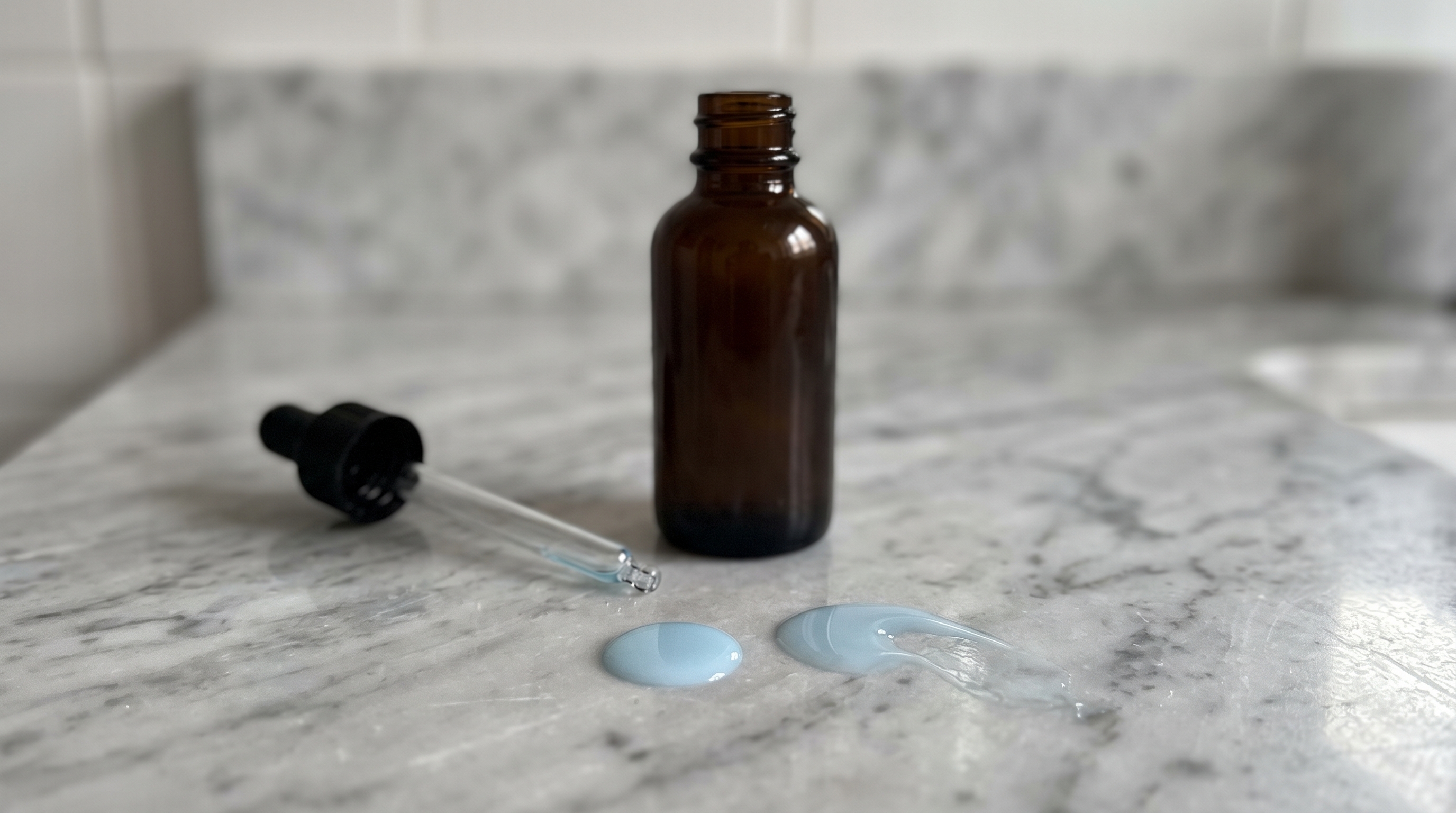
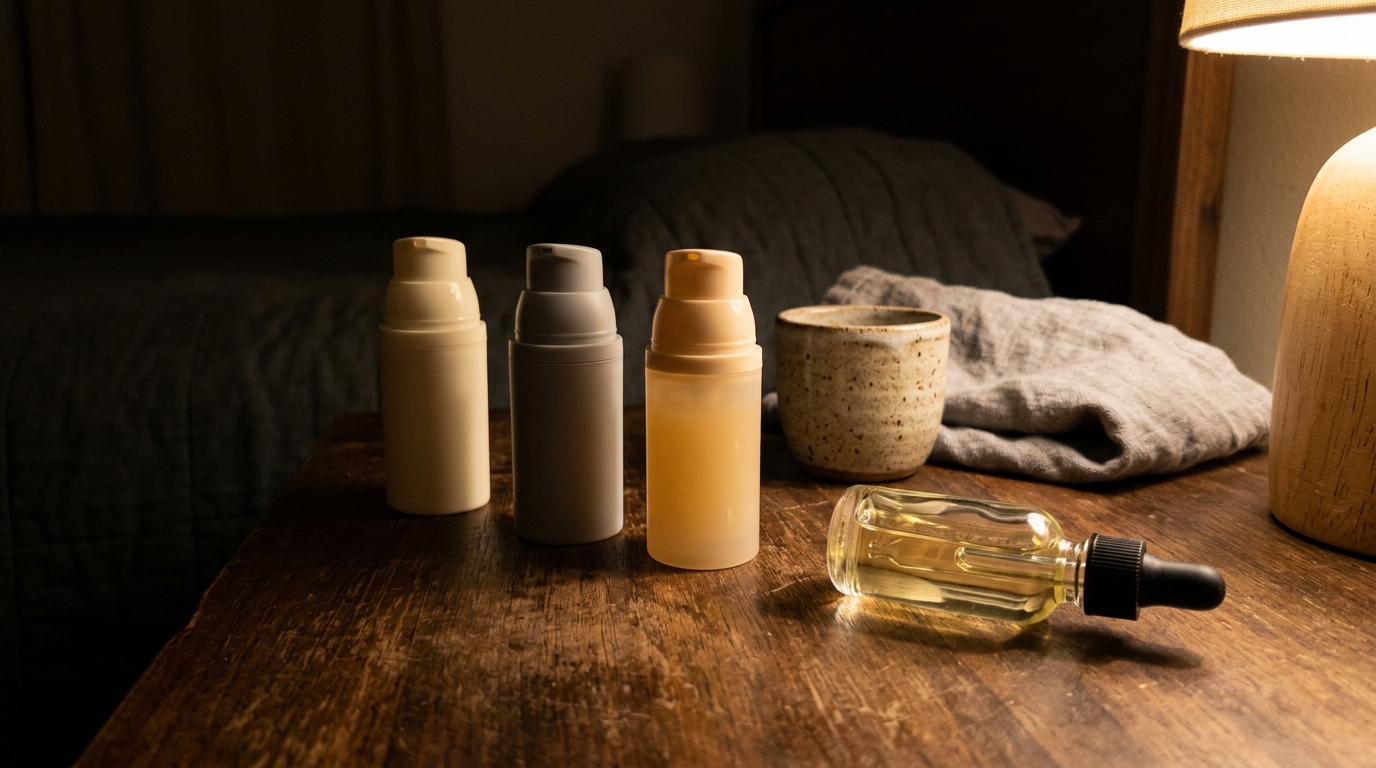
Read that range again. A jar labelled 1% is not necessarily a 1% product by the time it reaches your face, and two bottles printed with identical numbers can differ by an order of magnitude in what they actually deliver. This is why packaging is a formulation decision, not an aesthetic one. Opaque, airless, single-direction dispensers exist because retinol is destroyed by light, oxygen and heat. A retinol serum in a clear dropper bottle that you open twice a day for three months is running an unplanned degradation experiment on your own bathroom shelf.
3. How the formula gets retinol past the barrier
Your stratum corneum is built to keep foreign molecules out, and it is good at its job. Conventional retinol formulations solve this by force: solvents and penetration enhancers that increase lipid mobility in the barrier, loosening the mortar between corneocytes so the active can slip through.
A serum that lets you stay consistent is doing more for your collagen than one that forces a recovery week every month.
It works, and it is the mechanism behind almost everything people hate about retinol. The redness, the flaking, the tight stinging week — that is not the retinol “working.” It is a disrupted barrier. Clinical reviews of the retinoid class describe this irritation as the main factor limiting real-world use, because tolerability, not potency, is what determines whether someone is still applying the product at month three [2]. A comparative study of retinol against retinoic acid in human skin made the same practical point from the other direction: the gentler molecule can deliver histological and molecular change without the penalty that pushes people to quit [6].
Encapsulation is the alternative approach. Rather than breaking the barrier open, the active is packaged in a lipid carrier that crosses it. Work on solid lipid nanoparticles showed that encapsulating retinoids this way improved their chemical stability compared with conventional carriers [7], which addresses the shelf-life problem and the delivery problem with one design choice. We cover the category in more depth in our guide to encapsulated retinol.
4. Whether you can actually keep using it
The best retinol serum is the one still in your routine in six months. That sounds like a truism until you look at how many people abandon retinol during the adjustment period and never return. A formula you use three nights a week for a year beats a stronger formula you use for nine days and shelve. If you are starting out, our beginner’s guide to retinol covers pacing, and our retinol concentration guide explains why chasing a higher number usually backfires.
The checklist to shop with
- Form first. Look for retinol or retinaldehyde named specifically, not just “vitamin A derivative.” Check where it sits in the ingredient list.
- Packaging is data. Opaque and airless signals a formulator who understood the stability problem. Clear glass with a dropper signals one who did not, or did not care.
- Ask how it penetrates. Solvent-driven penetration and carrier-based delivery produce very different side-effect profiles at the same nominal dose.
- Discount the percentage. Treat it as one weak input among four, not the headline.
- Judge on tolerability. A serum that lets you stay consistent is doing more for your collagen than one that forces a recovery week every month.
Where Nanoretinol lands on this rubric
Nanoretinol was designed around the delivery question rather than the percentage race. It uses biomimetic lipid nanoparticles that the skin recognises as “self,” so the retinol crosses the epithelial barrier instead of being pushed through a barrier that has been chemically loosened first. The retinol inside is stabilised and protected within those particles, which is the same reason encapsulation helps with the shelf-life problem.
At 0.2%, it would rank last on a percentage-sorted list. Measured on the axis that matters, North Biomedical’s clinical study summary reports 232% greater effectiveness in collagen recovery and 73% greater effectiveness in elastin recovery against conventional retinol, with 61% higher skin firmness and 56% higher elasticity over 56 days of use [8]. Because delivery does not depend on damaging the barrier, the cytotoxicity profile is substantially gentler than conventional retinol, and the side effects reported in trials were minimal and milder when they occurred.
How to shop from here
Percentage survives as the industry’s ranking metric because it is the only number that is easy to print and easy to compare. It is a proxy for potency that stopped being accurate the moment formulators learned to control delivery. When you next compare two retinol serums, ask what form the vitamin A is in, what protects it from light and air, how it is designed to get past the barrier, and whether you will still be using it in six months. Those four answers will predict your results far better than any figure on the front of the box.
References
- Kafi R, Kwak HSR, Schumacher WE, Cho S, Hanft VN, et al. “Improvement of Naturally Aged Skin With Vitamin A (Retinol).” Archives of Dermatology. 2007;143(5):606-612. doi:10.1001/archderm.143.5.606
- Mukherjee S, Date A, Patravale V, Korting HC, Roeder A, Weindl G. “Retinoids in the treatment of skin aging: an overview of clinical efficacy and safety.” Clinical Interventions in Aging. 2006;1(4):327-348. doi:10.2147/ciia.2006.1.4.327
- Zasada M, Budzisz E. “Retinoids: active molecules influencing skin structure formation in cosmetic and dermatological treatments.” Advances in Dermatology and Allergology. 2019;36(4):392-397. doi:10.5114/ada.2019.87443
- Duell EA, Kang S, Voorhees JJ. “Unoccluded Retinol Penetrates Human Skin In Vivo More Effectively Than Unoccluded Retinyl Palmitate or Retinoic Acid.” Journal of Investigative Dermatology. 1997;109(3):301-305. doi:10.1111/1523-1747.ep12335788
- Temova Rakuša Ž, Škufca P, Kristl A, Roškar R. “Retinoid stability and degradation kinetics in commercial cosmetic products.” Journal of Cosmetic Dermatology. 2021;20(7):2350-2358. doi:10.1111/jocd.13852
- Kong R, Cui Y, Fisher GJ, Wang X, Chen Y, et al. “A comparative study of the effects of retinol and retinoic acid on histological, molecular, and clinical properties of human skin.” Journal of Cosmetic Dermatology. 2016;15(1):49-57. doi:10.1111/jocd.12193
- Jenning V, Gohla SH. “Encapsulation of retinoids in solid lipid nanoparticles (SLN).” Journal of Microencapsulation. 2001;18(2):149-158. doi:10.1080/02652040010000361
- North Biomedical LLC. “Nanoretinol vs. Conventional Retinol: Efficacy in Collagen and Elastin Recovery.” Clinical Study Summary, 2024. northbiomedical.com/documents/Nanoretinol-Study_Summary.pdf