Dry Scaly Skin on Legs: Why It Happens and How to Get Smooth Skin Back
That snakeskin texture on your shins is your skin barrier waving a white flag — here is what is breaking down and how to rebuild it.
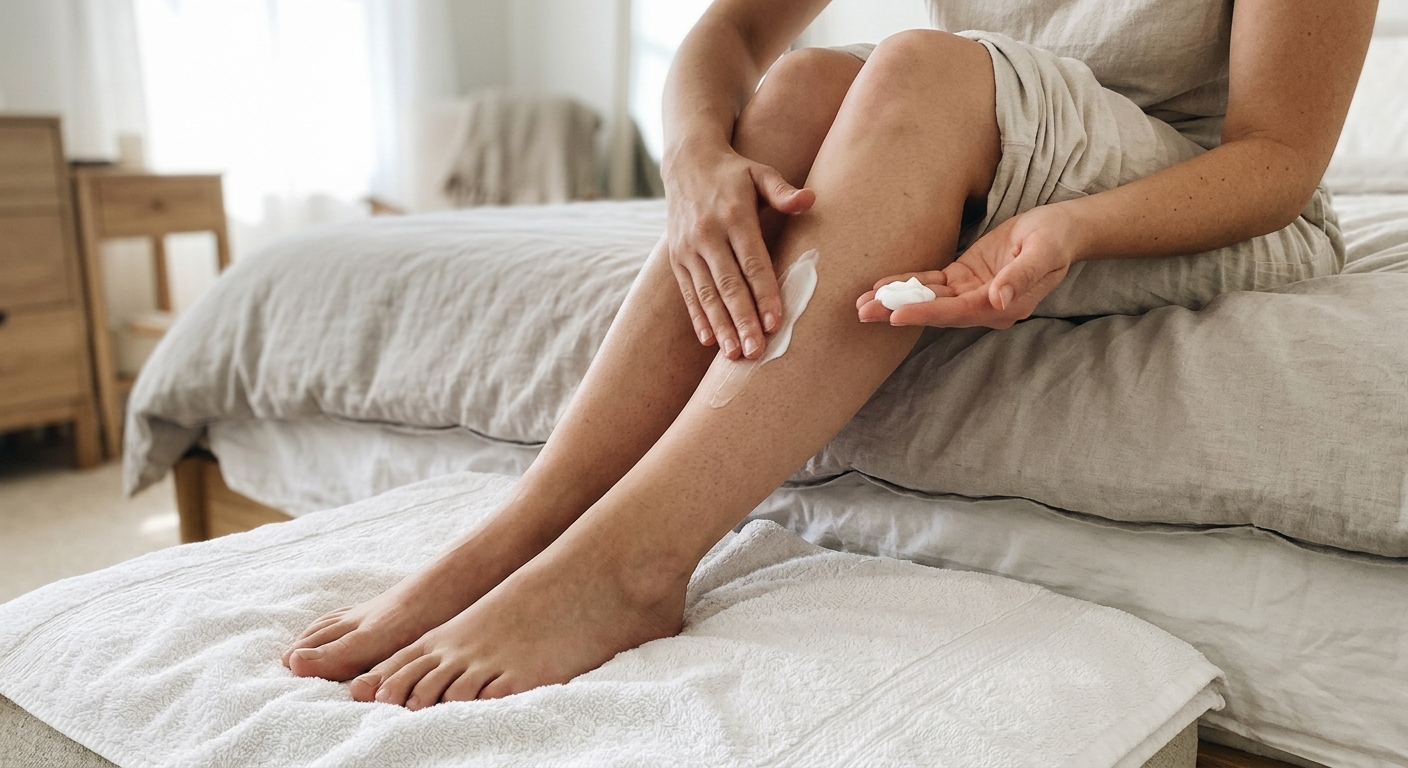
You ran your hand down your shin after a shower and felt it — that rough, flaky, almost reptilian texture that catches on your fingertips and turns ashy or white when you scratch it. Maybe it flakes onto dark trousers. Maybe it itches at night. Whatever the trigger that made you notice, the underlying story is usually the same, and it is rarely anything sinister: your skin’s moisture barrier is breaking down faster than it can repair itself.
The medical term for this is xerosis, and the lower legs are its favorite address. Understanding why the shins dry out before almost anywhere else is the key to fixing them — and to keeping them smooth for good.
Why Your Lower Legs Dry Out First
Skin holds water through a structure dermatologists compare to a brick wall. The “bricks” are flattened skin cells in the outermost layer, the stratum corneum, and the “mortar” is a blend of lipids — ceramides, cholesterol, and fatty acids — that seals moisture in and locks irritants out. When that mortar thins, water escapes, the bricks curl and lift, and the surface turns rough and scaly.
The lower legs are structurally disadvantaged from the start. They carry fewer oil glands than the face or torso, so there is less natural sebum to reinforce the barrier. They take the brunt of hot showers, harsh soaps, shaving, rough towels, and dry indoor air. And gravity-driven circulation changes mean the shins are often the last place to get well-nourished blood flow. Of those, the wash you use every day is the easiest to change, and our guide to the best body wash for dry skin explains which surfactants strip least.
Age stacks the deck further. Research into the aging epidermis shows three compounding changes: the barrier becomes slower to repair itself, the stratum corneum holds less water, and skin surface pH rises in ways that impair the enzymes responsible for making protective lipids [1]. In other words, older skin makes less mortar, makes it more slowly, and makes it less effectively — and the under-oiled lower legs feel that shortfall first.
You ran your hand down your shin after a shower and felt it — that rough, flaky, almost reptilian texture that catches on your fingertips and turns ashy or white when you scratch it.
Dry and Scaly, or Something More?
For the large majority of people, scaly legs are simple xerosis — uncomfortable and unsightly, but entirely manageable with the right care. A few signs, though, warrant a professional eye. If the skin is intensely itchy, cracked and weeping, spreading in well-defined red plaques, or not improving at all with diligent moisturizing, see a dermatologist to rule out conditions like eczema, an underactive thyroid, or other medical causes. Persistent, treatment-resistant scaling is a reason to get checked rather than to keep guessing.
For everyone else, the fix is a matter of replacing what the barrier has lost — in the right order.
What Actually Repairs Scaly Legs
Smoothing rough legs is a two-part job: gently clear away the built-up dead, scaly cells, then flood the skin with ingredients that both attract and seal in water. The order and the ingredients matter.
Humectants and emollients — the daily foundation
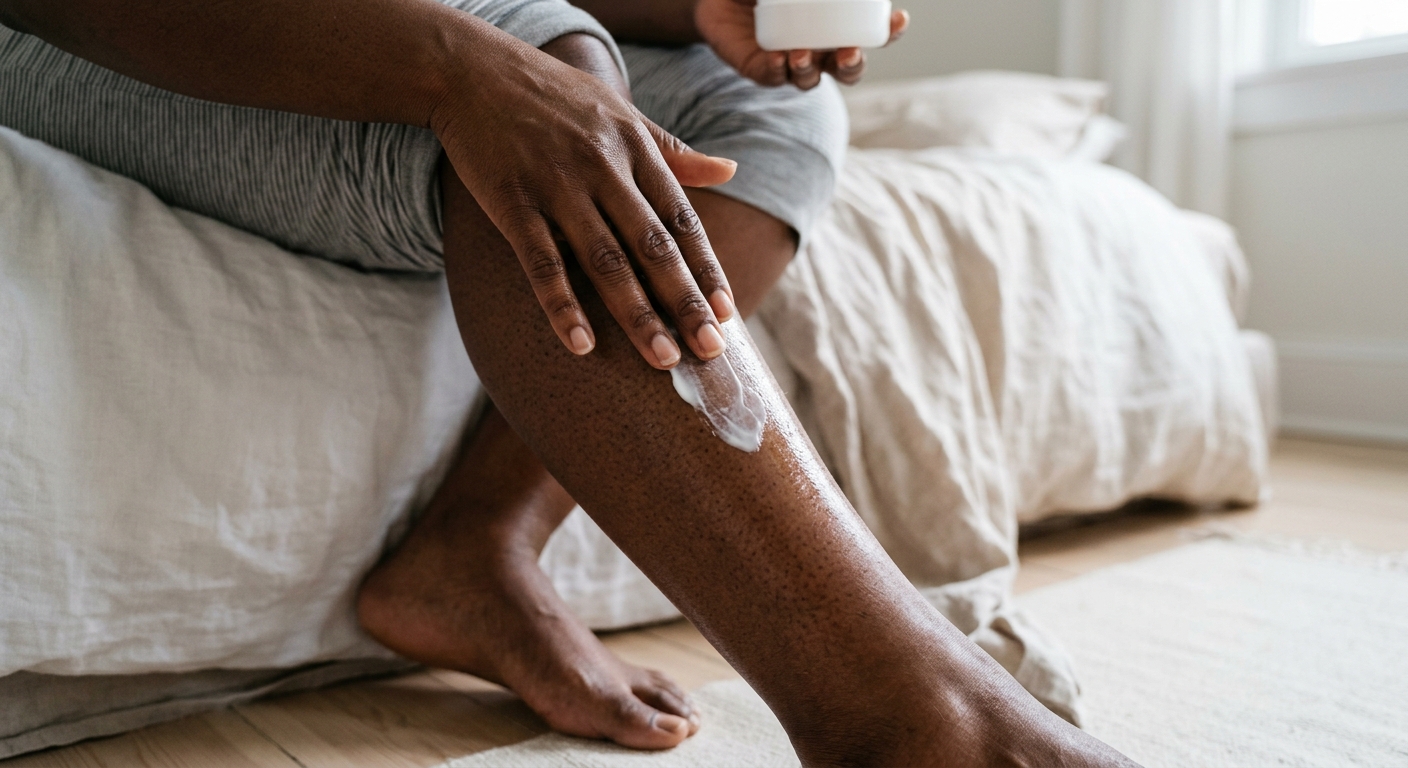
The everyday workhorses are humectants, which pull water into the skin, and emollients and occlusives, which slow its escape. Glycerin, hyaluronic acid, and squalane all qualify, a hyaluronic acid body lotion that combines a humectant with an occlusive covers both jobs at once, and the single highest-impact habit is applying a rich moisturizer to slightly damp skin within minutes of showering, while the surface is still hydrated. If your legs read as dehydrated all over, our guide to dehydrated skin covers the humectant side in depth. The heaviest version of that occlusive step is a body butter for dry skin, which works best applied to still-damp skin, while a fragrance-free colloidal oatmeal lotion suits shins that itch as well as flake. Getting that hydration right first is also what prevents the patchy result a self tanner gives on scaly skin.
Lotions in the 10% range are ideal for everyday smoothing of rough shins.
Urea — the multitasker for scaly skin
Few ingredients suit scaly legs as precisely as urea. A natural component of skin’s own moisturizing factor, urea both binds water and, at higher strengths, gently dissolves the bonds holding dead, scaly cells in place. A comprehensive review describes how urea hydrates, softens scale, and even boosts the skin’s production of barrier proteins like filaggrin [2]. Lotions in the 10% range are ideal for everyday smoothing of rough shins. See urea for skin for how the ingredient works, and our guide to choosing a urea lotion for which strength to buy.
Ceramides — rebuilding the mortar
If thinning lipids are the core problem, ceramides are the most direct repair. In a randomized controlled trial in adults with senile xerosis, a ceramide-containing cream improved skin hydration and reduced water loss for up to 24 hours from a single use, with further gains in barrier function over 28 days of twice-daily use [3]. Replacing the exact lipids the barrier is missing is about as targeted as skincare gets, and our guide to choosing a ceramide body lotion explains which lipid ratio to look for. Our overview of ceramides for skin explains the different types.
Lactic acid — smoothing and rebuilding at once
Lactic acid is unusually well suited to scaly legs because it does two jobs. As a gentle alpha-hydroxy acid it loosens flaky surface cells, and — less obviously — it actually stimulates the skin to make more of its own ceramides. A foundational study showed that L-lactic acid increased keratinocyte ceramide synthesis and measurably strengthened the barrier [4]. A lactic-acid lotion, such as the buffered 12% ammonium lactate lotion that outperformed a petrolatum cream in trials, can take legs from rough to soft faster than a plain moisturizer because it treats the scale and the underlying lipid deficit in one step.
Don’t Forget the Habits
Ingredients can only do so much against a punishing routine. Shorten your showers and turn down the temperature — hot water strips lipids fast. Swap foaming, high-pH soaps for a gentle, fragrance-free cleanser. Pat, do not rub, dry. And run a humidifier in dry months. These small changes stop the barrier from being re-stripped every single day, which is often the difference between legs that improve and legs that stay scaly no matter what you slather on.
Where Nanoretinol Fits
Once your legs are no longer actively flaking and the barrier is rebuilt, you may notice the deeper signs of aging that the dryness had been masking — crepey, thin-looking, finely lined skin, especially above the knee. That texture is a collagen-and-elastin story, and retinol is among the most evidence-backed ingredients for prompting skin to rebuild both [5].
The traditional obstacle is that retinol can be irritating, and irritation is the last thing already-compromised leg skin needs. Nanoretinol is engineered around exactly that conflict. By encapsulating stabilized retinol inside biomimetic lipid nanoparticles — structures the skin accepts as its own and absorbs without barrier-damaging chemicals — it delivers retinol’s renewing benefits far more gently than conventional formulas. Fittingly, those same nanoparticle membranes are built from skin-friendly phospholipids that nourish as they deliver. For legs that have finally been coaxed back to smooth, it is a way to address the underlying aging without restarting the cycle of irritation and flaking you just escaped.
Smooth Skin Is a Maintenance Project
Scaly legs are not a life sentence, but they are a maintenance commitment. Repair the barrier with the right lipids and humectants, exfoliate the scale gently rather than scrubbing it raw, and protect your skin from the hot-water-and-harsh-soap routine that caused the problem. Stay consistent, and the snakeskin texture gives way to skin that finally feels as smooth as it looks. Further down, the thicker skin of the heel needs a stronger version of the same approach, set out in the guide to foot creams for dry, cracked feet. When the callus is already thick, the acid route works faster than cream, and our foot peel mask guide explains why the shedding only starts days later.
References
- Wang Z, Man MQ, Li T, Elias PM, Mauro TM. “Aging-associated alterations in epidermal function and their clinical significance.” Aging (Albany NY). 2020;12(6):5551-5565. doi:10.18632/aging.102946
- Piquero-Casals J, Morgado-Carrasco D, Granger C, Trullàs C, Jesús-Silva A, Krutmann J. “Urea in Dermatology: A Review of its Emollient, Moisturizing, Keratolytic, Skin Barrier Enhancing and Antimicrobial Properties.” Dermatology and Therapy. 2021;11(6):1905-1915. doi:10.1007/s13555-021-00611-y
- Lueangarun S, Tragulplaingam P, Sugkraroek S, Tempark T. “The 24-hr, 28-day, and 7-day post-moisturizing efficacy of ceramides 1, 3, 6-II containing moisturizing cream compared with hydrophilic cream on skin dryness and barrier disruption in senile xerosis treatment.” Dermatologic Therapy. 2019;32(6):e13090. doi:10.1111/dth.13090
- Rawlings AV, Davies A, Carlomusto M, et al. “Effect of lactic acid isomers on keratinocyte ceramide synthesis, stratum corneum lipid levels and stratum corneum barrier function.” Archives of Dermatological Research. 1996;288(7):383-390. doi:10.1007/BF02507107
- Mukherjee S, Date A, Patravale V, Korting HC, Roeder A, Weindl G. “Retinoids in the treatment of skin aging: an overview of clinical efficacy and safety.” Clinical Interventions in Aging. 2006;1(4):327-348. doi:10.2147/ciia.2006.1.4.327