Dry Skin Around Mouth: Why It Happens and How to Fix It
Lip licking, toothpaste, cold wind and retinol that creeps into the corners all hit the same small ring of skin. What causes it, a simple repair routine, and when it is something else
The rest of your face feels fine, but the skin around your lips has turned tight, rough and faintly flaky. Lipstick catches on it, foundation settles into it, and by evening there is a pale, papery ring that no amount of lip balm seems to fix. In winter it is one of the most common complaints people bring to a skincare counter.
The skin around the mouth is a small area that takes an unusual amount of abuse. It is wetted and dried dozens of times a day, it meets toothpaste every morning and night, it stretches every time you talk or eat, and it is the first place a too-strong retinol or acid tends to collect. Once you know which of those is driving your dryness, the fix is usually simple.
Why the skin around your lips dries out first
Lip licking. Saliva feels soothing for a second, then evaporates and takes more of the skin’s own water with it. Repeated wetting and drying is a classic irritant, and constant licking is one of the recognized local causes of soreness and cracking at the corners of the mouth [3]. The habit is often unconscious, and it gets worse in winter precisely because the lips feel dry.
Cold, dry air. Low humidity and low temperatures weaken the skin barrier and make it easier to irritate [1]. Heated indoor air and wind outdoors pull water from the skin, and the area around the mouth, which is always moving, shows it quickly.
A thinner lipid shield. The lips themselves carry fewer ceramides, the waxy fats that seal the outer skin layer, than skin elsewhere on the body, which is part of why they dry and roughen so easily [2]. The border where lip meets face is where that weaker barrier begins.
Toothpaste and mouthwash. Foaming detergents and flavourings in oral care products touch the skin around the lips twice a day. In an Italian multicentre study of people with eczema-like rashes on the lips, toothpaste was confirmed as the cause in 15 of 54 patients, most often because of flavourings such as spearmint [4].
Your skin around the mouth is wetted and dried over and over every day by talking, eating, drinking and licking, far more often than your cheeks ever are.
Your skin around the mouth is wetted and dried over and over every day by talking, eating, drinking and licking, far more often than your cheeks ever are.
Retinol and acids that creep. Leave-on actives spread as you sleep and pool in the creases beside the nose and mouth. That is why so many people who start retinol notice peeling at the corners of the mouth before anywhere else. Retinoids are known for burning, scaling and dermatitis that put people off, although retinol is considerably less irritating than prescription tretinoin [7].
A simple repair routine
Most perioral dryness settles within one to two weeks once the irritants stop and the barrier gets some help.
- Wash gently. Use a mild, fragrance-free cleanser and lukewarm water, and pat the area dry rather than rubbing.
- Moisturize while the skin is still slightly damp. A plain cream with glycerin or ceramides holds water in the outer layer. Take it right up to the lip line.
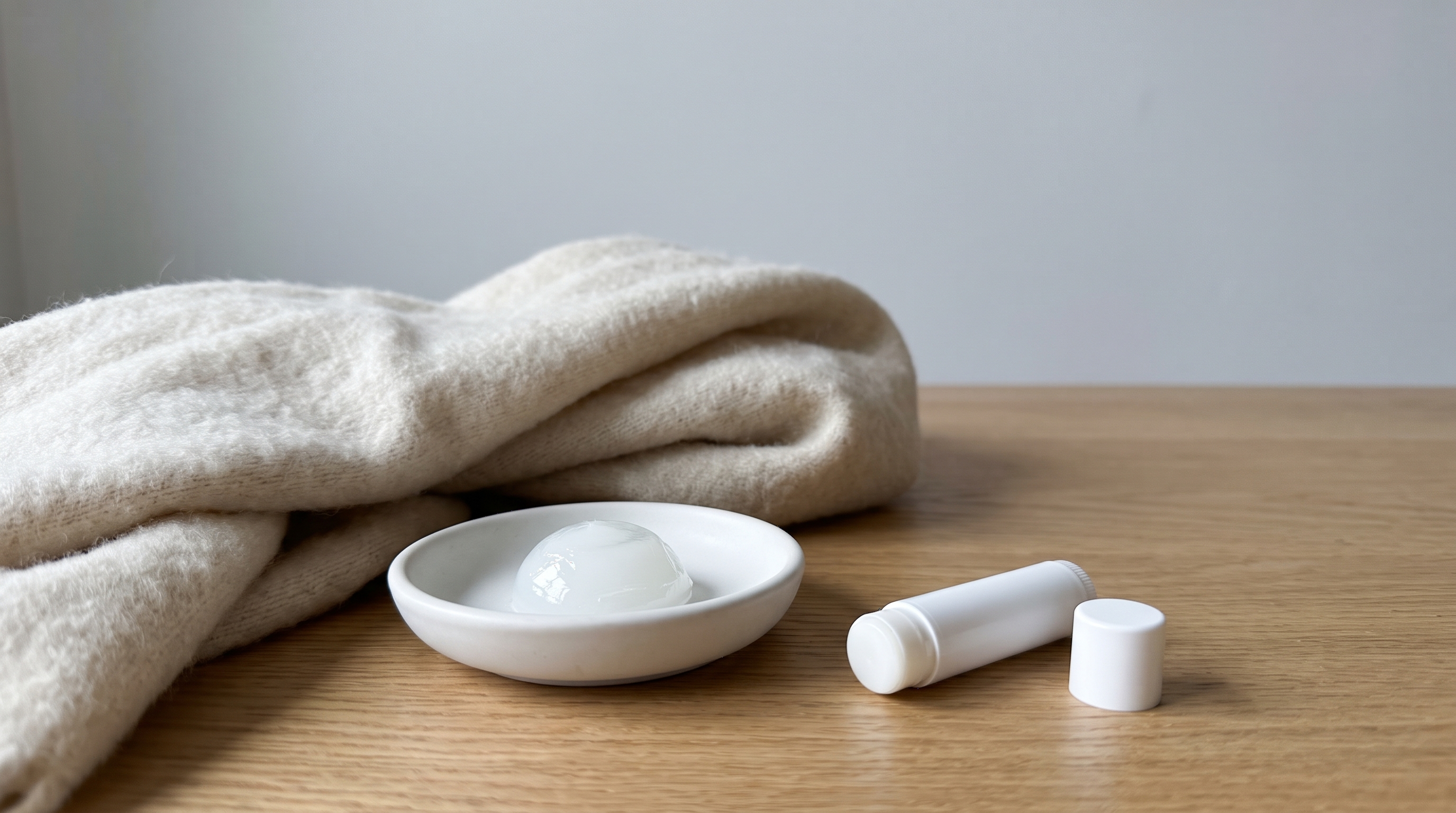
- Seal it at night. Press a thin layer of petroleum jelly or a plain ointment over the dry ring before bed. Petrolatum does more than sit on top: in barrier studies it moved into the outer skin layer and sped up repair after the barrier had been damaged [6].
- Protect it outdoors. Reapply a balm or ointment before you go out into wind or cold, and wear a scarf over the lower face on bitter days. Our guide to the best lip balm for dry lips explains which formulas seal and which only feel nice.
- Rinse after brushing. Wipe toothpaste off the skin around your mouth with water as soon as you finish, and consider switching to an unflavoured or low-foaming toothpaste for a few weeks.
Your skin around the mouth usually calms within 2 weeks once you stop licking it and seal it at night, much faster than if you keep changing products.
How to keep retinol from peeling your mouth corners
You do not need to give up retinol to stop the peeling. You need to stop it gathering in the wrong place.
Your skin around the mouth usually calms within 2 weeks once you stop licking it and seal it at night, much faster than if you keep changing products.
- Leave a gap. Apply retinol to the rest of the face but stop about a finger’s width from the lip line and the corners of the mouth.
- Shield the corners first. Dab a little petroleum jelly or balm on the mouth corners and the creases beside the nose before you apply any active.
- Use less, less often. A pea-sized amount covers the whole face. If the mouth area is already flaking, drop to every second or third night until it settles.
- Do not stack actives. An exfoliating acid and a retinol on the same night double the irritation where both collect.
The same pattern turns up around the nostrils, where actives pool in the folds in the same way; our guide to dry skin around the nose covers that area. For the broader seasonal picture, including humidifiers and shower habits, see our guide to winter dry skin.
When it is not just dryness
Some rashes around the mouth look like dryness but need a different approach, and heavy creams can make them worse.
Perioral dermatitis shows up as small red or skin-coloured bumps around the mouth, often with a clear band of normal skin right next to the lips, sometimes with scaling. It often follows the use of steroid creams on the face, and it usually needs treatment from a doctor rather than a richer moisturizer [5]. Our article on perioral dermatitis explains how to tell the two apart.
Angular cheilitis is soreness, redness and cracking at the corners of the mouth specifically. Saliva pooling in deep mouth-corner folds, ill-fitting dentures and yeast or bacterial infection can all play a part [3].
Contact allergy can cause an itchy, persistent rash around the lips that comes back whenever you use a particular toothpaste, lip product or cosmetic [4].
See a doctor if the rash has bumps or pustules, if the corners of the mouth are split and weeping, if it spreads to the nose or eyes, or if it has not improved after about three weeks of gentle care.
Gentler retinol for the lower face
The area around the mouth is also where fine lines and lip lines start to show, so many people want a retinoid there, and it is exactly where conventional formulas cause the most trouble. Many of them rely on solvents that loosen the skin’s lipid barrier to push retinol through, the same barrier that is already weakest around the lips.
Nanoretinol delivers 0.2% retinol inside biomimetic lipid nanoparticles in a light, water-based gel, so it does not depend on breaking the barrier down, and its side effects in clinical testing were minimal and milder than those of conventional retinol. In North Biomedical’s study it was 232% more effective in collagen recovery and 73% more effective in elastin recovery than conventional retinol [8]. Heal the dry ring first, then apply it at night with a small gap at the lip line, and seal the corners with a balm.
References
- Engebretsen KA, Johansen JD, Kezic S, Linneberg A, Thyssen JP. “The effect of environmental humidity and temperature on skin barrier function and dermatitis.” Journal of the European Academy of Dermatology and Venereology. 2016;30(2):223-249. doi:10.1111/jdv.13301
- Tamura E, Ishikawa J, Yasuda Y, Yamamoto T. “The efficacy of synthetic pseudo-ceramide for dry and rough lips.” International Journal of Cosmetic Science. 2021;43(2):158-164. doi:10.1111/ics.12677
- Park KK, Brodell RT, Helms SE. “Angular cheilitis, part 1: local etiologies.” Cutis. 2011;87(6):289-295. PubMed 21838086
- Francalanci S, Sertoli A, Giorgini S, Pigatto P, Santucci B, Valsecchi R. “Multicentre study of allergic contact cheilitis from toothpastes.” Contact Dermatitis. 2000;43(4):216-222. doi:10.1034/j.1600-0536.2000.043004216.x
- Tempark T, Shwayder TA. “Perioral dermatitis: a review of the condition with special attention to treatment options.” American Journal of Clinical Dermatology. 2014;15(2):101-113. doi:10.1007/s40257-014-0067-7
- Ghadially R, Halkier-Sorensen L, Elias PM. “Effects of petrolatum on stratum corneum structure and function.” Journal of the American Academy of Dermatology. 1992;26(3 Pt 2):387-396. PubMed 1564142
- Mukherjee S, Date A, Patravale V, Korting HC, Roeder A, Weindl G. “Retinoids in the treatment of skin aging: an overview of clinical efficacy and safety.” Clinical Interventions in Aging. 2006;1(4):327-348. doi:10.2147/ciia.2006.1.4.327
- North Biomedical LLC. “Nanoretinol vs. Conventional Retinol: Efficacy in Collagen and Elastin Recovery.” Clinical Study Summary, 2024. Study summary