Exfoliating Gloves: Do Korean Scrub Mitts Work, and Are They Safe?
What the grey rolls really are, what a hard scrub does to your skin barrier, how often to use a mitt, and how to keep it clean
Few skincare videos are as oddly satisfying as a Korean scrub mitt in action: a few firm passes over damp skin and grey rolls appear as if from nowhere. Exfoliating gloves are cheap, need no product and promise skin that feels smoother than any lotion can manage. They also raise fair questions. What exactly is coming off? Is it harming your skin barrier? And how often is too often?
Here is what the research says about scrubbing with a glove, and how to get the smoothness without the downsides.
What the Grey Rolls Really Are
The surface of your skin is a layer of flat, dead cells called corneocytes, stacked like roof tiles and glued together by lipids. They are meant to fall away. Desquamation, the continuous and invisible shedding of these cells, is how the skin renews its surface and clears away whatever has settled on it [1].
When you soak in warm water, those outer cells swell and loosen. A rough glove then rolls them up with sebum, sweat and any product left on the skin. The grey colour is simply what a clump of pale cells and oil looks like against your skin, not a sign of hidden dirt. Even freshly washed skin will produce rolls, because a mitt removes cells that were not quite ready to let go.
Your skin renews its outer layer in about 20 days when you are young, but the same process runs more than 10 days slower than that in older adults.
That slowdown is why older skin feels rough and looks dull. In a classic study using a fluorescent dye, the time it took for the outer layer to turn over lengthened by more than 10 days in older adults, and the decline steepened after about age 50 [2]. A glove speeds up the last step, the shedding; it does nothing to speed up the cells being made underneath.
Your skin renews its outer layer in about 20 days when you are young, but the same process runs more than 10 days slower than that in older adults.
Friction Has a Long-Term Cost
Scrubbing too hard for too long can mark the skin. Friction melanosis, sometimes called towel melanosis, is a brownish darkening over bony areas such as the collarbones, shoulder blades, shins and spine. In an Italian series of 24 patients, it was caused by years of cleaning the skin with cotton towels, horse-hair gloves or rough sponges [3]. The pigment fades only slowly once the rubbing stops.
The practical rule: a mitt should leave your skin pink at most, never red, stinging or raw. Skip bony areas or go very lightly over them.
Keep Your Glove Clean
A wet scrubbing tool hanging in a warm shower is an ideal place for bacteria to grow. When microbiologists traced a case of Pseudomonas folliculitis, an infection of the hair follicles, to a contaminated loofah, they found that loofah sponges supported the growth of several kinds of potentially harmful bacteria, and that skin cells trapped in the fibres fed that growth [4]. The authors noted the same risk applies to other exfoliating tools.
- Rinse the glove thoroughly after every use, turn it inside out and hang it to dry outside the shower.
- Wash it in the machine with your towels at least weekly.
- Replace it every few months, or sooner if it smells musty or stays damp.
- Never share it.
What a Hard Scrub Does to Your Skin Barrier
The best evidence on scrub mitts comes from Korea, where scrubbing the skin with a rough towel after a warm soak is a traditional bathing custom. Researchers at Seoul National University Hospital soaked volunteers’ forearms in warm water for five minutes, then scrubbed patches 5, 10 or 15 times with a rough towel [5].
After a single scrub, the skin’s ability to hold water dropped for about six hours, and water loss through the skin, a sign of barrier stress, peaked on the second day before settling. When volunteers scrubbed regularly over a longer period, hydration and barrier function did not change, but the skin’s turnover time shortened.
Your skin needed about 3 days to settle after a single hard scrub in a Korean study, so scrubbing again sooner than that never lets it fully recover.
Your skin needed about 3 days to settle after a single hard scrub in a Korean study, so scrubbing again sooner than that never lets it fully recover.
In other words, the skin adapts to occasional scrubbing, but each session is a small injury that takes a couple of days to repair. That matters more as you age. Older skin has fewer barrier lipids and repairs its barrier more slowly after damage [6], so the same scrub costs mature skin more.
How to Use an Exfoliating Glove
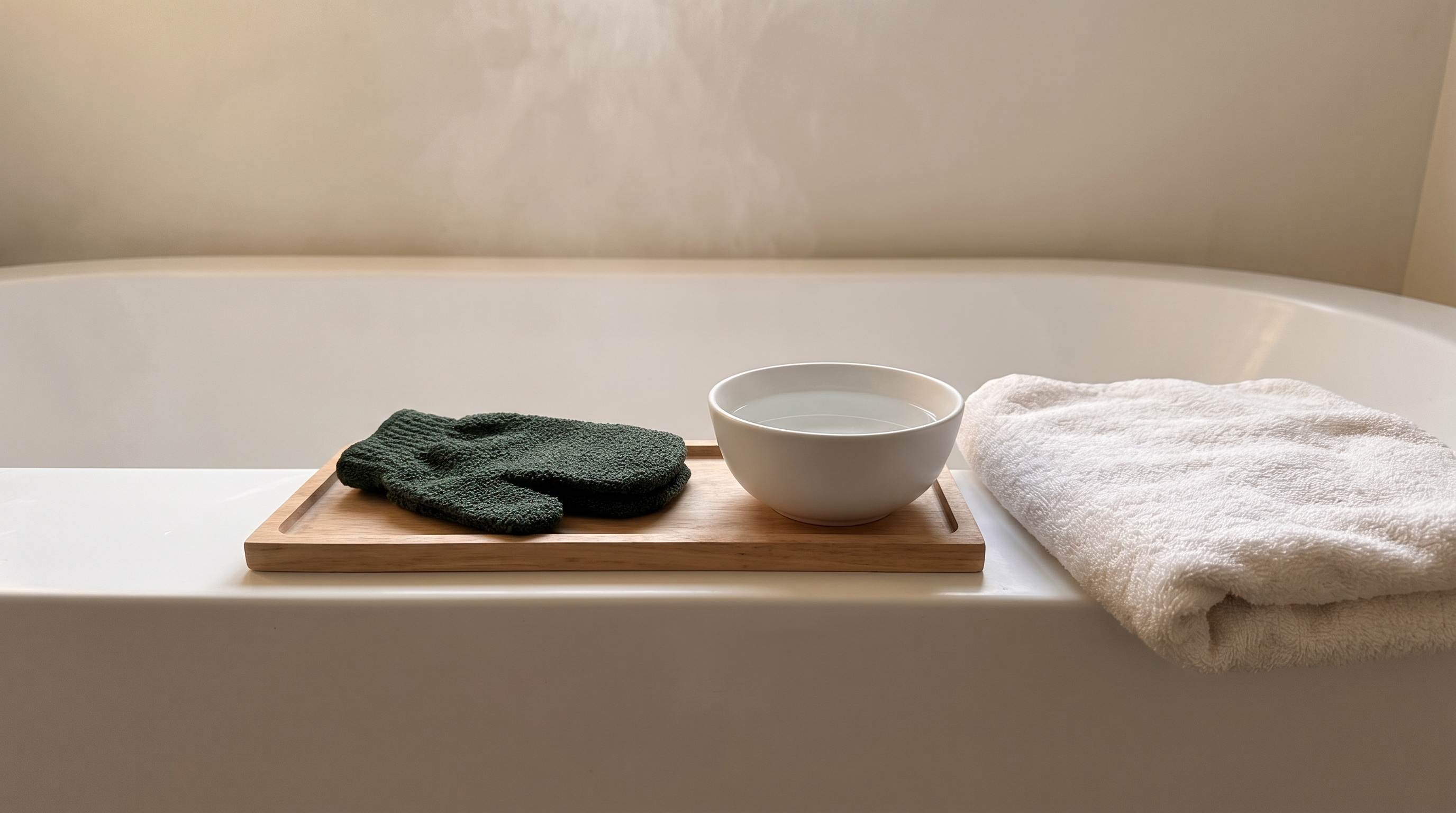
- Soak first. Spend at least five to ten minutes in a warm shower or bath so the outer layer softens.
- Use a damp, not soapy, glove. Cleanser makes the mitt glide without gripping, so many people scrub before washing.
- Work in long strokes with light to moderate pressure, one area at a time, and stop when rolls appear.
- Avoid the face, breasts, genitals, and any broken, sunburned or irritated skin.
- Moisturise straight away while skin is still slightly damp.
Once a week is plenty for most people; twice a week only if your skin stays calm. If you prefer something gentler, our guides to dry brushing and an exfoliating body wash compare mechanical and acid-based options.
Who Should Skip the Mitt
- Anyone using a retinoid on the same area. Retinoids already speed shedding and make the surface more reactive; adding a scrub on top invites redness and stinging.
- People with eczema, psoriasis, rosacea or very thin, fragile skin.
- Anyone prone to dark marks after irritation, since friction can leave pigmentation that lasts longer than the smoothness.
If your skin is rough and bumpy rather than simply dull, the cause may be a follicle problem that scrubbing aggravates; our article on rough, bumpy skin explains how to tell the difference.
The Limits of Scrubbing
A glove removes cells that are already on their way out. It cannot rebuild the collagen that makes skin firm, or speed up the renewal happening deeper down. That is the job of a retinoid. In a study of adults with a mean age of 87, a 0.4% retinol lotion applied to the arms improved fine wrinkling and increased collagen production compared with the base lotion alone over 24 weeks [7]. Our guide to retinol for the body covers where it helps most.
A Gentler Way to Renew Skin
Many conventional retinol formulas rely on chemicals and petroleum derivatives that loosen the lipids of the skin barrier to push the active in, which is exactly the kind of damage you are trying to avoid when you put the mitt down.
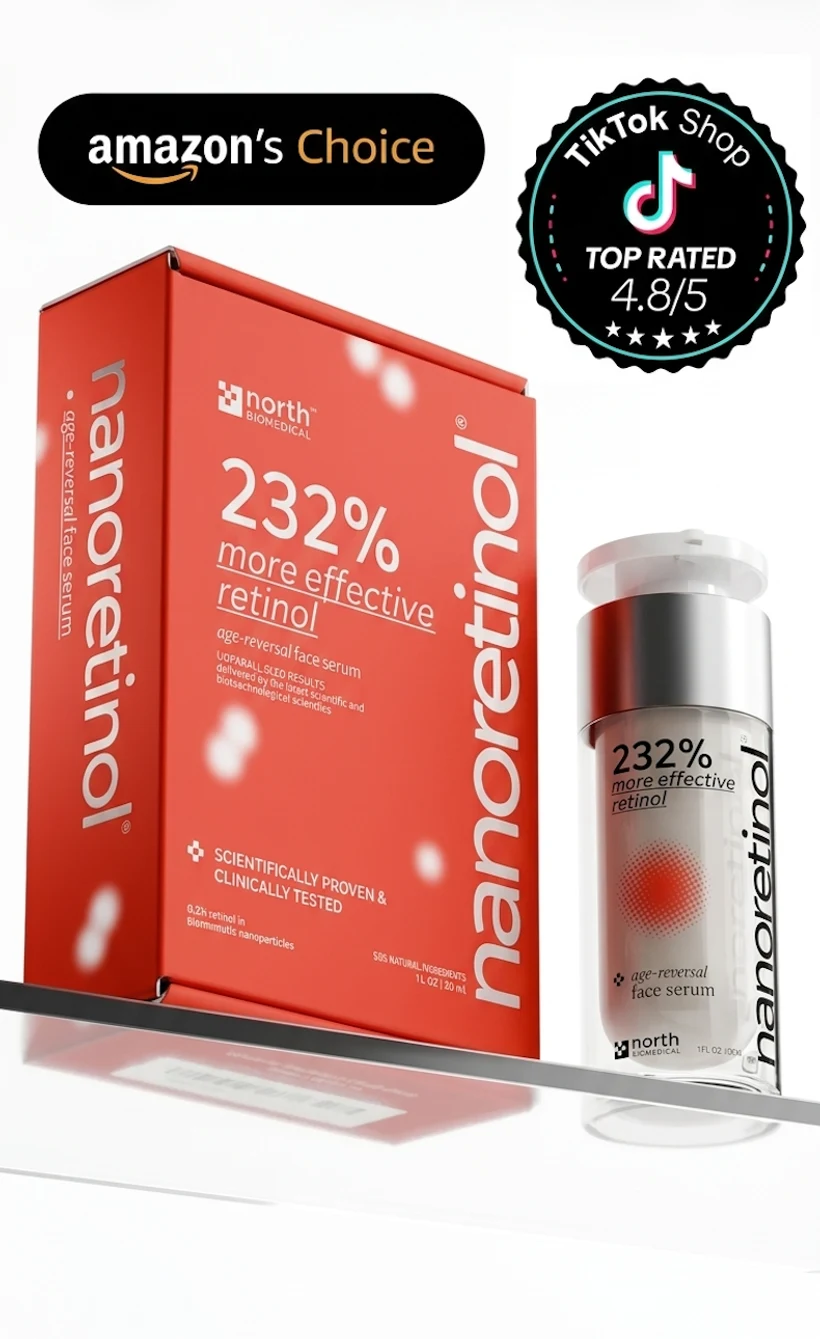
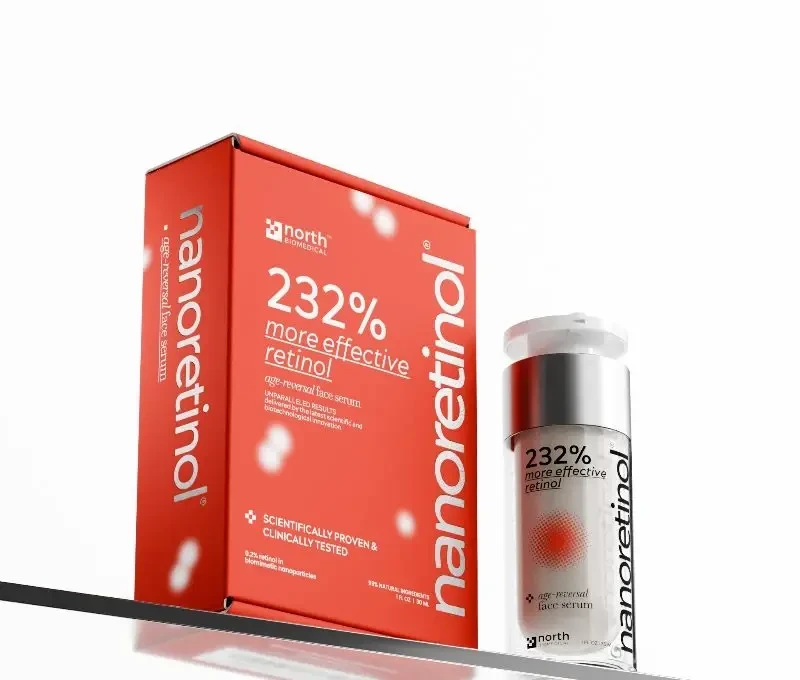
Nanoretinol, from North Biomedical, carries 0.2% retinol inside biomimetic lipid nanoparticles that the skin recognises as its own, so the active crosses the barrier without breaking it down. The water-based gel absorbs completely to a smooth matte finish and is made with 99% natural ingredients. In laboratory testing it was 232% more effective than conventional retinol in collagen recovery, and in clinical use it increased skin firmness by 61% and elasticity by 56% in 56 days, with side effects that, when present, were milder than those of conventional retinol. Use it at night on skin you have not scrubbed that day, and wear sunscreen the next morning.
Smooth, Not Sanded
An exfoliating glove is a useful, inexpensive tool when it is used gently, about once a week, on soaked skin, and kept clean between uses. Treat it as polish, not repair: let the mitt clear the surface, and let a well-tolerated retinol and a good moisturiser do the slow work underneath.
References
- Milstone LM. “Epidermal desquamation.” Journal of Dermatological Science. 2004;36(3):131-140. doi:10.1016/j.jdermsci.2004.05.004
- Grove GL, Kligman AM. “Age-associated changes in human epidermal cell renewal.” Journal of Gerontology. 1983;38(2):137-142. doi:10.1093/geronj/38.2.137
- Siragusa M, Ferri R, Cavallari V, Schepis C. “Friction melanosis, friction amyloidosis, macular amyloidosis, towel melanosis: many names for the same clinical entity.” European Journal of Dermatology. 2001;11(6):545-548. PubMed: 11701405
- Bottone EJ, Perez AA 2nd, Oeser JL. “Loofah sponges as reservoirs and vehicles in the transmission of potentially pathogenic bacterial species to human skin.” Journal of Clinical Microbiology. 1994;32(2):469-472. doi:10.1128/jcm.32.2.469-472.1994
- Huh CH, Seo KI, Kim SD, Han JH, Eun HC. “Biophysical changes after mechanical injury of the stratum corneum in normal skin.” Contact Dermatitis. 2002;46(1):24-28. doi:10.1034/j.1600-0536.2002.460105.x
- Elias PM, Ghadially R. “The aged epidermal permeability barrier: basis for functional abnormalities.” Clinics in Geriatric Medicine. 2002;18(1):103-120. PubMed: 11913735
- Kafi R, Kwak HS, Schumacher WE, et al. “Improvement of naturally aged skin with vitamin A (retinol).” Archives of Dermatology. 2007;143(5):606-612. doi:10.1001/archderm.143.5.606