Hand Scrub: What It Can Fix, What It Can't, and How to Choose One
A good hand scrub smooths rough, dull skin in a minute. It will not fade age spots or firm crepey skin. Sugar vs salt vs beads, gentle acid alternatives, how often to scrub, and when to skip it
Hands get a rough deal. They are washed more than any other part of the body, they spend the most time in the sun, and they rarely get the care we give our faces. By midwinter the backs can look dull and papery, the knuckles rough, the skin around the nails ragged.
A hand scrub is the quickest way to change that. A minute of gentle polishing at the sink lifts the dull layer of dead skin and leaves hands noticeably softer. But it is worth being clear about what a scrub does, because the things that make hands look older, such as crepey texture and brown spots, start below the layer a scrub can reach.
What a hand scrub actually does
The outer layer of your skin is a sheet of flattened dead cells that the body sheds slowly and continuously. When skin is dry, those cells cling together instead of flaking away invisibly, and the surface turns rough, grey and light-scattering. A scrub uses small particles to loosen and sweep away that clinging layer.
That is useful, and it is also the limit. Exfoliation smooths the surface and helps creams spread evenly, which makes it a supporting step rather than a treatment on its own. It does not rebuild collagen, it does not reach the pigment cells that make age spots, and it cannot restore the fat and volume the back of the hand loses with age. A systematic review of hand rejuvenation studies found that treatments target two kinds of change, volume loss and surface wrinkling, and the volume side is restored with procedures such as fillers or fat grafting, not with anything rubbed on at a sink [1].
Your skin on the backs of your hands looks dull mostly from clinging dead cells, which a gentle 60-second scrub lifts away, but it cannot reach anything deeper than that.
Sugar, salt or beads: choosing a scrub
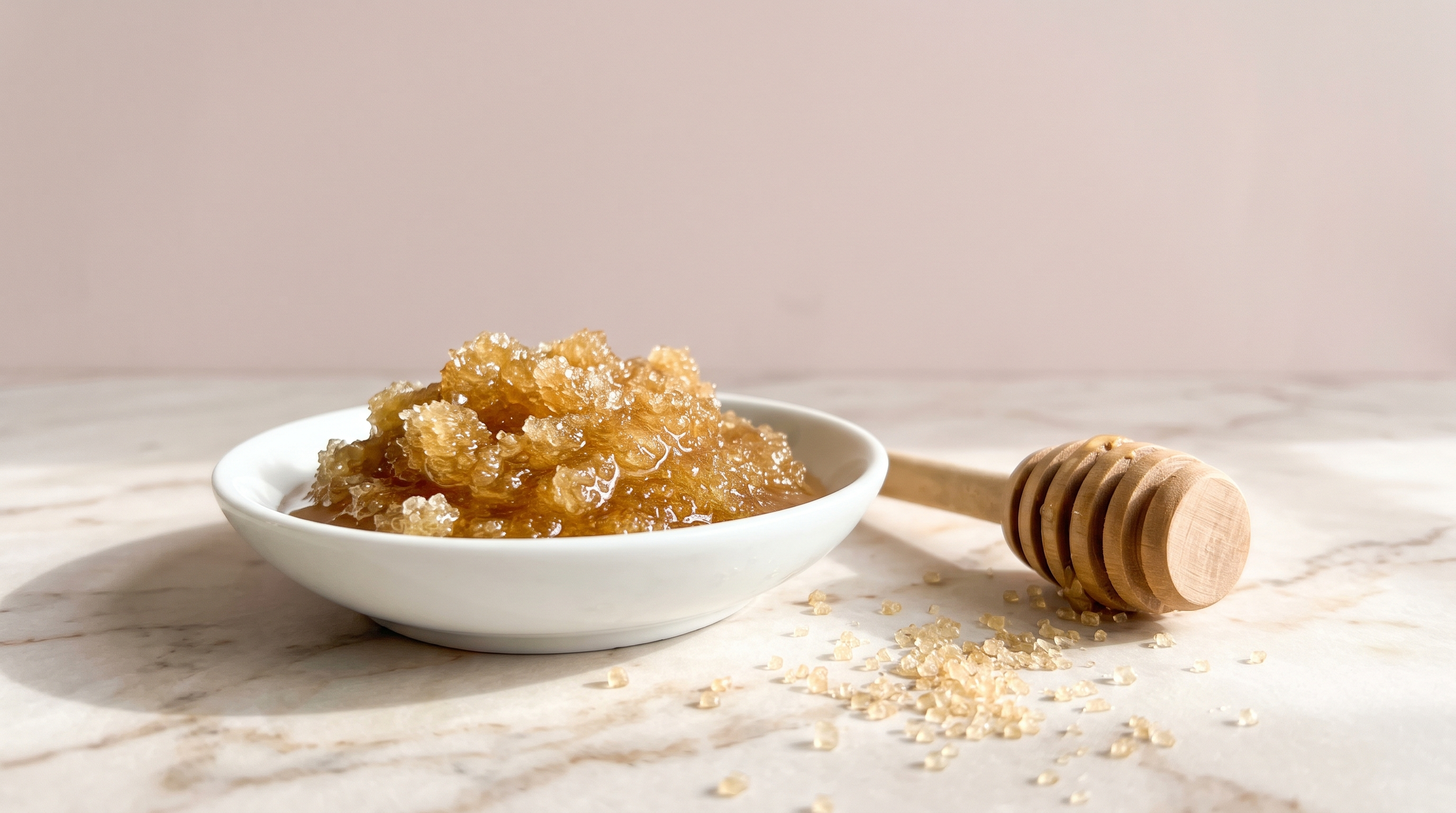
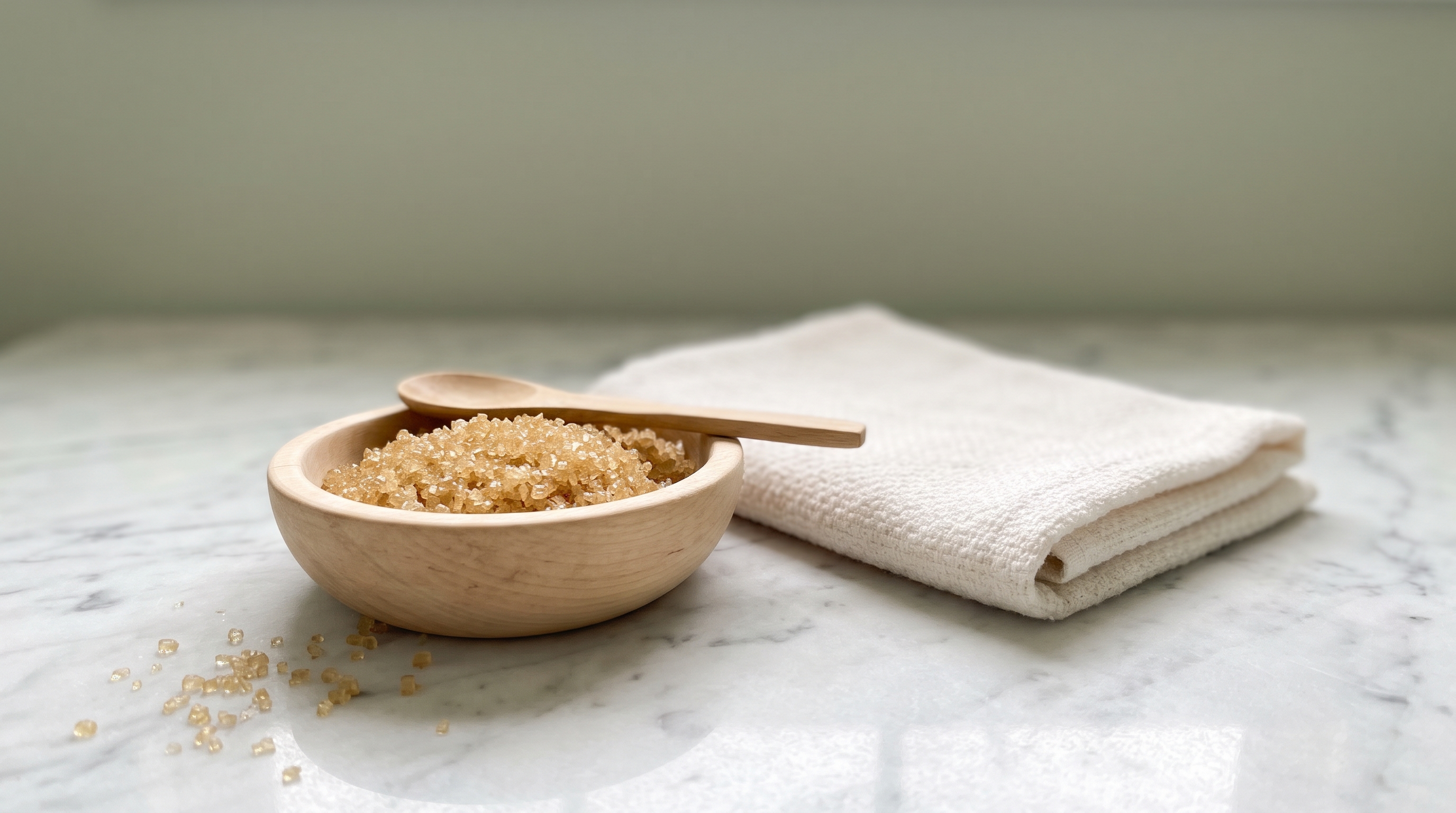
Sugar scrubs are the gentlest common option. Sugar crystals are relatively soft, they partly dissolve as you rub, which rounds their edges, and sugar is a humectant that pulls a little water into the skin. Most hand scrubs for dry or aging skin are sugar-based for good reason.
Your skin on the backs of your hands looks dull mostly from clinging dead cells, which a gentle 60-second scrub lifts away, but it cannot reach anything deeper than that.
Salt scrubs are coarser and sharper. They work well on thick skin such as feet and elbows but can sting on the hands, especially around the cuticles or on any small cut.
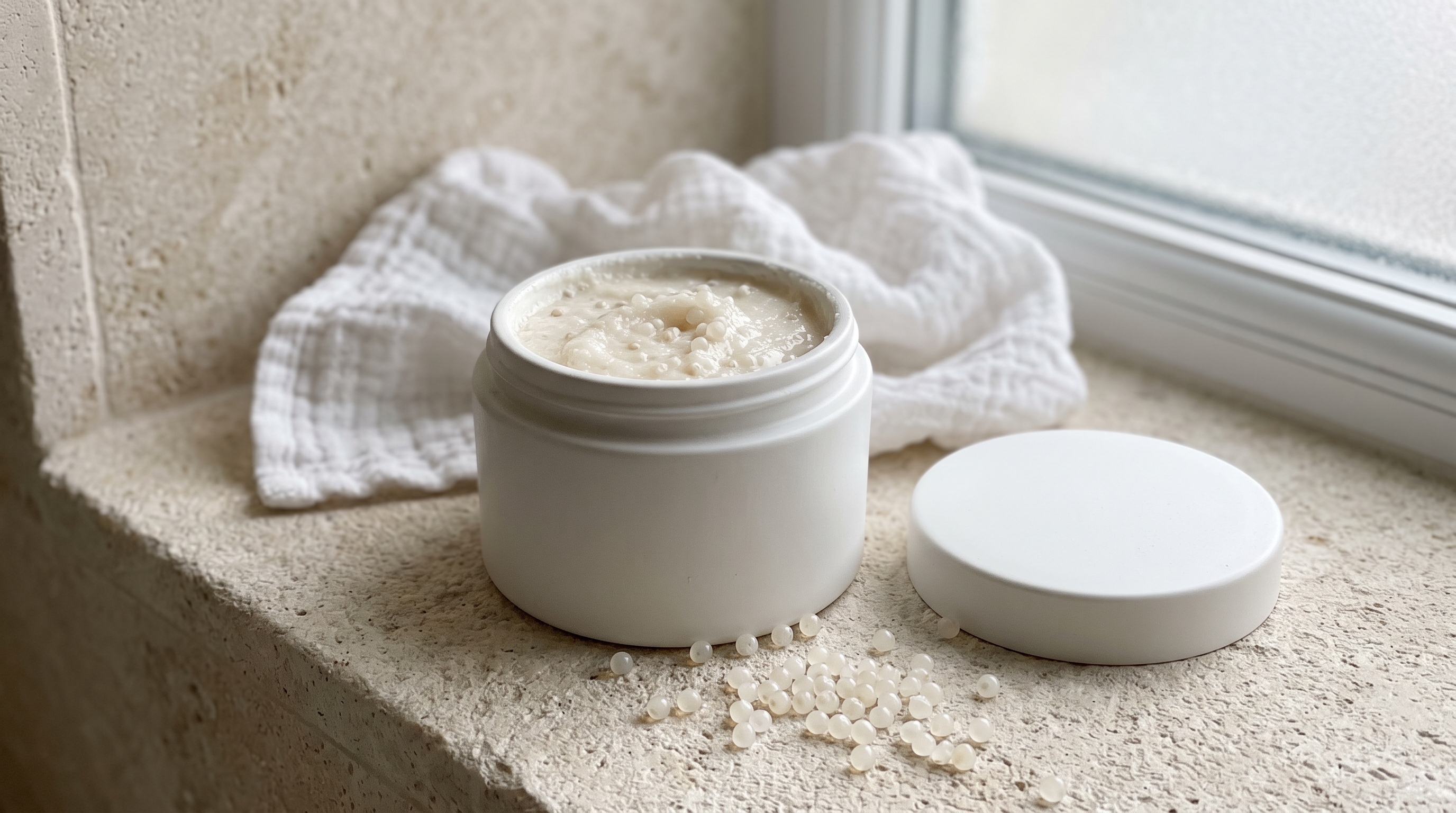
Jojoba beads and other wax beads are smooth, round and uniform. They are the gentlest physical option and suit sensitive skin. Plastic microbeads were banned from rinse-off cosmetics under a 2015 US law, so a modern bead scrub should use wax or plant-based beads.
Ground shells, pits and pumice are the harshest. Jagged particles can scratch skin, and they are best left for heels.
Whatever the particle, the base matters as much. Look for a scrub suspended in oil or a rich cream rather than a foaming soap, so the hands are cushioned while you scrub and left with a film of moisture afterward. Skip strong fragrance if your hands are already dry or irritated.
Gentle acids: the scrub-free alternative
If your hands are sensitive or you prefer not to scrub, a lotion with lactic acid or glycolic acid does a similar job chemically. These alpha-hydroxy acids loosen the bonds between dead cells so they shed evenly, and at higher strengths they act deeper too [2].
Your skin can grow firmer after 3 months of a 12% lactic acid lotion, a deeper change than any scrub is designed to make.
In a 3-month trial, people applied 5% or 12% lactic acid twice a day. Both strengths smoothed the skin and improved its texture, but only the 12% strength also thickened and firmed the deeper dermis [3]. That makes a lactic acid hand lotion a more useful long-term step for aging hands than a scrub, although it should not be layered with a scrub on the same day. Acids can also increase sun sensitivity [2], so use them at night and wear sunscreen on your hands.
Your skin can grow firmer after 3 months of a 12% lactic acid lotion, a deeper change than any scrub is designed to make.
How to use a hand scrub without overdoing it
- Start with damp hands. Wet them with lukewarm water, not hot.
- Use a small amount. About a teaspoon is plenty for both hands.
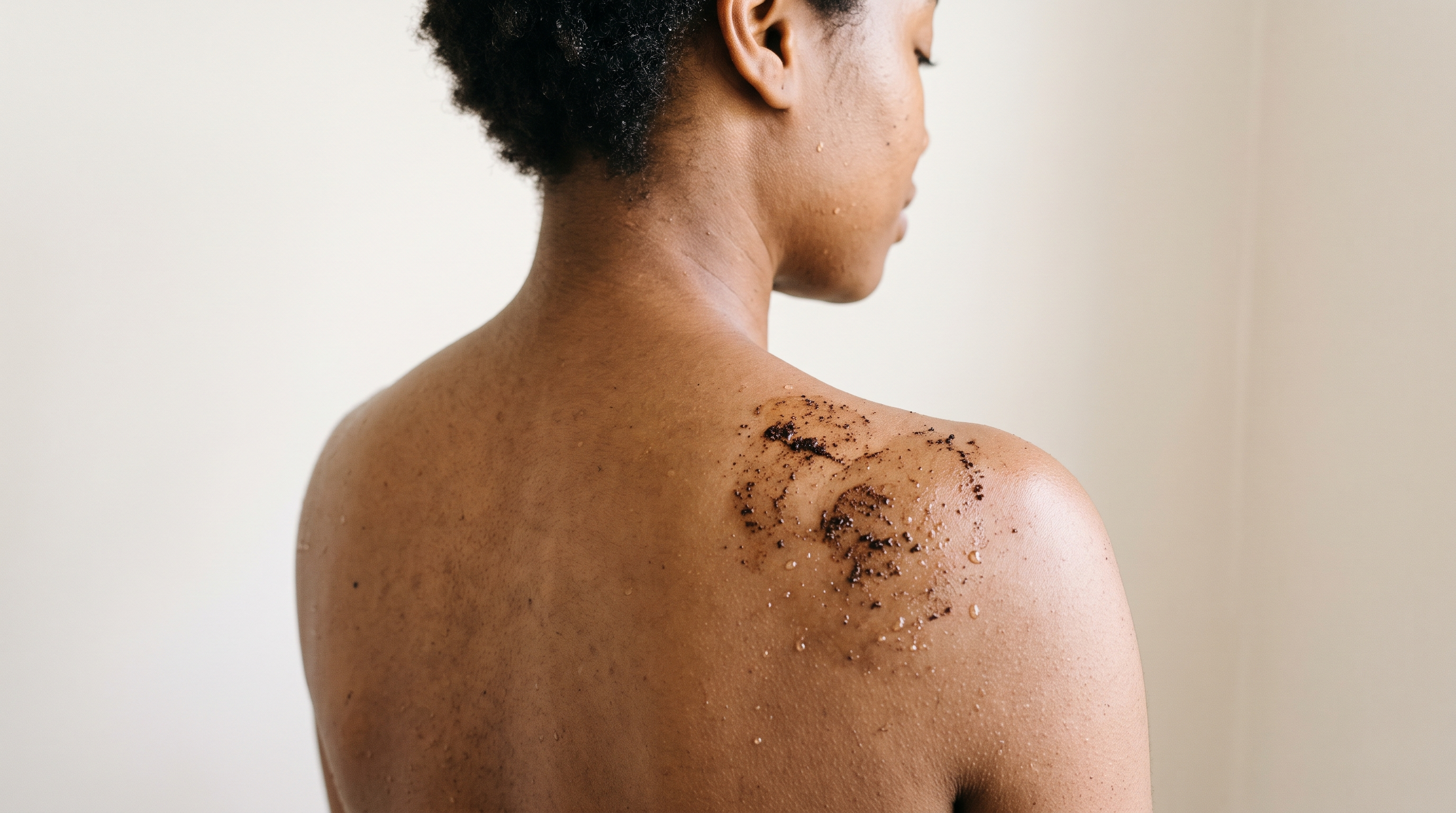
- Massage gently for 30 to 60 seconds. Use light circles on the backs of the hands, knuckles and around the nails. Let the particles do the work; pressing harder does not help.
- Rinse and pat dry. Leave a little moisture on the skin.
- Moisturize immediately. This step matters more than the scrub. Freshly exfoliated skin loses water easily, and moisturizers measurably protect hands against repeated washing [4].
Once or twice a week is enough for most people. Daily scrubbing strips the barrier faster than it can repair, which leaves hands redder, rougher and more sensitive, the opposite of the goal.
Skip the scrub when:
- Your hands have cracks, cuts or fissures
- You have eczema, a rash or any patch that itches or weeps
- Your skin is red or stinging from a new product
- You applied a retinoid or an acid to your hands that night
What actually changes aging hands
If the goal is younger-looking hands rather than just softer ones, the scrub is the warm-up. The real work happens with ingredients that act below the surface and with daily sun protection, since sun exposure drives most of the visible aging on the backs of the hands.
Retinoids have the strongest evidence. In a 10-month trial of a prescription retinoid on sun-related brown spots, 83% of people with spots on the face saw them lighten, compared with 29% on a plain cream, and spots on the arms responded similarly [5]. Over-the-counter retinol has evidence too: in a 24-week trial in very elderly people, a 0.4% retinol lotion on the arm significantly improved fine wrinkling and increased collagen production compared with the untreated arm [6]. Our guides to age spots on hands and crepey hands go deeper on each concern.
A simple weekly rhythm works well: scrub once or twice a week in the evening, use a hand serum or retinol on the other nights, and apply hand cream and sunscreen every morning.
Where Nanoretinol fits
The catch with retinol on hands is irritation. The backs of the hands have thin, frequently washed skin, and many conventional retinol formulas use solvents that loosen the skin’s lipid barrier to force retinol through, which shows up as dryness and peeling. Nanoretinol delivers 0.2% retinol inside biomimetic lipid nanoparticles in a light, water-based gel that absorbs completely, so it does not need to break the barrier down to work. In North Biomedical’s study it was 232% more effective in collagen recovery and 73% more effective in elastin recovery than conventional retinol, with a 61% increase in skin firmness after 56 days [7]. Apply a thin layer to the backs of the hands at night, on nights you have not scrubbed, then seal with hand cream. Let the scrub polish the surface, and let retinol rebuild what sits beneath it.
References
- Ovadia SA, Efimenko IV, Lessard AS. “Dorsal Hand Rejuvenation: A Systematic Review of the Literature.” Aesthetic Plastic Surgery. 2021;45(4):1804-1825. doi:10.1007/s00266-020-02077-3
- Kornhauser A, Coelho SG, Hearing VJ. “Applications of hydroxy acids: classification, mechanisms, and photoactivity.” Clinical, Cosmetic and Investigational Dermatology. 2010;3:135-142. doi:10.2147/CCID.S9042
- Smith WP. “Epidermal and dermal effects of topical lactic acid.” Journal of the American Academy of Dermatology. 1996;35(3 Pt 1):388-391. PubMed 8784274
- Williams C, Wilkinson SM, McShane P, et al. “A double-blind, randomized study to assess the effectiveness of different moisturizers in preventing dermatitis induced by hand washing to simulate healthcare use.” British Journal of Dermatology. 2010;162(5):1088-1092. doi:10.1111/j.1365-2133.2010.09643.x
- Rafal ES, Griffiths CE, Ditre CM, et al. “Topical tretinoin (retinoic acid) treatment for liver spots associated with photodamage.” New England Journal of Medicine. 1992;326(6):368-374. doi:10.1056/NEJM199202063260603
- Kafi R, Kwak HS, Schumacher WE, et al. “Improvement of naturally aged skin with vitamin A (retinol).” Archives of Dermatology. 2007;143(5):606-612. doi:10.1001/archderm.143.5.606
- North Biomedical LLC. “Nanoretinol vs. Conventional Retinol: Efficacy in Collagen and Elastin Recovery.” Clinical Study Summary, 2024. Study summary