Eye Gel: What It Can Do for Puffiness and Fine Lines, and When You Need a Cream
A cool, light gel is the most pleasant thing you can put under your eyes in the morning. Here is what the evidence says it changes, what it cannot, and how to choose one
Eye gels sell on a feeling. You press a cool, clear jelly under your eyes in the morning, it vanishes in seconds, and the puffy, tired look seems to fade a little. That feeling is real, but it is only part of what a good eye gel can do, and it is easy to pay for the sensation rather than the ingredients.
This guide explains what makes a gel different from an eye cream, which ingredients have been tested on the eye area, and when a gel is the wrong choice.
Why the eye area needs its own product
The skin of the eyelids is the thinnest on the face. In a study that measured skin at 15 facial sites, the upper eyelid was the thinnest in every subject, and the skin of the forehead was about 2.8 times thicker [1]. Thin skin has less dermis to hide the blood vessels and fluid underneath, and it creases more easily every time you smile or squint.
Your eyelid skin is so thin that the skin on your forehead is nearly 3 times thicker, which is why lines and puffiness show there first.
That thinness is also why the eye area reacts badly to heavy fragrance, strong acids and high-strength actives. An eye product does not need to be magic, but it does need to be gentle, light and well tested near the eyes.
Gel, cream or serum: what the format changes
The difference between an eye gel and an eye cream is mostly about water and oil.
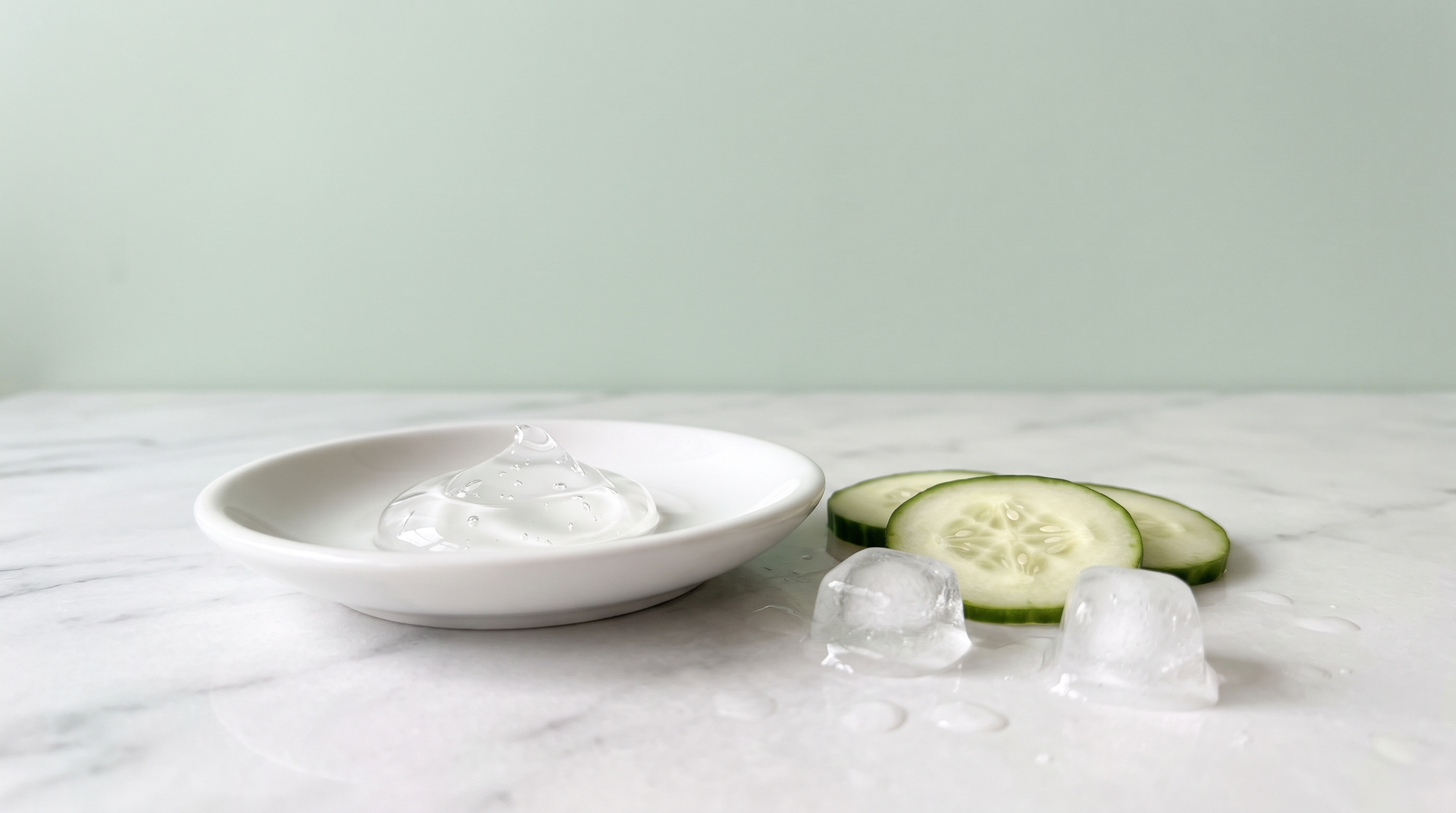
A gel is mainly water thickened with a polymer such as carbomer, xanthan gum or a cellulose. It has little or no oil, so it sinks in fast, leaves no film and sits well under concealer. Its weakness is the same thing: with little to seal the surface, it does less to stop water escaping from dry skin.
Your eyelid skin is so thin that the skin on your forehead is nearly 3 times thicker, which is why lines and puffiness show there first.
A cream is an emulsion of water and oils. It feels richer, slows water loss better and suits dry or crepey lids, but it can feel heavy in the morning and can migrate into the eyes if overapplied.
A serum is usually a thin, concentrated liquid layered under either one. If you are weighing the three, our guide to eye serum vs eye cream covers how to layer them.
The cooling effect of a gel comes from simple physics. Water evaporating from the skin takes heat with it, and many people keep their gel in the fridge, which adds to the chill. Cold narrows small blood vessels for a short time, which can make a puffy, pink morning eye look calmer for an hour or two. It does not drain fluid for the rest of the day, and it does not change the skin.
What causes the puffiness a gel is trying to fix
Morning puffiness is mostly fluid. When you lie flat, fluid collects in the loose tissue around the eyes, and salt, alcohol, allergies and poor sleep make it worse. That kind of swelling usually settles within a few hours of being upright.
Puffiness that is there all day is often something else: fat pads behind the lower lid that bulge forward with age, or a hollow under the bag that casts a shadow. A review of dark circles under the eyes lists these structural causes, along with pigment and visible blood vessels, and notes that each needs a different approach [2]. No gel will move fat. If your bags look the same at 6 pm as at 7 am, our guide to puffy eyes explains the causes that skincare can and cannot reach.
Eye gel ingredients with real evidence
Caffeine
Caffeine is the classic de-puffing ingredient. It is a small molecule that passes through the skin barrier readily, it has antioxidant activity, and it increases blood flow in the skin’s small vessels; most cosmetic formulas use about 3% [3]. In a small 4-week study, 11 women wore a pad with 3% caffeine and 1% vitamin K under one eye and a water-only pad under the other, and the treated side showed shallower wrinkles and lighter dark circles [4]. That is a tiny study of a pad, not a gel, but it fits the mechanism.
Your skin around the eyes can look smoother after just 4 weeks of a well-made eye product, far sooner than the months that collagen repair takes.
Hyaluronic acid
Hyaluronic acid holds water in the outer layer of skin, which plumps fine dryness lines for a while. In a 60-day study of 76 women aged 30 to 60, creams with 0.1% hyaluronic acid improved hydration and elasticity around the eyes compared with a plain cream on the other side, and the two smallest molecular weights also reduced wrinkle depth [5]. Hyaluronic acid fits a gel naturally, because both are water-based.
Peptides and niacinamide
Peptides and niacinamide have been tested together in eye products. In two split-face studies of women aged 30 to 70, an eye cream with niacinamide, two signalling peptides, carnosine and caffeine improved the smoothness of crow’s feet after 4 weeks of twice-daily use, measured with 3-D imaging [6]. These ingredients work as well in a gel base as in a cream.
Your skin around the eyes can look smoother after just 4 weeks of a well-made eye product, far sooner than the months that collagen repair takes.
Who should choose a cream instead
A gel is a good fit for oily or combination skin, for mornings, for anyone who wears concealer, and for puffiness that comes and goes. It is a weaker choice in a few situations:
- Dry, flaky or crepey lids. Thin, dry skin needs oils or occlusives to slow water loss, so a cream or a gel followed by a light balm works better.
- Winter and dry climates. Many people use a gel in the morning and a cream at night.
- Sensitive eyes. Look for fragrance-free formulas, and keep any product a few millimetres from the lash line.
If puffiness is your main concern and you want a richer texture, our roundup of the best eye cream for puffy eyes covers the cream options.
How to use an eye gel
- Take a rice-grain amount for both eyes. More product does not mean more effect, and excess can migrate into the eyes.
- Tap it along the orbital bone with your ring finger, working outward. Avoid the lash line and the moving lid.
- Let it absorb for a minute before concealer, or it can pill.
- For the strongest cooling effect, store it in the fridge.
Fine lines need more than a gel
A gel can calm a puffy morning and keep the area hydrated, but lines and crepey texture come from a slower loss of collagen in that thin skin. Retinol is the over-the-counter ingredient with the strongest evidence for rebuilding it. In a 24-week trial in adults over 80, 0.4% retinol improved fine wrinkling and increased collagen production compared with the vehicle [7].
The problem is that the eye area is exactly where conventional retinol stings and flakes most. Our guide to retinol around the eyes explains how to introduce it safely.
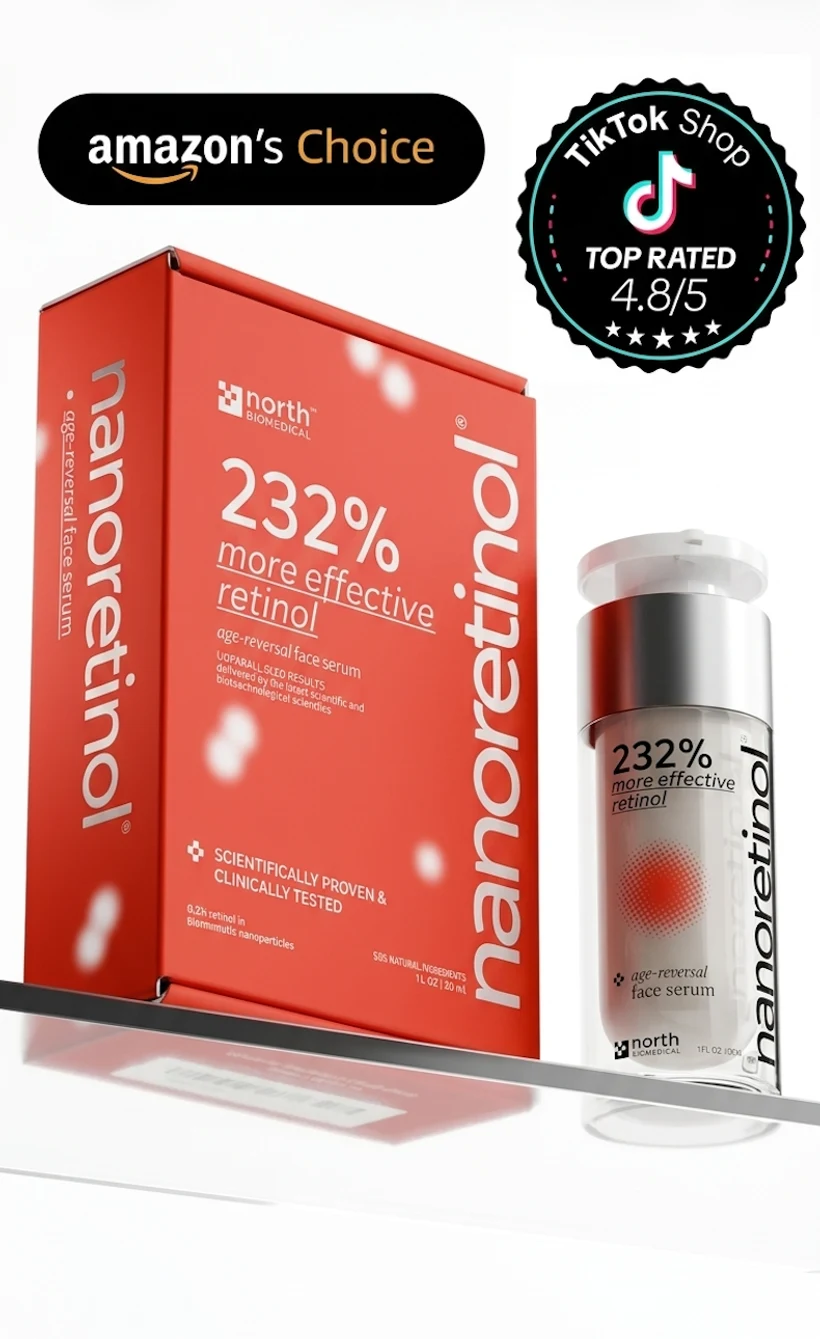
Nanoretinol was built for that trade-off, and its texture fits an eye-gel routine. It is a light, water-based gel with 0.2% retinol carried in biomimetic lipid nanoparticles, and it is safe for the eye contour. In North Biomedical’s clinical study it was 232% more effective in collagen recovery and 73% more effective in elastin recovery than conventional retinol, and users saw a 61% increase in skin firmness and a 56% increase in elasticity after 56 days, with milder side effects than conventional retinol [8].
Use your cooling eye gel in the morning, Nanoretinol at night, and sunscreen every day.
References
- Ha RY, Nojima K, Adams WP Jr, Brown SA. “Analysis of Facial Skin Thickness: Defining the Relative Thickness Index.” Plastic and Reconstructive Surgery. 2005;115(6):1769-1773. doi:10.1097/01.prs.0000161682.63535.9b
- Vrcek I, Ozgur O, Nakra T. “Infraorbital Dark Circles: A Review of the Pathogenesis, Evaluation and Treatment.” Journal of Cutaneous and Aesthetic Surgery. 2016;9(2):65-72. doi:10.4103/0974-2077.184046
- Herman A, Herman AP. “Caffeine’s Mechanisms of Action and Its Cosmetic Use.” Skin Pharmacology and Physiology. 2013;26(1):8-14. doi:10.1159/000343174
- Ahmadraji F, Shatalebi MA. “Evaluation of the Clinical Efficacy and Safety of an Eye Counter Pad Containing Caffeine and Vitamin K in Emulsified Emu Oil Base.” Advanced Biomedical Research. 2015;4:10. doi:10.4103/2277-9175.148292
- Pavicic T, Gauglitz GG, Lersch P, Schwach-Abdellaoui K, Malle B, Korting HC, Farwick M. “Efficacy of Cream-Based Novel Formulations of Hyaluronic Acid of Different Molecular Weights in Anti-Wrinkle Treatment.” Journal of Drugs in Dermatology. 2011;10(9):990-1000. PubMed: 22052267
- Kaczvinsky JR, Griffiths CE, Schnicker MS, Li J. “Efficacy of Anti-Aging Products for Periorbital Wrinkles as Measured by 3-D Imaging.” Journal of Cosmetic Dermatology. 2009;8(3):228-233. doi:10.1111/j.1473-2165.2009.00444.x
- Kafi R, Kwak HS, Schumacher WE, Cho S, Hanft VN, Hamilton TA, et al. “Improvement of Naturally Aged Skin with Vitamin A (Retinol).” Archives of Dermatology. 2007;143(5):606-612. doi:10.1001/archderm.143.5.606
- North Biomedical LLC. “Nanoretinol vs. Conventional Retinol: Efficacy in Collagen and Elastin Recovery.” Clinical Study Summary, 2024. Study summary