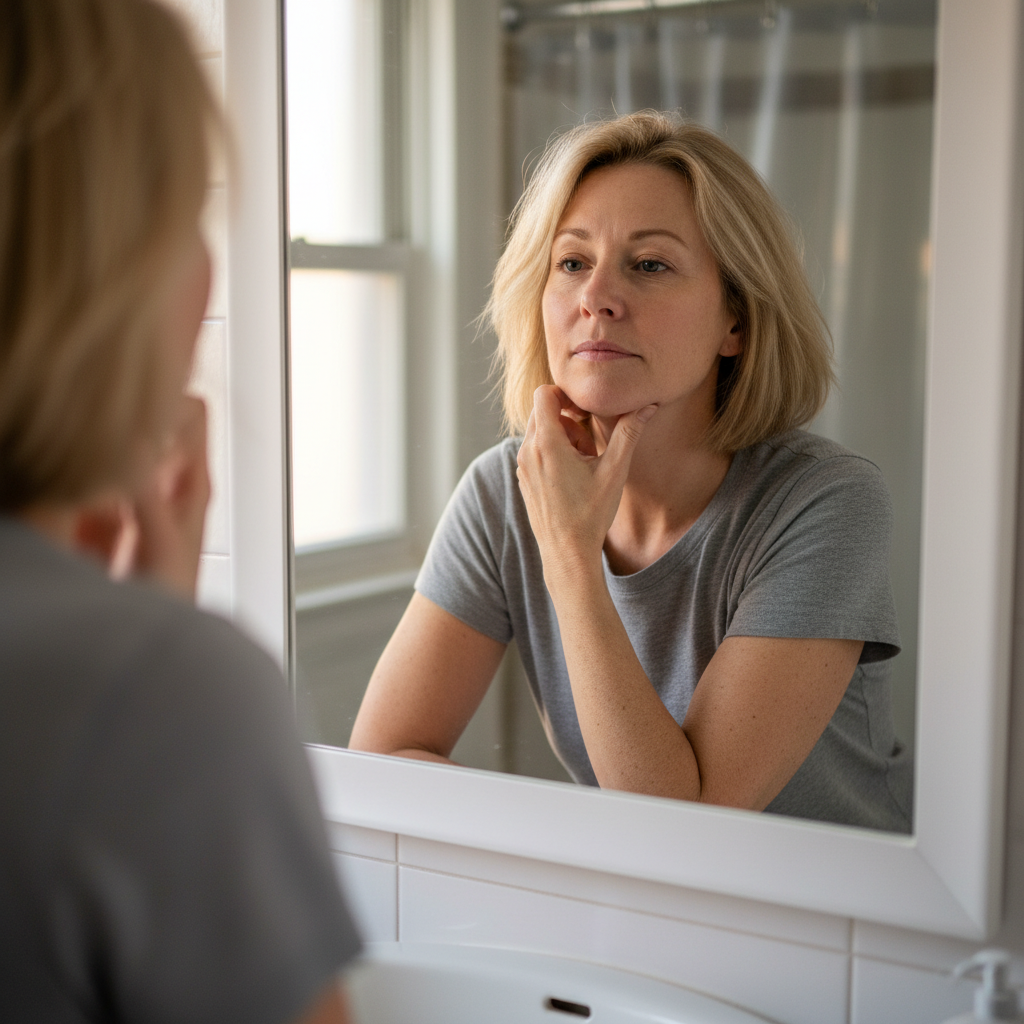
How to Get Rid of Jowls: What the Science Says About a Sagging Jawline
Jowls form because of structural changes in bone, fat, and muscle — and that changes which treatments are actually worth trying
Why Jowls Form — And Why It’s Not Just About Loose Skin
Jowls are the soft tissue that sags below the jawline, obscuring the sharp definition that characterizes a younger face. They tend to appear in the forties, accelerate after menopause, and are consistently among the most-asked-about concerns in anti-aging skincare.
The common framing — that jowls are simply “loose skin” — leads to a lot of wasted effort on solutions that can’t address the actual problem. Firming creams and facial exercises have their place, but they cannot counteract the structural forces driving jowl formation if you don’t understand what those forces are.
Research into facial anatomy has identified four independent processes that interact to create jowls: skeletal resorption, fat pad displacement, retaining ligament laxity, and dermal collagen loss [3]. Treating any one in isolation produces limited results. Understanding all four points toward a more rational approach to both prevention and treatment.
The Four Anatomical Drivers
Skeletal Changes
The jawline’s sharpness depends on the projection of the underlying mandible. Longitudinal anatomical studies have confirmed that the mandible loses volume with age, particularly in the anterior and lateral regions [2]. The prejowl sulcus — a subtle depression just lateral to the chin — deepens as bone resorbs. The mandibular angle recedes. As this bony scaffold withdraws, the soft tissue it once supported drops toward and below the jaw margin.
This is partly why jowling accelerates faster in some individuals than others. Women with naturally less mandibular projection often show jowls earlier, independent of skin quality or body weight. The structure was less forgiving to begin with.
Fat Pad Displacement
The face contains a layered series of deep and superficial fat compartments that, in youth, sit in well-organized, elevated positions. With age, these compartments deflate and descend. The deep medial cheek fat is particularly significant — as it deflates, it creates a volume deficit in the midface that makes the tissue below disproportionately heavy relative to its structural support [3].
A specific anatomical structure called the mandibular septum acts as the retaining wall that keeps jowl fat compartments above the jawline. A 2008 study in Plastic and Reconstructive Surgery [1] identified the mandibular septum as the critical structure that weakens with age, allowing the jowl fat pads to descend below the mandibular border. When the septum is taut, the jawline is defined. When it laxes, the fat rolls over it.
Ligament Laxity
The soft tissue of the face is anchored to the bone through a series of retaining ligaments. As these ligaments stretch and weaken over decades, they lose their ability to counteract gravity’s downward forces. The tissue they once held in an elevated position migrates south [2].
The interaction between ligament laxity and fat pad deflation is cumulative: ligaments hold less, and there’s more weight pulling against them. The combination accelerates the rate of visible descent through the fifties and sixties.
Dermal Collagen Loss
Even when the structural components are addressed, the quality of the skin itself determines how visibly the soft tissue deforms. A 2019 study [4] mapped the molecular cascade driving collagen decline in aging skin: reactive oxygen species accumulate with UV exposure and hormonal changes, matrix metalloproteinase (MMP) enzymes are upregulated, TGF-β signaling is impaired, and fibroblasts — the cells that synthesize collagen — enter senescence. The result is a dermis that is thinner, weaker, and more deformable.
Skin with poor collagen density can’t resist the mechanical forces pressing it into the jowl position. This is the dimension that topical skincare is best positioned to address.
Skin with poor collagen density can’t resist the mechanical forces pressing it into the jowl position.
The Evidence for Retinoids
Retinoids — vitamin A derivatives including tretinoin, retinol, and retinaldehyde — are the most evidence-supported topical agents for collagen restoration in aging skin, and they are the most relevant topical tool for addressing the dermal component of jowling.
A comprehensive review of clinical trial data [5] documented that retinoids work via two complementary mechanisms: activating nuclear retinoid receptors (RAR/RXR) to upregulate procollagen gene expression, producing new collagen; and inhibiting the AP-1 transcription factor pathway that drives MMP overexpression, reducing the rate of collagen breakdown. Stimulating synthesis and suppressing degradation simultaneously.
The clinical outcomes are well-documented. A 2022 systematic review that pooled data from eight randomized controlled trials with 1,361 patients [6] found that topical tretinoin produced statistically significant improvements in fine wrinkling, skin roughness, mottled pigmentation, and — most relevant here — skin laxity compared to vehicle controls. Improvements were dose-dependent and continued accumulating through 24 weeks of consistent use.
For the lower face, where jowling is most visible, sustained retinoid use contributes to dermal thickening, improved collagen fiber density, and measurably better mechanical skin resistance.
The Challenge: Retinoid Tolerance on Aging Skin
The clinical effectiveness of retinoids is well-established. The challenge is tolerability.
Conventional retinol penetrates the skin by disrupting the lipid barrier — the same mechanism that causes the retinization period of redness, flaking, and sensitivity. For women already dealing with thinning facial skin, this barrier disruption can be particularly problematic. The inflammatory response temporarily worsens skin quality, and the irritation causes many users to reduce frequency or stop entirely — breaking the consistency that collagen stimulation requires.
This is the core argument for lipid nanoparticle delivery. Nanoretinol encapsulates retinol in biomimetic lipid nanoparticles that the skin recognizes as compatible with its own cellular membranes. The nanoparticles cross the epithelial barrier without breaking it down, delivering the retinol payload to deeper skin cells without the surface inflammation of conventional formulations.
Clinical results show 232% more collagen recovery and 73% more elastin recovery compared to conventional retinol, with significantly lower cytotoxicity. For a skin concern like jowling — where consistent long-term use is what produces structural collagen gains — reducing the inflammation barrier to adherence isn’t a minor comfort feature. It’s what makes the treatment actually work over the necessary timeline.
You can read more about how the nanotechnology compares to standard retinol delivery in what Nanoretinol is and how it works, and the tretinoin vs. retinol comparison covers the broader retinoid spectrum if you’re weighing OTC against prescription options.
What Topical Treatments Can and Can’t Do
It’s important to be realistic about the scope of topical skincare for jowls.
Improvements were dose-dependent and continued accumulating through 24 weeks of consistent use.
What retinoids can do: Increase dermal collagen density, improve skin laxity scores, thicken the epidermis, and slow the rate of collagen loss. These are real, clinically measurable changes that improve the overall quality and resilience of skin in the jowl area.
What retinoids cannot do: Restore resorbed mandibular bone, reverse fat pad deflation, or re-tension lax retaining ligaments. These structural changes require professional intervention.
The practical implication: topical retinoids are excellent for prevention and for maintaining skin quality as part of a broader strategy. They are less effective as a standalone treatment for established jowling with significant structural descent.
Professional Treatments That Address Structural Causes
For deeper or more established jowls, professional interventions address the anatomical dimensions that topical care cannot:
Dermal fillers: Restoring volume to the prejowl sulcus and mandibular border recreates the visual impression of a defined jaw. Mid-face filler that lifts deflated cheek compartments often produces significant lower-face improvement by reducing the downward tissue pressure [3].
Radiofrequency and HIFU: Energy delivered to the deep dermis and SMAS layer induces heat-based collagen remodeling and some measurable tissue tightening, though multiple sessions are required and results are modest relative to injectable options.
Biostimulators: Poly-L-lactic acid and calcium hydroxylapatite stimulate collagen production over 3–6 months, improving tissue quality in a way that complements what topical retinoids do — just at a deeper anatomical level.
For related concerns in the neck area, the turkey neck article covers the anatomy of lower-face and cervical aging with the same level of structural detail. The sunken cheeks guide addresses the midface volume loss that often precedes and drives visible jowl formation.
A Realistic Timeline for Retinoid Use
Starting a retinoid regimen to address jowling requires appropriate expectations:
- Weeks 1–4: Skin adjustment. Irritation is expected with conventional formulations, minimal with nanoparticle delivery.
- Weeks 4–12: Epidermal thickening begins. Texture improvements become visible. Deep laxity unchanged yet.
- Weeks 12–24: Measurable collagen increases documented clinically. Skin firmness and resilience improve.
- 6 months+: Sustained collagen improvement continues with consistent use. The density you build is structural, not cosmetic.
Every week of consistent retinoid use is building collagen. The results are slow and not dramatic on any given day — which is why people underestimate how much is accumulating over months.
The Bottom Line on Jowls
Jowls are a multi-tissue problem. The question “how to get rid of jowls” has a more complicated answer than most skincare content admits — because the answer involves bone, fat, ligaments, and skin all at once.
Topical retinoids handle the collagen dimension effectively, provided they can be tolerated consistently. Professional treatments handle the structural dimensions. The combination of both, sustained over time, is what produces the clearest outcomes.
References
-
Reece EM, Pessa JE, Rohrich RJ. “The mandibular septum: anatomical observations of the jowls in aging — implications for facial rejuvenation.” Plastic and Reconstructive Surgery. 2008;121(4):1414–1420. doi:10.1097/01.prs.0000302462.61624.26
-
Mendelson B, Wong C-H. “Changes in the facial skeleton with aging: implications and clinical applications in facial rejuvenation.” Aesthetic Plastic Surgery. 2012;36(4):753–760. doi:10.1007/s00266-012-9904-3
-
Swift A, Liew S, Weinkle S, Garcia JK, Silberberg MB. “The Facial Aging Process From the ‘Inside Out’.” Aesthetic Surgery Journal. 2021;41(10):1107–1119. doi:10.1093/asj/sjaa339
-
Shin JW, Kwon SH, Choi JY, Na JI, Huh CH, Choi HR, Park KC. “Molecular Mechanisms of Dermal Aging and Antiaging Approaches.” International Journal of Molecular Sciences. 2019;20(9):2126. doi:10.3390/ijms20092126
-
Mukherjee S, Date A, Patravale V, Korting HC, Roeder A, Weindl G. “Retinoids in the treatment of skin aging: an overview of clinical efficacy and safety.” Clinical Interventions in Aging. 2006;1(4):327–348. doi:10.2147/ciia.2006.1.4.327
-
Sitohang IBS, Makes WI, Sandora N, Suryanegara J. “Topical tretinoin for treating photoaging: A systematic review of randomized controlled trials.” International Journal of Women’s Dermatology. 2022;8(1):e003. doi:10.1097/JW9.0000000000000003