Sheet Masks: What 20 Minutes Under a Wet Sheet Actually Does
The randomized duration study nobody quotes, why 40 minutes is worse than 15, and the reason a collagen sheet mask cannot deliver collagen
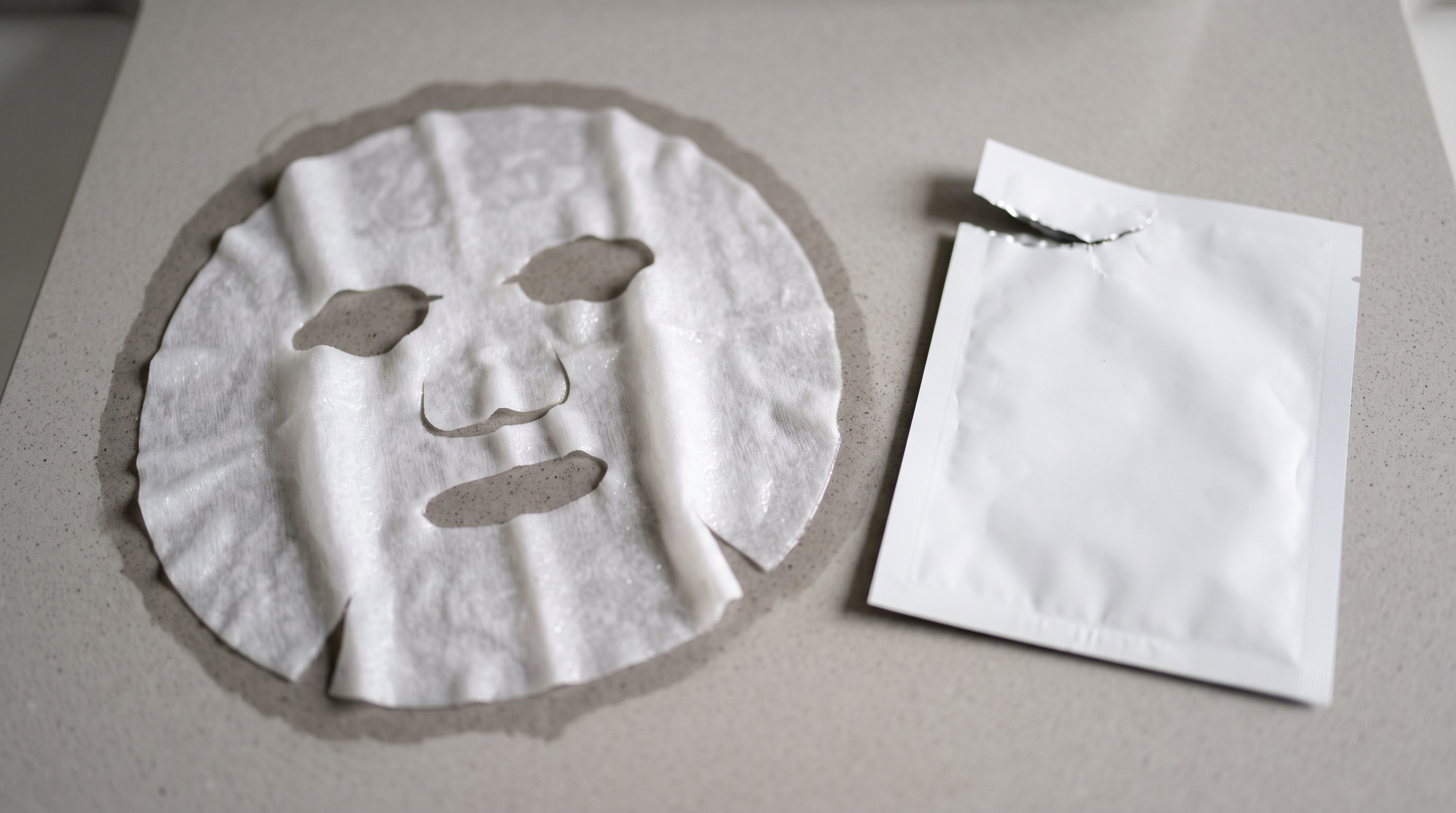
A sheet mask is a piece of cotton, hydrogel or biocellulose soaked in a water-based serum and pressed against the face. It is the most occlusive thing most people will ever put on their skin, and for 15 minutes that is genuinely useful. The interesting question is not whether sheet masks do anything. It is what they do, for how long, and what happens if you leave one on through an entire film.
That last question has an answer, and it is not the one the packaging implies.
The duration study nobody quotes
A randomized controlled study at West China Hospital tested three sheet mask types, one soaked in pure water, one in hyaluronan and one in bifida ferment lysate, across four wearing durations of 5, 15, 25 and 40 minutes [1]. Researchers measured moisture content, transepidermal water loss, sebum, corneocyte size and aquaporin-3 expression before and after, and logged adverse reactions.
The results have a clear shape. Hydration and transepidermal water loss both rose first and then fell, so the curve turns rather than climbing. Sebum increased with every mask type and was highest after 40 minutes. Aquaporin-3 expression, the water channel that moves moisture through the epidermis, tracked with duration, as did vasodilation. Corneocyte size did not change at all.
Then the part worth pinning up. Among 28 subjects, dryness was reported by 57.14% and redness by 10.71%, concentrated in the longest wear times and worst with the pure-water masks past 25 minutes. The authors’ conclusion was that short use, under 25 minutes, improves hydration, reduces redness and activates aquaporin-3, while prolonged use produces dryness and redness.
A mask soaked in plain water and left on for 40 minutes made more people’s skin drier, not wetter, which is the opposite of the entire premise.
Why longer is worse rather than more
The mechanism behind that reversal is well characterized, and it is about overhydration rather than about anything in the serum.
Using transmission and cryo-scanning electron microscopy, researchers defined how the stratum corneum behaves under extended water exposure [2]. Four hours of water produced a 3-fold expansion in stratum corneum thickness, and 24 hours produced a 4-fold expansion. More importantly, hydration opened large pools of water in the intercellular space, some exceeding the size of the water-swollen corneocytes themselves, and inside those pools the intercellular lipid lamellae delaminated and rolled up. The lipid architecture that constitutes the barrier came apart.
A sheet mask is nowhere near four hours. But it sits at the start of that same curve, and it explains why the benefit turns: you are driving water into a structure whose mortar loosens as it swells. Once the sheet comes off, a barrier that is slightly disorganized loses water faster than it did before, which is exactly the delayed dryness the duration study picked up. This is the same physics behind dehydrated skin rebounding after a long bath.
The practical rule is therefore narrow and unglamorous. Take the mask off while the sheet is still damp, and never sleep in one.
The collagen sheet mask problem
Sheet masks soaked in collagen are a large category, and the claim cannot work as stated.
The stratum corneum is a size-selective barrier, and the working threshold is the 500-dalton rule: compounds above roughly 500 daltons do not meaningfully cross intact skin, which is why almost every effective topical drug sits under that ceiling [3]. Native collagen is a triple-helical protein measured in hundreds of thousands of daltons. Even aggressively hydrolyzed collagen peptides sit in the thousands. Both are orders of magnitude above the gate.
That does not make a collagen mask useless, but it does relocate the benefit. Collagen and its hydrolysates are excellent film-forming humectants. They hold water against the surface and they make skin look smoother and plumper while they are there. What they cannot do is arrive in the dermis and become your collagen. Any product promising structural collagen from the outside, in a sheet or otherwise, is describing a surface effect in structural language.
Collagen applied to the face is a very good humectant wearing the costume of a building material.
What sheet masks are genuinely good for
Stripped of the structural claims, the case for them is real and worth stating precisely.
Occlusion plus humectant is a strong short-term hydration strategy. Clinical evaluation of peel-off facial masks found that masks improved stratum corneum moisturization more effectively than a comparable oil-in-water emulsion, measured by corneometry [4]. A sealed sheet holds humectants in contact with the surface at a concentration and for a duration that a cream rubbed in cannot match.
Some of those humectants also do more than hold water. Glycerol, the most common of them, accelerates the recovery of barrier function in vivo rather than simply hydrating passively [5]. So a well-formulated mask with a glycerin-forward serum, worn for 15 minutes, is a legitimate barrier-support step and not just a cosmetic one.
That gives sheet masks a well-defined role: an acute, event-driven hydration and calming step. Before something photographed, after a flight, on skin that looks tight and dull. They sit alongside the other formats in our guide to the best face mask for aging skin, and they are a different tool from an overnight face mask, which is designed for long, low-grade occlusion rather than a saturating burst.
How to use one properly
Cleanse first, since a mask will hold whatever is on your face against it for a quarter of an hour. Apply to slightly damp skin. Set a timer for 15 minutes and take it off while the sheet still feels wet. Pat in the remaining serum rather than rinsing, then seal with a moisturizer, because the humectants you just loaded on will otherwise evaporate and take surface water with them. If you are working through barrier repair, keep masks to two or three times a week rather than daily.
Where Nanoretinol fits
Sheet masks are the clearest illustration available of the difference between hydration and remodeling. Everything a mask achieves happens in and on the stratum corneum, which is why it looks excellent for an evening and is gone by Tuesday. Collagen and elastin are produced in the dermis, and changing them requires a molecule that actually reaches the cells that make them.
That is a delivery problem, and it is the one Nanoretinol was built to solve. The retinol is encapsulated in biomimetic lipid nanoparticles that are externally identical to skin cells, so the body recognizes them as self and admits them through the epithelial barrier intact, with no need for the solvents and petroleum derivatives conventional retinol formulations use to force a path. North Biomedical’s clinical study summary reports the encapsulated form as 232% more effective in collagen recovery and 73% more effective in elastin recovery than conventional retinol, with a 61% increase in skin firmness and a 56% increase in skin elasticity over 56 days of use. The mask is for tonight. The retinoid is for next spring.
References
- Wang Y, Cao Y, Huang X, Zhang M, Hu J, Li L, Xiong L. “Short-term skin reactions and changes in stratum corneum following different ways of facial sheet mask usage.” Journal of Tissue Viability. 2024;33(4):831-839. doi:10.1016/j.jtv.2024.06.012
- Warner RR, Stone KJ, Boissy YL. “Hydration disrupts human stratum corneum ultrastructure.” Journal of Investigative Dermatology. 2003;120(2):275-284. doi:10.1046/j.1523-1747.2003.12046.x
- Bos JD, Meinardi MM. “The 500 Dalton rule for the skin penetration of chemical compounds and drugs.” Experimental Dermatology. 2000;9(3):165-169. doi:10.1034/j.1600-0625.2000.009003165.x
- Velasco MV, Vieira RP, Fernandes AR, Dario MF, Pinto CA, Pedriali CA, Kaneko TM, Baby AR. “Short-term clinical of peel-off facial mask moisturizers.” International Journal of Cosmetic Science. 2014;36(4):355-360. doi:10.1111/ics.12133
- Fluhr JW, Gloor M, Lehmann L, Lazzerini S, Distante F, Berardesca E. “Glycerol accelerates recovery of barrier function in vivo.” Acta Dermato-Venereologica. 1999;79(6):418-421. doi:10.1080/000155599750009825