Skin Care Products for Women Over 50: What Actually Works After Menopause
Evidence-based picks for the products that earn shelf space when estrogen drops and collagen leaves with it
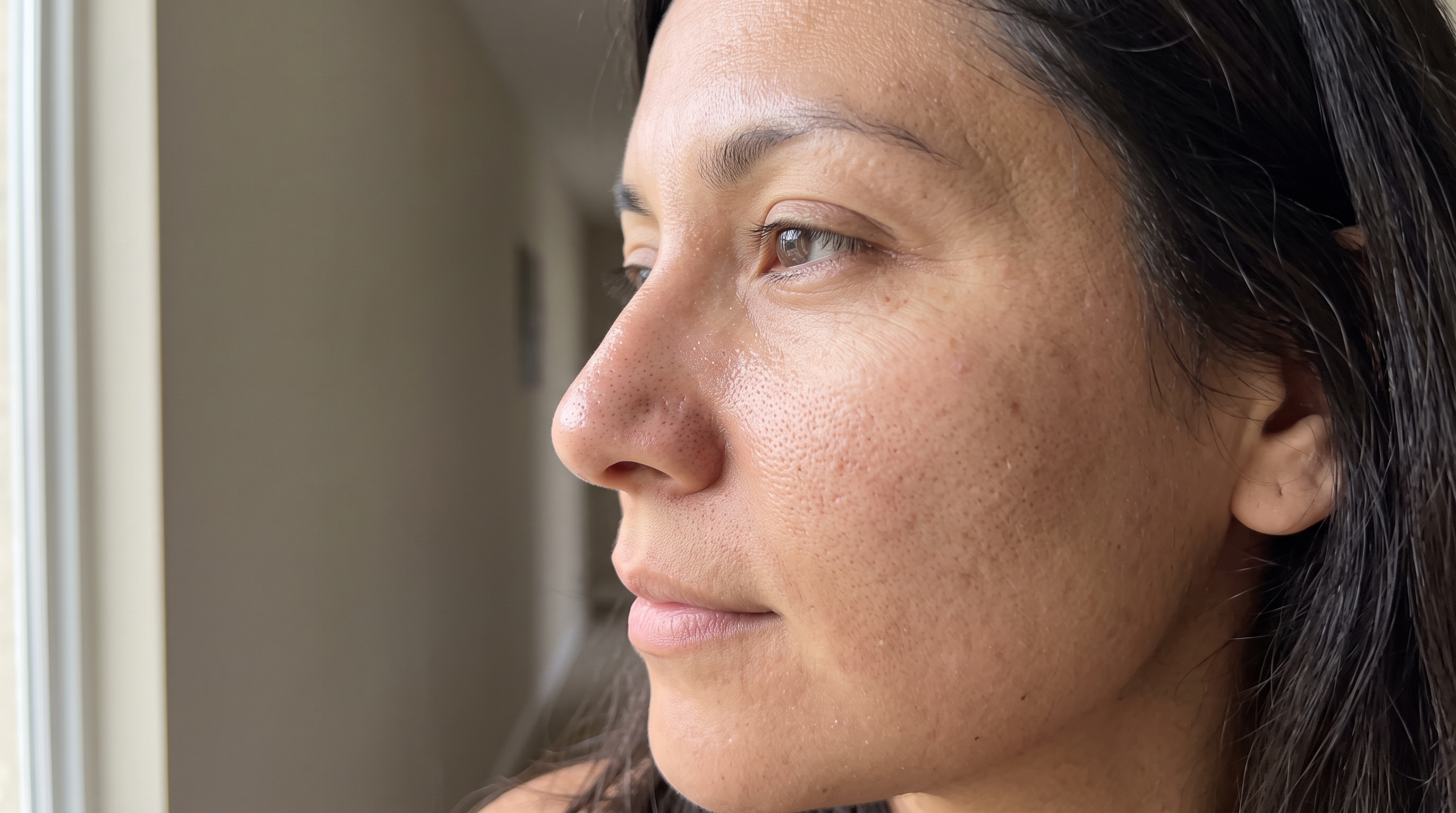
The skin you’re living in at 52 is not the same organ you had at 32. After menopause, dermal collagen drops by roughly 30% in the first five years, then continues falling at about 2% every year after that [1]. That’s not a vague feeling. It’s a measurable change in the scaffolding under your skin — and most products marketed to women over 50 are still formulated for women in their 30s.
This isn’t a list of brand recommendations. Brand names rotate; the science doesn’t. What follows is the small group of ingredients that earn shelf space after 50, why they work, and how to put them together.
Why Skin Behaves Differently After 50
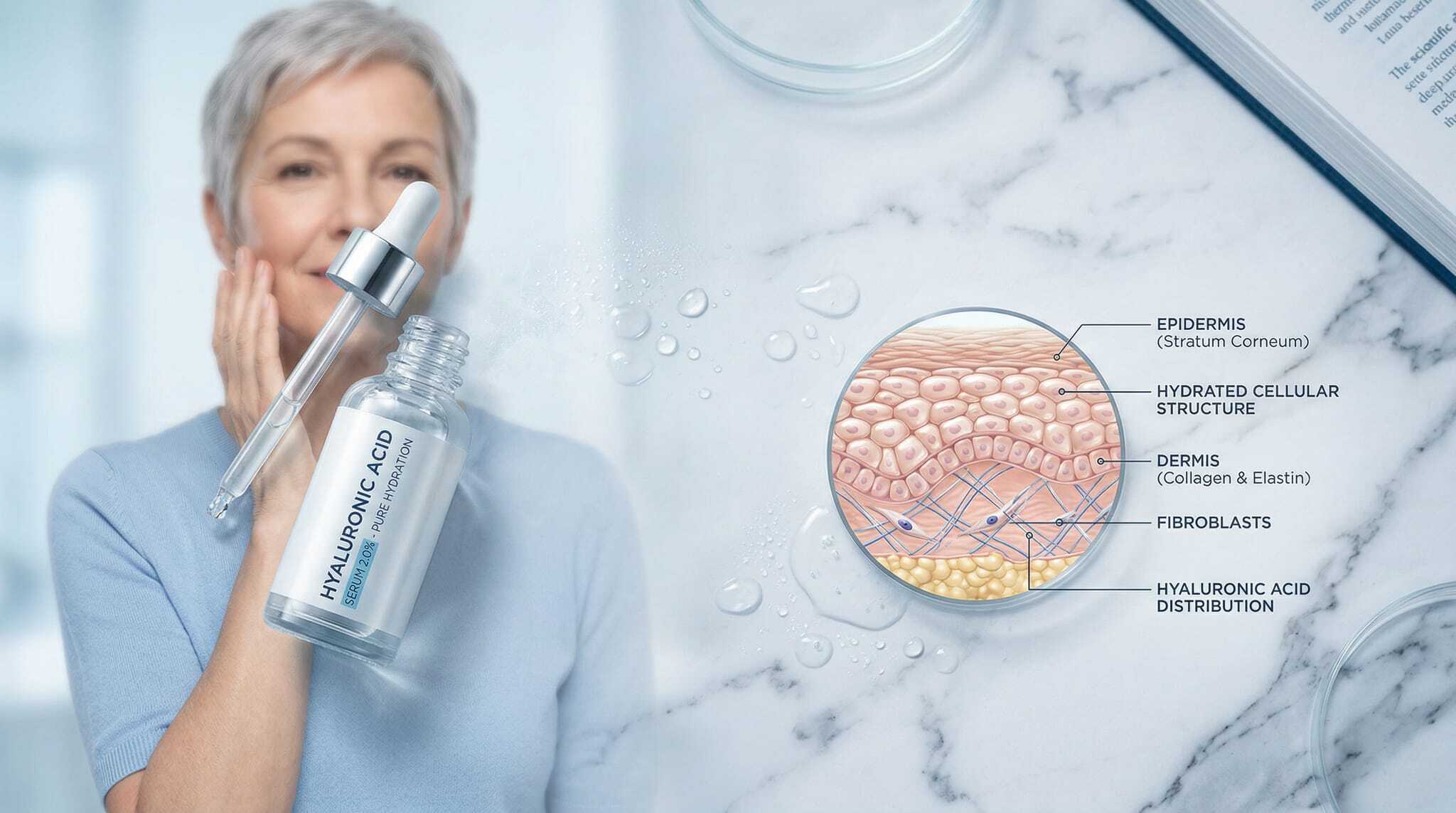
Estrogen is a master regulator of skin. It signals fibroblasts to produce collagen, holds water in the dermis through hyaluronic acid synthesis, and regulates sebum. When estrogen falls during perimenopause and menopause, all three pathways slow at once [1].
Three changes show up almost universally:
- Thinner dermis. Collagen and elastin networks get sparser, so skin loses bounce and bruises more easily.
- Persistent dryness. Sebum output drops, hyaluronic acid synthesis slows, and the skin barrier loses water faster than it can hold on.
- Slower turnover. Cell renewal in the basal layer slows from roughly 28 days to closer to 45-60 days, which makes skin look duller and pigmented spots fade more reluctantly.
A skincare routine for this stage of life isn’t about adding more steps. It’s about pivoting the routine you have toward ingredients with strong evidence in postmenopausal skin.
The Five Categories Worth Buying
1. A Retinoid — The Single Most-Studied Anti-Aging Ingredient
If you only invest in one anti-aging product over 50, make it a retinoid. Retinoids (the broad family that includes retinol, retinaldehyde, and prescription tretinoin) are the only topical ingredients with decades of clinical evidence for reversing — not just slowing — the structural signs of aging [2].
A landmark multicenter trial in Archives of Dermatology showed that 79% of subjects using 0.05% tretinoin for 24 weeks had measurable improvement in fine wrinkles, mottled hyperpigmentation, roughness, and laxity [3]. Over-the-counter retinol delivers a milder version of the same effect: a separate study found retinol increased dermal elastin synthesis — something almost no other ingredient does [4].
The catch is irritation. Conventional retinol formulations push concentrations higher to compensate for poor delivery, and that’s what causes the burning, peeling, and redness that makes most women quit by week three. The current generation of nanoencapsulated retinol formulations bypass this problem by carrying retinol through the skin barrier in lipid carriers rather than forcing their way across it — which is the approach used by Nanoretinol [8].
If you only invest in one anti-aging product over 50, make it a retinoid.
2. Vitamin C — For Brightness and Photoprotection Support
After 50, dullness often outpaces wrinkles as the visual giveaway of aging skin. Vitamin C addresses both.
In a six-month double-blind trial, 5% topical ascorbic acid significantly reduced deep wrinkles and improved skin texture in sun-exposed areas compared to placebo [5]. It also inhibits tyrosinase (the enzyme that drives melanin overproduction), which is why it fades the diffuse pigmentation that builds up after decades of UV exposure.
Look for L-ascorbic acid at 10-20%, ideally stabilized with vitamin E and ferulic acid. Apply in the morning, under sunscreen.
3. Niacinamide — The Multitasker
Niacinamide is the rare ingredient that does several things competently rather than one thing brilliantly. In a 12-week split-face trial, 5% niacinamide reduced fine lines, hyperpigmented spots, red blotchiness, and yellowing while improving elasticity [6].
For women over 50, niacinamide is most useful for two specific problems: the diffuse redness that estrogen loss tends to amplify, and the impaired barrier function that makes mature skin react to almost everything. It pairs well with retinol because it reduces the irritation that retinoids tend to cause.
4. A Real Moisturizer — With Ceramides and Hyaluronic Acid
The lightweight gel-creams that work for 30-year-olds are usually inadequate after menopause. The barrier needs ceramides (the lipid molecules that decline sharply after 50), and the dermis needs humectants like hyaluronic acid and glycerin to compensate for the slowdown in natural HA production.
Look for products that list ceramides (usually ceramide NP, ceramide AP, ceramide EOP) in the first half of the ingredient list, alongside cholesterol and free fatty acids. This trio is what mimics the skin’s natural barrier composition.
Look for L-ascorbic acid at 10-20%, ideally stabilized with vitamin E and ferulic acid.
A separate neck cream is often worth the spend, since neck skin has fewer sebaceous glands and ages faster than the face.
5. Sunscreen — Non-Negotiable, Even If You’re Inside
UV exposure causes about 80% of visible facial aging, which is why this still matters at 50, 60, and 70. The randomized Nambour trial followed adults for 4.5 years and found that those who used broad-spectrum sunscreen daily showed no detectable increase in skin aging, while the discretionary-use group showed measurable photoaging [7].
The version you’ll actually wear matters more than the SPF number. A mineral sunscreen at SPF 30-50, reapplied at midday if you’re outside, is the floor.
What to Skip
A short list of categories that get pushed at women over 50 but don’t earn shelf space:
- Collagen creams. Topically applied collagen molecules are too large to penetrate the skin barrier. They sit on the surface as a humectant, which is fine but unrelated to the marketing claim.
- Stem cell creams. Plant or human stem cells in topical products are dead by the time they’re in the bottle. Any benefit comes from the growth factors or peptides they release during processing — which you can buy directly without the markup.
- “Anti-aging” cleansers. A cleanser is on your skin for 30 seconds. It cannot deliver active ingredients in any meaningful concentration. Use a gentle cleanser; spend on serums and treatments instead.
One category worth adding rather than skipping is sheer tinted coverage, because the iron oxides that tint it also defend against visible light. Our guide to the best tinted moisturizer for mature skin covers how to choose one.
If you are shopping for the decade after this one, the shortlist narrows further in our guide to the best skin care for women over 60.
A Sequenced Routine That Fits Together
A routine for skin over 50 can fit on one hand:
Morning: Gentle cleanser → vitamin C serum → moisturizer with ceramides → mineral sunscreen.
Evening: Gentle cleanser → retinoid (start two nights a week, work up to nightly) → ceramide-rich moisturizer.
Niacinamide can layer at either time of day. If you’re in early menopause and dryness is the dominant issue, see our guide to menopause skin changes. If wrinkles are the priority, our retinol-for-menopause article goes deeper on the dosing strategy.
What “Best” Actually Means at This Stage
The best skin care products for women over 50 aren’t a list of brand names. They’re a short ingredient stack with strong clinical evidence: a retinoid, vitamin C, niacinamide, a barrier-supporting moisturizer, and daily sunscreen. Everything else is optional. Makeup sits outside that stack by design, though choosing a CC cream for mature skin that suits your surface makes the daily result noticeably better.
The single most common mistake we see is not which products women buy — it’s quitting the retinoid in the third week because it stings, or buying a luxury moisturizer and skipping the active. The structural changes that drive aging skin after menopause respond to ingredients that work inside the dermis, not on top of it. A formulation that gets the active where it needs to go, with tolerable side effects, is worth more than a $200 cream that sits on the surface. For the order and spacing those products belong in, see the skin care routine for your 50s.
References
- Thornton MJ. “Estrogens and aging skin.” Dermato-Endocrinology. 2013;5(2):264-270. doi:10.4161/derm.23872
- Mukherjee S, Date A, Patravale V, et al. “Retinoids in the treatment of skin aging: an overview of clinical efficacy and safety.” Clinical Interventions in Aging. 2006;1(4):327-348. doi:10.2147/ciia.2006.1.4.327
- Weinstein GD, Nigra TP, Pochi PE, et al. “Topical tretinoin for treatment of photodamaged skin. A multicenter study.” Archives of Dermatology. 1991;127(5):659-665. PMID:2024983
- Rossetti D, Kielmanowicz MG, Vigodman S, et al. “A novel anti-ageing mechanism for retinol: induction of dermal elastin synthesis and elastin fibre formation.” International Journal of Cosmetic Science. 2011;33(1):62-69. doi:10.1111/j.1468-2494.2010.00588.x
- Humbert PG, Haftek M, Creidi P, et al. “Topical ascorbic acid on photoaged skin. Clinical, topographical and ultrastructural evaluation: double-blind study vs. placebo.” Experimental Dermatology. 2003;12(3):237-244. PMID:12823436
- Bissett DL, Oblong JE, Berge CA. “Niacinamide: A B vitamin that improves aging facial skin appearance.” Dermatologic Surgery. 2005;31(7 Pt 2):860-865. doi:10.1111/j.1524-4725.2005.31732
- Hughes MC, Williams GM, Baker P, Green AC. “Sunscreen and prevention of skin aging: a randomized trial.” Annals of Internal Medicine. 2013;158(11):781-790. doi:10.7326/0003-4819-158-11-201306040-00002
- North Biomedical LLC. “Nanoretinol vs. Conventional Retinol: Efficacy in Collagen and Elastin Recovery.” Clinical Study Summary, 2024. https://northbiomedical.com/documents/Nanoretinol-Study_Summary.pdf