Skin Care Routine for Dry Skin: Build It Around Lipids, Not Steps
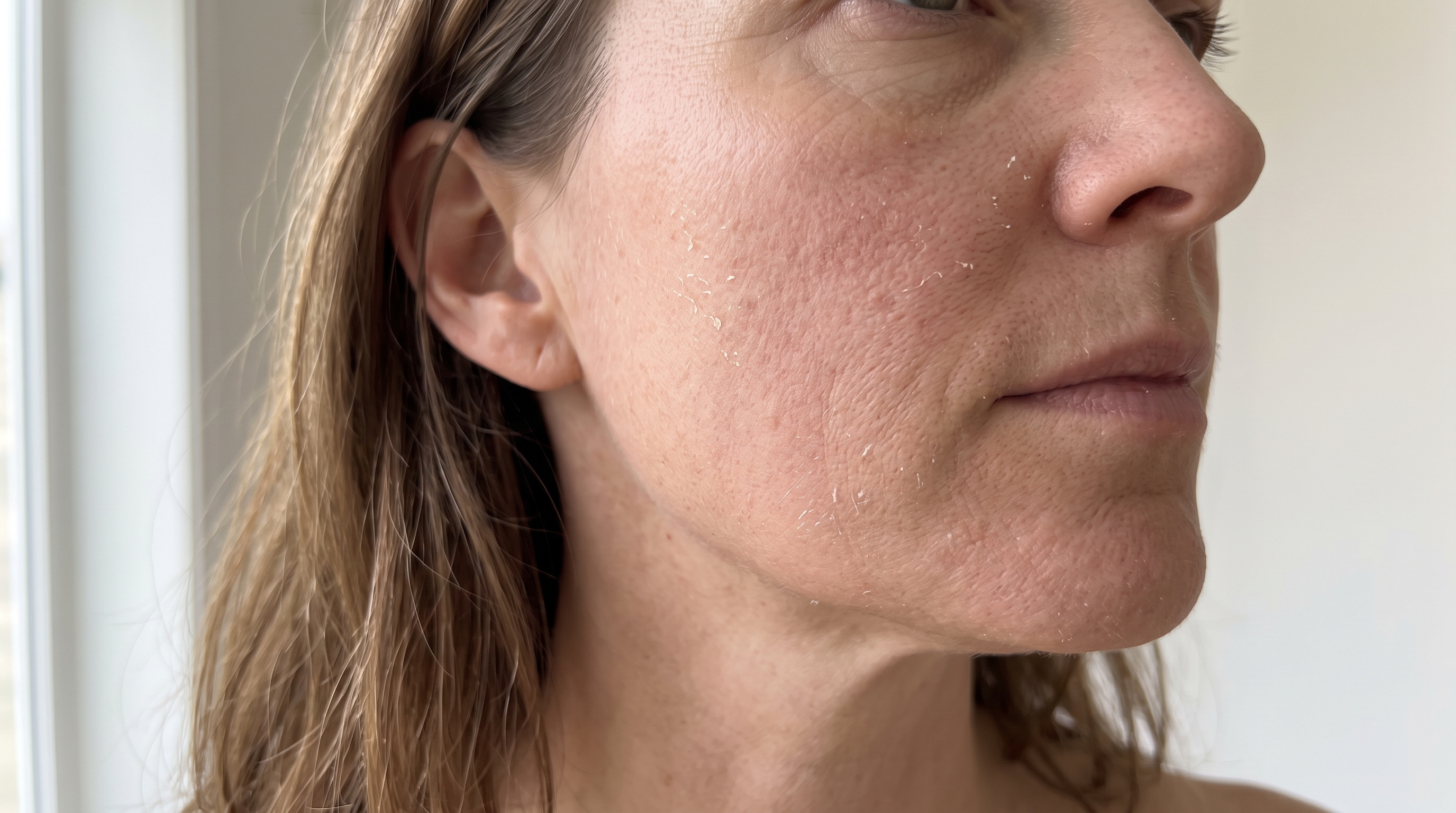
Dry skin is a barrier problem, and the order you apply things changes how well that barrier repairs
Most dry-skin routines are assembled from product categories. Cleanser, toner, serum, moisturiser, oil, in that order, because that is the order the shelf is arranged in. It is a reasonable-looking routine that frequently does not work, and the reason it does not work is that dryness is not a shortage of products. It is a shortage of specific molecules in a specific structure.
Build the routine around replacing those molecules and the sequence changes, some steps disappear, and one or two decisions that felt cosmetic turn out to be doing most of the work.
Dry Is a Lipid Problem Before It Is a Water Problem
The outermost layer of skin is corneocytes embedded in a lipid matrix, and that matrix is what holds water in. Its three main components — ceramides, cholesterol, and free fatty acids — have to be present in roughly balanced proportions for repair to proceed normally. When researchers tested incomplete and unbalanced mixtures against balanced ones, the unbalanced formulations actively delayed barrier recovery rather than simply failing to help [1].
That is the single most useful fact in this article. A product supplying one of the three, in isolation, is not a partial solution. It can be worse than nothing.
The clinical shorthand for how well the matrix is working is transepidermal water loss, the standard instrument-based measure of barrier function used to quantify impairment in dry and xerotic skin [2]. It is a leak rate. Dry skin is skin leaking faster than it can replace, and everything below is aimed at that number rather than at how the surface feels ten minutes after application.
Step One: The Cleanser Is Where Most Damage Happens
Cleansers are the least examined and most destructive product in a dry-skin routine. Surfactants do not politely remove oil and stop; they disrupt barrier lipids and denature proteins in the stratum corneum, and traditional soaps raise the skin’s surface pH sharply in the process [3].
That pH shift is not a footnote. The skin surface is acidic for functional reasons: the enzymes that process lipids into their mature form and control orderly desquamation are pH-dependent, and moving the surface toward alkaline degrades barrier homeostasis directly [4]. Every alkaline wash buys a period of impaired lipid processing.
If your skin feels tight and squeaky afterwards, that is not cleanliness.
So the first decision is a synthetic detergent (syndet) cleanser at an acidic pH, used once daily at night rather than twice, with lukewarm rather than hot water. If your skin feels tight and squeaky afterwards, that is not cleanliness. That is a stripped barrier announcing itself, and it is the most common single cause of a dry, flaking face that no moisturiser seems to fix.
Step Two: Humectants Are Conditional, Not Automatic
Humectants pull water. Where they pull it from depends on the air.
Glycerin is the best-supported of them, and it is not just another hydrating ingredient: work in a barrier-deficient model identified glycerin as the key endogenous regulator of stratum corneum hydration [5]. Hyaluronic acid behaves differently by molecular weight, with larger molecules forming a surface film and smaller fractions penetrating further, which is why formulations combining weights behave better than any single one [6].
The conditional part is ambient humidity. Low humidity and low temperature measurably reduce barrier function and raise susceptibility to irritation [7]. In a dry room, a humectant layer left exposed on the surface has one convenient reservoir to draw from, and that is the skin underneath it. This is the mechanism behind the common experience of a hyaluronic acid serum making skin feel tighter in winter than it did before.
The fix is not to abandon humectants. It is to never leave one uncovered.
Step Three: Seal It While the Skin Is Still Damp
Apply humectants to skin that is still visibly damp from cleansing, then cover them within a minute or so with something occlusive enough to slow evaporation. The damp skin supplies the water, the humectant binds it, the occlusive stops it leaving. Each of the three steps is nearly useless without the other two, which is why the sequencing is not an aesthetic preference.
For the occlusive layer, the ingredient list matters more than the category name. A cream supplying ceramides with cholesterol and fatty acids is working with the repair mechanism described above. One supplying ceramides alone, at a token concentration, is buying you the word on the front of the jar. Choosing a moisturiser for dry skin is mostly this one judgement, repeated.
The water-based, 99% natural formulation is suited to sensitive and dry skin rather than something to be endured by it.
If your skin is genuinely dehydrated rather than dry — lacking water rather than lipids — the same sequence applies, but the occlusive layer can be lighter.
Step Four: Where a Retinoid Goes, and When
Dry skin is the population that abandons retinoids fastest, and the reason is mechanical rather than a matter of willpower. Retinoid irritation involves barrier disruption and inflammatory signalling, and the literature on reducing it converges on formulation and delivery strategies — encapsulation, dose modulation, and barrier-supportive co-ingredients — rather than on simply telling people to persist [8].
Which means the routine order is load-bearing. Introduce a retinoid only once the barrier is behaving: no tightness after cleansing, no flaking, no stinging from a plain moisturiser. That usually takes two to four weeks of the steps above. Then start twice weekly, at night, on completely dry skin, with the moisturiser applied afterwards rather than skipped.
Attempting a retinoid on a compromised barrier produces the irritation cycle that convinces people their skin cannot tolerate retinoids at all. Usually it can. It just could not tolerate that particular delivery system at that particular moment.
The Routine, In Order
Morning: rinse with water only or a brief syndet wash, humectant on damp skin, moisturiser, sunscreen.
Night: syndet cleanser, humectant on damp skin, retinoid on dry skin if the barrier is ready, moisturiser over the top.
That is the whole thing. Four or five products, not nine. Most of what gets added to a dry-skin routine — toners, exfoliating acids used daily, foaming washes, alcohol-heavy essences — is working against the lipid matrix that the rest of the routine is trying to rebuild.
Where Nanoretinol Changes the Calculation
The retinoid step is where dry-skin routines usually break, and the fault has always been the vehicle rather than the molecule. Conventional retinol formulations rely on chemicals and petroleum derivatives that increase lipid mobility and break down the epithelial barrier in order to force retinol through it. On skin whose entire problem is a leaking barrier, that is the worst possible delivery mechanism.
Nanoretinol inverts it. Retinol at 0.2% is encapsulated in biomimetic lipid nanoparticles the skin recognises as self and admits through the barrier without damaging it, and as the nanoparticles release their contents the cells absorb the phospholipids from their membranes. Delivery, not concentration, is what produces 232% more effective collagen recovery and 73% more effective elastin recovery than conventional retinol, with drastically reduced cytotoxicity. The water-based, 99% natural formulation is suited to sensitive and dry skin rather than something to be endured by it.
Apply at night, reduce frequency if irritation appears, and use sunscreen within twenty-four hours. It replaces any other retinoid in the routine rather than joining it.
Getting the Order Right
If a dry-skin routine is not working, the usual culprit is not a missing product. It is an alkaline cleanser at the start, a humectant left uncovered in the middle, or a retinoid introduced before the barrier could take it.
Fix the sequence and most of the routine’s job is done by four products applied in the right order, on skin that is damp when it should be damp and dry when it should be dry. The lipid matrix rebuilds itself given the right materials and no further interference. Most of good dry-skin care is supplying the first and stopping the second.
References
- Man MQ, Feingold KR, Thornfeldt CR, Elias PM. “Optimization of Physiological Lipid Mixtures for Barrier Repair.” Journal of Investigative Dermatology. 1996;106(5):1096-1101. PMID: 8618046
- Alexander H, Brown S, Danby S, Flohr C. “Research Techniques Made Simple: Transepidermal Water Loss Measurement as a Research Tool.” Journal of Investigative Dermatology. 2018;138(11):2295-2300. PMID: 30348333
- Ananthapadmanabhan KP, Moore DJ, Subramanyan K, Misra M, Meyer F. “Cleansing Without Compromise: The Impact of Cleansers on the Skin Barrier and the Technology of Mild Cleansing.” Dermatologic Therapy. 2004;17(Suppl 1):16-25. PMID: 14728695
- Schmid-Wendtner MH, Korting HC. “The pH of the Skin Surface and Its Impact on the Barrier Function.” Skin Pharmacology and Physiology. 2006;19(6):296-302. PMID: 16864974
- Fluhr JW, Mao-Qiang M, Brown BE, et al. “Glycerol Regulates Stratum Corneum Hydration in Sebaceous Gland Deficient (Asebia) Mice.” Journal of Investigative Dermatology. 2003;120(5):728-737. PMID: 12713573
- Papakonstantinou E, Roth M, Karakiulakis G. “Hyaluronic Acid: A Key Molecule in Skin Aging.” Dermato-Endocrinology. 2012;4(3):253-258. PMID: 23467280
- Engebretsen KA, Johansen JD, Kezic S, Linneberg A, Thyssen JP. “The Effect of Environmental Humidity and Temperature on Skin Barrier Function and Dermatitis.” Journal of the European Academy of Dermatology and Venereology. 2016;30(2):223-249. PMID: 26449379
- Narsa AC, Suhandi C, Afidika J, Ghaliya S, Elamin KM, Wathoni N. “A Comprehensive Review of the Strategies to Reduce Retinoid-Induced Skin Irritation in Topical Formulation.” Dermatology Research and Practice. 2024;2024:5551774. PMID: 39184919