Gua Sha Benefits for Skin: What the Science Actually Supports (and What It Doesn't)
A science-first look at facial gua sha — separating peer-reviewed evidence from social media claims
The Gap Between the Feed and the Evidence
Open TikTok or Instagram and you will find gua sha presented as a near-miraculous tool: it sculpts jawlines, drains lymph, lifts sagging skin, erases wrinkles, and “detoxifies” the face. The demonstrations are compelling — smooth stone gliding along oiled skin with satisfying before-and-after shots showing visibly less puffiness.
But here is the uncomfortable question that a science-based brand has to ask: how much of this is supported by clinical evidence, and how much is the result of temporary fluid displacement that reverses within hours?
The honest answer is that the evidence base for facial gua sha is thin. Not nonexistent — but thin enough that anyone claiming it as a proven anti-aging treatment is getting ahead of the research. Let us walk through what actually exists.
What Traditional Gua Sha Actually Is
Modern facial gua sha and traditional gua sha are barely the same practice. Traditional gua sha, rooted in Chinese medicine with origins dating back nearly 2,000 years, involves firm, repeated scraping of lubricated skin — typically on the back, neck, or limbs — with enough pressure to intentionally cause petechiae and ecchymosis (subcutaneous bruising) [1]. The resulting marks, called “sha,” were historically interpreted as a sign of stagnant qi being released.
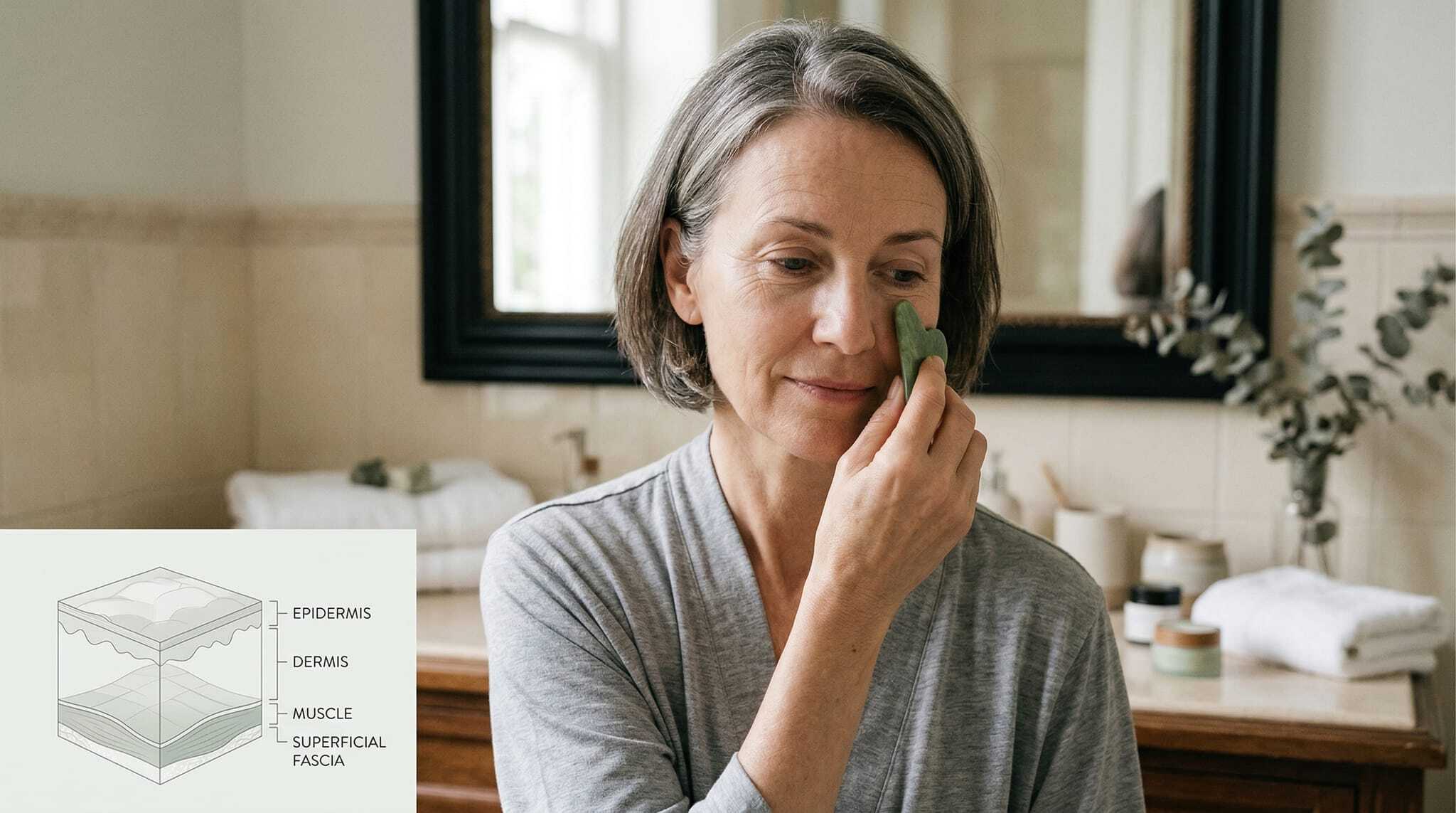
The gentle, sweeping technique promoted by beauty influencers — using rose quartz or jade tools on the face with light pressure — bears little resemblance to this traditional practice. It is closer to a light facial massage performed with a smooth tool. That distinction matters, because nearly all of the peer-reviewed research on gua sha studied the traditional, high-pressure version — not the gentle facial version [2]. Used gently it is still a pleasant, low-risk step, which is why it belongs inside an at-home facial rather than at the center of a routine.
What the Research Actually Shows
Microcirculation: Real, but Temporary
The most cited study on gua sha’s physiological effects comes from Nielsen et al. (2007), who used laser Doppler imaging to measure blood flow changes in 11 healthy subjects after traditional gua sha treatment on the back [1]. The results were striking: a fourfold increase in microcirculation that persisted for over 25 minutes. Subjects also reported decreased myalgia (muscle pain) in both treated and untreated areas.
Interestingly, skin elasticity did not improve in the gua sha group; the facial roller group showed elasticity gains instead.
This is real data. But context is critical: the study used traditional high-pressure gua sha on the back (not the face), the sample was 11 people, there was no control group, and the circulation boost was temporary. The leap from “vigorous scraping increases blood flow in the back for 25 minutes” to “gentle facial gua sha produces lasting anti-aging benefits” is enormous — and the evidence does not bridge that gap.
Facial Contour Changes: One Promising RCT
The strongest evidence for facial gua sha specifically comes from Ahn et al. (2025), a randomized controlled trial comparing facial roller and gua sha massage in 34 women over 8 weeks [3]. The gua sha group performed 10-minute sessions five times per week and showed significant reductions in facial surface distances (2.23–2.40 mm, p < 0.001), suggesting measurable improvements in facial contour.
The gua sha group also showed significant reductions in muscle tone parameters — oscillation frequency and dynamic stiffness both decreased — which the authors interpreted as relaxation of facial muscles contributing to the contouring effect. Interestingly, skin elasticity did not improve in the gua sha group; the facial roller group showed elasticity gains instead [3].
This is the best evidence available for facial gua sha, and it should be taken seriously. But it is one study, with 17 participants per group, over 8 weeks, without a true no-treatment control. It tells us something is happening — but it does not tell us the effect persists once you stop, or that the magnitude is clinically meaningful compared to proven interventions.
Facial Massage in General: Preliminary Signals
A pilot study by Okuda et al. (2022) used high-resolution CT imaging to assess facial changes after 2 weeks of self-massage (twice daily) in 5 volunteers [4]. They found that the malar top became thinner and shifted cranially, while the SMAS (superficial musculoaponeurotic system) height increased. The authors attributed these changes to lifting and tightening effects.
Five people. Two weeks. No control group. The CT technology was sophisticated, but the study design was as preliminary as it gets. It is pilot data worth following up on — not evidence to build clinical claims around.
If you wake up with a puffy face and use a gua sha tool, you will probably look less puffy afterward — the same way a cold compress or manual massage would.
The Dermatology Community’s Assessment
A 2023 review in the Journal of Cosmetic Dermatology by Hamp et al. examined the evidence for gua sha, jade rollers, and facial massage within dermatology [2]. The conclusion was measured: while some mechanistic plausibility exists (improved blood flow, potential lymphatic drainage), the overall body of evidence is insufficient to make definitive claims about anti-aging efficacy. Most studies suffer from small sample sizes, short durations, lack of controls, and the fundamental problem of studying traditional gua sha and extrapolating to the modern facial version.
The Claims That Have No Scientific Support
To be direct about what remains unproven:
- “Gua sha detoxifies the skin.” The skin does not accumulate “toxins” that require manual drainage. Your liver and kidneys handle detoxification. This claim has no basis in physiology [5].
- “Gua sha stimulates collagen production.” No study has demonstrated that facial gua sha increases collagen synthesis. Mechanical stimulation can theoretically influence fibroblasts, but there is zero direct evidence for collagen induction from gentle facial scraping.
- “Gua sha provides lasting facial sculpting.” The Ahn et al. study showed measurable contour changes during an 8-week active intervention period, but whether those changes persist after stopping is unknown. Any reduction in facial puffiness from a single session is almost certainly temporary fluid redistribution.
- “Gua sha replaces professional treatments.” No evidence suggests gua sha produces outcomes comparable to retinoids, injectable treatments, or laser therapy for any anti-aging indication.
What Gua Sha Probably Does Do
Being critical does not mean being dismissive. Based on the available evidence and reasonable physiological extrapolation, facial gua sha likely:
- Temporarily reduces puffiness by manually encouraging fluid movement in subcutaneous tissue. If you wake up with a puffy face and use a gua sha tool, you will probably look less puffy afterward — the same way a cold compress or manual massage would.
- Increases local blood flow for a short period. Whether this translates to any meaningful skin benefit beyond a temporary “glow” is unestablished.
- Promotes relaxation. The ritual of a 5–10 minute facial massage is genuinely calming. Stress reduction has well-documented benefits for skin health, including reduced cortisol-driven inflammation and better barrier function [6].
- Reduces muscle tension in the jaw and face, particularly for people who clench or grind their teeth. The Ahn et al. study supports this directly [3].
If You Want Proven Anti-Aging: Start With What Works
We are a science brand. That means saying clearly: if your primary goal is reducing wrinkles, improving skin elasticity, or rebuilding lost collagen, the interventions with decades of clinical evidence behind them are:
- Retinoids — the most extensively studied topical anti-aging ingredient in existence, with consistent evidence for collagen stimulation, wrinkle reduction, and skin renewal [7].
- Sunscreen — preventing further UV damage is the single most impactful anti-aging measure.
- Antioxidants like vitamin C — photoprotection and collagen support with robust clinical data.
That does not mean you should not use a gua sha tool. It means you should use it for what it actually offers — a pleasant facial massage with modest, primarily temporary effects — and not as a substitute for ingredients with real mechanistic evidence behind them.
Nanoretinol® delivers retinol via biomimetic lipid nanoparticles that bypass the skin barrier without the harsh penetration enhancers that cause irritation. In clinical testing, it demonstrated a 232% improvement in collagen recovery and 73% improvement in elastin recovery compared to conventional retinol. That is the kind of quantified, mechanism-driven result that separates evidence-based skincare from wellness marketing.
Should You Use a Gua Sha Tool?
If you enjoy the ritual, find it relaxing, and notice temporary improvements in puffiness — yes. There is nothing wrong with using a gua sha tool as part of your routine. It is low-risk (when done gently with adequate lubrication), affordable, and the self-care aspect is psychologically real.
Just do not expect it to replace your actives. And be skeptical of anyone who tells you a jade stone can do what decades of retinoid research has accomplished.
References
- Nielsen A, Knoblauch NTM, Dobos GJ, Michalsen A, Kaptchuk TJ. “The Effect of Gua Sha Treatment on the Microcirculation of Surface Tissue: A Pilot Study in Healthy Subjects.” Explore. 2007;3(5):456-466. doi:10.1016/j.explore.2007.06.001
- Hamp A, Anderson J, Laughter MR, et al. “Gua-sha, Jade Roller, and Facial Massage: Are There Benefits Within Dermatology?” Journal of Cosmetic Dermatology. 2023;22(2):700-703. doi:10.1111/jocd.15421
- Ahn SH, Hwang UJ, Han HS, et al. “Comparative Effects of Facial Roller and Gua Sha Massage on Facial Contour, Muscle Tone, and Skin Elasticity: Randomized Controlled Trial.” Journal of Cosmetic Dermatology. 2025;24(6):e70236. doi:10.1111/jocd.70236
- Okuda I, Ichioka S, Ito M, Oba J. “Objective Analysis of the Effectiveness of Facial Massage Using Breakthrough Computed Tomographic Technology: A Preliminary Pilot Study.” Skin Research and Technology. 2022;28(3):472-479. doi:10.1111/srt.13152
- Klein AV, Kiat H. “Detox Diets for Toxin Elimination and Weight Management: A Critical Review of the Evidence.” Journal of Human Nutrition and Dietetics. 2015;28(6):675-686. doi:10.1111/jhn.12286
- Chen Y, Lyga J. “Brain-Skin Connection: Stress, Inflammation and Skin Aging.” Inflammation & Allergy Drug Targets. 2014;13(3):177-190. doi:10.2174/1871528113666140522104422
- Mukherjee S, Date A, Patravale V, et al. “Retinoids in the Treatment of Skin Aging: An Overview of Clinical Efficacy and Safety.” Clinical Interventions in Aging. 2006;1(4):327-348. PMID: 18046911