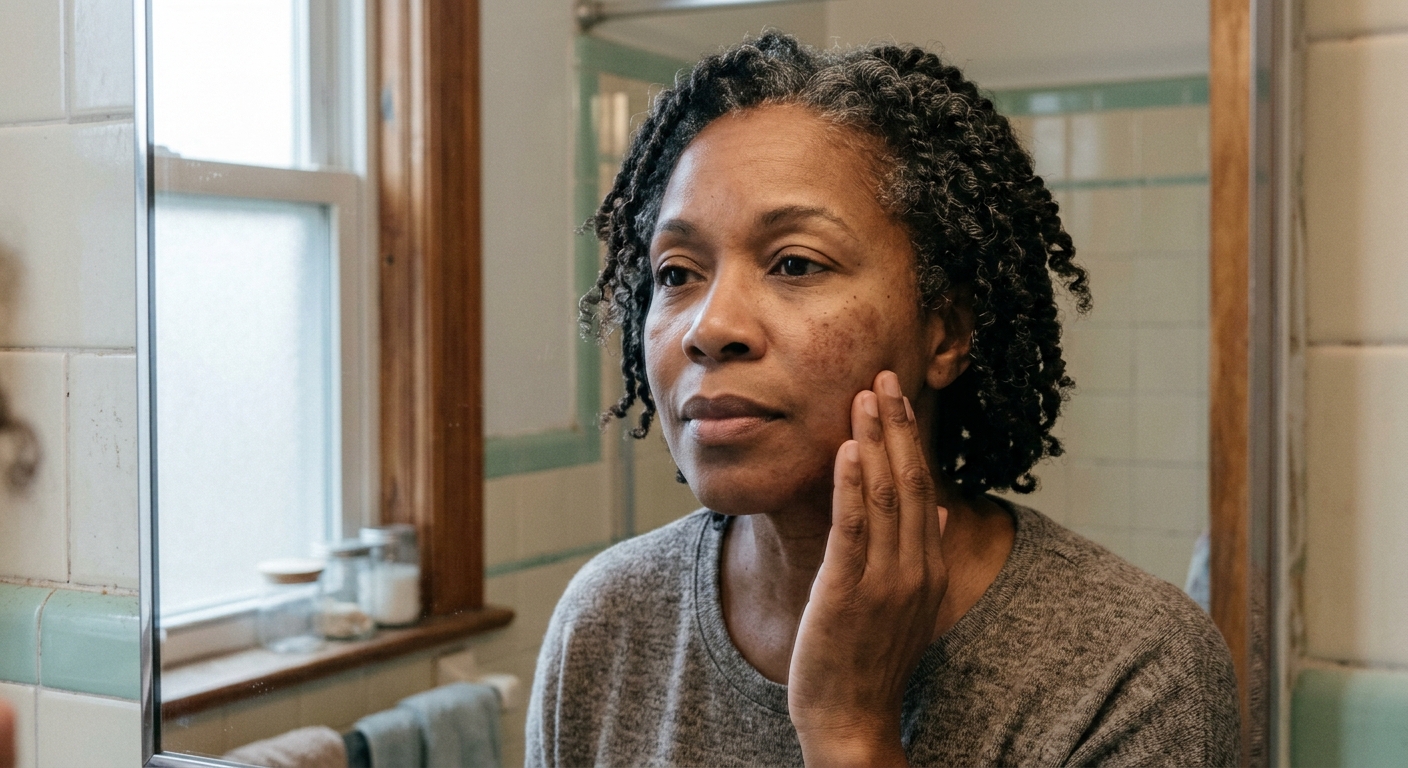
Uneven Skin Tone: What Causes It and How to Even Out Your Complexion
Blotchy, patchy skin isn't just cosmetic — it signals deeper changes that get worse without intervention
The Science of Why Skin Tone Becomes Uneven
Look at a child’s skin and you’ll notice something striking: the color is remarkably uniform. There are no patches, no blotches, no areas where pigment seems to have pooled or retreated. That uniformity isn’t permanent. By your forties, decades of UV exposure, hormonal fluctuations, inflammation, and slowing cell turnover conspire to create a complexion that looks mottled, patchy, and perpetually tired.
Uneven skin tone is the single most common reason women cite for looking “older than they feel.” Dermatologists actually consider it a more reliable marker of perceived age than wrinkles — a face with uniform color reads as younger than a smooth face with irregular pigmentation [1].
Understanding the mechanisms behind uneven tone is essential, because different causes require different solutions.
What Disrupts Your Skin’s Color Balance
UV-Triggered Melanin Overproduction
Melanin is your skin’s built-in sunscreen. When UV radiation hits your epidermis, melanocytes ramp up melanin production to absorb those rays and protect the DNA in surrounding keratinocytes. The problem is that this defense system doesn’t distribute pigment evenly as you age. Years of cumulative sun exposure cause melanocytes to become irregularly distributed — some clusters become hyperactive while others burn out entirely [2].
The result is a patchwork: areas of dark spots interspersed with lighter zones where melanocytes have stopped functioning. This is solar lentigines — what most people call age spots or sun spots — and it’s the most common driver of uneven skin tone after 40.
Post-Inflammatory Hyperpigmentation
Every time your skin experiences inflammation — from acne, eczema, a minor scrape, or even an aggressive skincare product — it can leave behind a pigmented mark. This post-inflammatory hyperpigmentation (PIH) happens because inflammation stimulates melanocytes to produce excess melanin in the damaged area [3].
PIH is particularly stubborn in darker skin tones because melanocytes are more reactive to inflammatory signals. But it affects every skin tone, especially when the inflammation is recurring or widespread.
Hormonal Melasma
Estrogen and progesterone directly influence melanocyte activity. During pregnancy, oral contraceptive use, or perimenopause, hormonal shifts can trigger melasma — symmetrical patches of darkened skin that typically appear on the cheeks, forehead, and upper lip. Unlike solar lentigines, melasma has a hormonal root that makes it notoriously resistant to treatment [3].
Slowed Cell Turnover
In your twenties, epidermal cells turn over approximately every 28 days. By your fifties, that cycle can stretch to 40–50 days. Slower turnover means pigmented cells linger on the surface longer before being shed, creating a buildup of uneven melanin that makes the complexion look dull and blotchy [4].
In your twenties, epidermal cells turn over approximately every 28 days.
Ingredients That Actually Work: The Evidence
Retinol — The Cell Turnover Accelerator
Retinol addresses uneven tone through multiple mechanisms simultaneously. By accelerating cell turnover, it pushes pigmented keratinocytes to the surface faster, where they shed naturally. But retinol also directly inhibits tyrosinase — the enzyme melanocytes need to produce melanin — and disperses existing melanin granules within the epidermis [4].
A clinical study by Sołdacka et al. (2023) found that a retinol-based regimen produced significant improvements in uneven skin tone, pigmentation, and dehydration across multiple skin parameters [5]. The key advantage of retinol over single-target brighteners is that it works on both the production and the distribution of pigment simultaneously.
Niacinamide — The Pigment Transfer Blocker
Niacinamide (vitamin B3) works through a unique mechanism: it doesn’t stop melanin production directly, but inhibits the transfer of melanosomes — pigment-containing packages — from melanocytes to surrounding keratinocytes. Clinical data shows that 5% niacinamide reduces hyperpigmentation and improves skin tone evenness with minimal irritation risk [6].
Vitamin C — The Tyrosinase Inhibitor
Vitamin C in its L-ascorbic acid form inhibits tyrosinase activity, interrupting melanin synthesis at an early stage. A systematic review confirmed that topical vitamin C demonstrates consistent depigmenting effects across multiple controlled studies [7]. It pairs exceptionally well with retinol — vitamin C works during the day as an antioxidant shield, while retinol accelerates renewal overnight.
Tranexamic Acid
One of the newer entrants in pigmentation science, tranexamic acid blocks the plasmin pathway that connects UV exposure to melanocyte activation. Clinical trials show it’s particularly effective against melasma — the hormonal pigmentation that resists most other treatments.
Building an Effective Evenness Routine
A evidence-based approach to uneven skin tone layers complementary mechanisms:
Morning:
- Vitamin C serum (tyrosinase inhibition + antioxidant protection)
- Niacinamide moisturizer (melanosome transfer blocking)
- Broad-spectrum SPF 30+ (prevents new pigment formation)
Evening:
- Retinol (accelerates turnover + inhibits melanin)
- Ceramide-based moisturizer (barrier support during retinoid use)
The critical component most people underestimate is sunscreen. Every morning without SPF undoes the brightening progress you made the night before. UV radiation is the primary trigger for melanogenesis, and even brief unprotected exposure can reactivate pigmentation pathways [2].
Clinical data shows that 5% niacinamide reduces hyperpigmentation and improves skin tone evenness with minimal irritation risk.
Why Delivery Matters for Pigmentation
For retinol to address uneven tone effectively, it needs to reach the basal layer of the epidermis — where melanocytes live. Conventional retinol formulations often cause barrier disruption and inflammation before enough active ingredient penetrates to the target cells. And here’s the irony: that inflammation itself triggers more pigmentation, potentially worsening the very problem you’re trying to solve.
Nanoretinol® solves this paradox through biomimetic lipid nanoparticle delivery. The nanoparticles pass through the epithelial barrier without triggering the inflammatory response that conventional retinol causes — because the body recognizes them as biological “self.” Clinical testing demonstrated +232% greater collagen recovery with significantly reduced cytotoxicity [8]. For uneven skin tone specifically, this means retinol reaches melanocytes at the basal layer without the inflammatory side effects that cause rebound pigmentation.
The result is a formulation that works faster, irritates less, and avoids the self-defeating cycle of irritation-driven hyperpigmentation that plagues many women who try retinol for tone correction.
Timeline: What to Expect
Correcting uneven skin tone is a gradual process. Here’s a realistic timeline:
Weeks 2–4: Surface texture improves; skin looks slightly brighter as dead cell buildup sheds.
Weeks 6–8: Mild PIH spots begin to fade. Overall tone starts looking more uniform.
Months 3–4: Dark spots show measurable fading. Melasma patches lighten (though hormonal melasma may require ongoing management).
Months 6+: Maximum brightening and tone correction from consistent retinol use. Maintenance becomes the priority.
Consistency matters more than concentration. A well-tolerated 0.2% retinol used nightly for six months will outperform a 1% retinol that causes so much irritation you use it twice a week for two months before quitting.
References
-
Fink B, Grammer K, Matts PJ. “Visible skin color distribution plays a role in the perception of age, attractiveness, and health in female faces.” Evolution and Human Behavior. 2006;27(6):433-442. doi:10.1016/j.evolhumbehav.2006.08.007
-
Rittié L, Fisher GJ. “Natural and Sun-Induced Aging of Human Skin.” Cold Spring Harbor Perspectives in Medicine. 2015;5(1):a015370. doi:10.1101/cshperspect.a015370
-
Handel AC, Miot LDB, Miot HA. “Melasma: a clinical and epidemiological review.” Anais Brasileiros de Dermatologia. 2014;89(5):771-782. doi:10.1590/abd1806-4841.20143063
-
Shao Y, He T, Fisher GJ, Voorhees JJ, Quan T. “Human Skin Aging and the Anti-Aging Properties of Retinol.” Biomolecules. 2023;13(11):1614. doi:10.3390/biom13111614
-
Sołdacka D, Barańska-Rybak W. “Unique Retinol Therapy with Antioxidant Compounds in Skin Rejuvenation.” Journal of Clinical Medicine. 2023;12(15):5085. doi:10.3390/jcm12155085
-
Hakozaki T, Minwalla L, Zhuang J, et al. “The effect of niacinamide on reducing cutaneous pigmentation and suppression of melanosome transfer.” British Journal of Dermatology. 2002;147(1):20-31. doi:10.1046/j.1365-2133.2002.04834.x
-
Telang PS. “Vitamin C in dermatology.” Indian Dermatology Online Journal. 2013;4(2):143-146. doi:10.4103/2229-5178.110593
-
North Biomedical LLC. “Nanoretinol® vs. Conventional Retinol: Efficacy in Collagen and Elastin Recovery.” Clinical Study Summary, 2024.